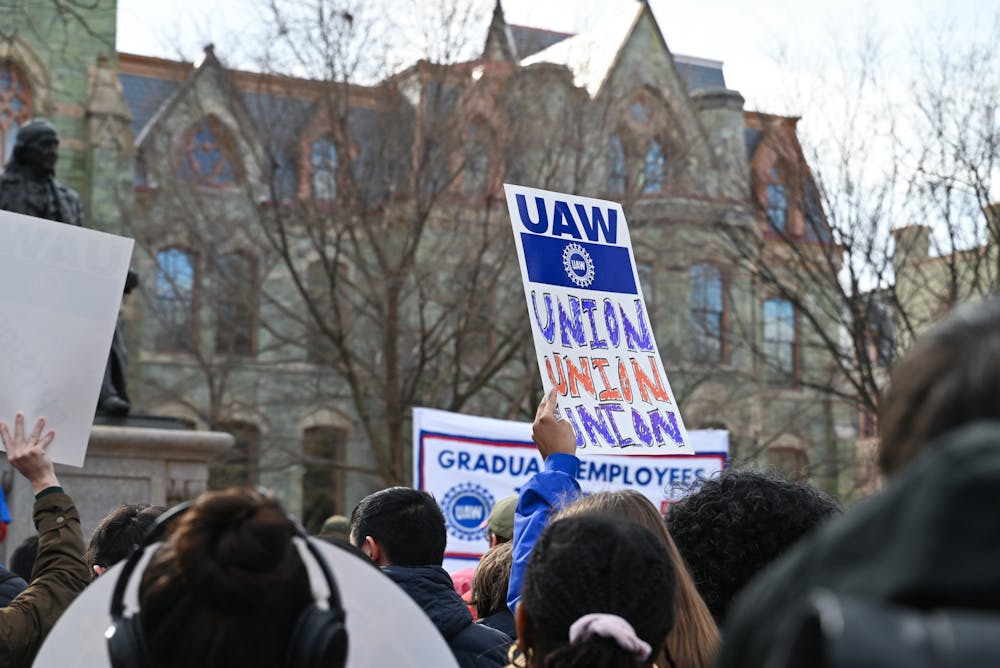
Penn asked a federal court on Friday to intervene in a longstanding dispute with its graduate worker union over whether certain doctoral students are eligible for union representation.
The Aug. 7 declaratory judgement action sets up a legal battle between Penn and its largest labor union, Graduate Employees Together — University of Pennsylvania. The University is seeking a ruling that first- and second-year students in the Biomedical Graduate Studies program are not employees represented by the bargaining unit and that GET-UP cannot pursue arbitration over the issue.
A University spokesperson wrote to The Daily Pennsylvanian that Penn “maintains its firm position that first- and second-year biomedical graduate studies (BGS) students are engaged in academic activities as they complete the foundational academic milestones of their doctoral program.”
“These are not bargaining unit activities,” the spokesperson wrote. “This distinction is important because it preserves students’ right to focus on their academic progress during this critical period, as well as the University’s right to make decisions in support of that academic progress.”
In a statement to the DP, a spokesperson for GET-UP wrote that “Penn Grad Workers are simply seeking to enforce our Collective Bargaining Agreement with Penn by going through our agreed-upon grievance and arbitration process” and argued that the contract “clearly applies to graduate student researchers who have finished their lab rotations and are now performing exactly the same research services to Penn as any other graduate student research assistant.”
According to the complaint, GET-UP filed a grievance on April 8 alleging that Penn’s description of the bargaining unit “improperly omitted certain first and second year BGS students” — in particular, those “who have joined labs and are no longer on lab rotation.” Penn’s filing argues that “students do not ‘join labs’ during those years and provide no research services to the University” until their third year.
Article 1 of the collective bargaining agreement reached between Penn and GET-UP in February — ratified as the union’s first contract — states that “Educational Fellowship Recipients in lab rotations in the ... first and second years of the Biomedical Graduate Studies PhD Program” are excluded from the union’s representation.
In July, a representative for GET-UP sent an arbitration request to the American Arbitration Association, prompting Penn to take legal action.
“The Union’s instant grievance and demand for arbitration is predicated on the presumption that first and second year BGS students are ‘employees’ as defined by the NLRA, and thus capable of inclusion within the agreed-upon bargaining unit specified in the CBA,” the filing reads. “This presumption is inconsistent with clear federal labor law as pronounced by the NLRB.”
Penn also argued that “arbitration is a matter of contract and a party cannot be required to submit to arbitration any dispute which he or she has not agreed so to submit.”
“Rather than abide by the language in our contract, Penn is attempting to deny these employees access to their contractual rights,” the GET-UP spokesperson wrote. “It’s disappointing that instead of cooperating with this agreed-upon process, the University is attempting to circumvent it and waste resources with a spurious lawsuit.”
As defined in article 10 of the contract between Penn and GET-UP, a grievance “is a claim or dispute regarding the interpretation, application, or alleged violation of specific terms or provisions of this Agreement.”
Moving forward with a grievance is a multi-step process that involves back-and-forth dialogue between GET-UP and the University. If the issue remains unresolved, GET-UP can file “a demand for arbitration with the Philadelphia Office of the American Arbitration Association.”
The arbitrator’s decision is “final, conclusive, and binding upon” all parties. GET-UP and Penn split arbitration fees equally but are responsible for expenses associated with their “own attorneys and witnesses.”
The status of educational fellowship recipients — a classification that includes first- and second-year BGS students and first-year biology graduate students in lab rotations — has long been a point of contention between GET-UP and the University.
GET-UP and Penn attended a National Labor Relations Board hearing in November 2023 aiming to settle the matter, which delayed GET-UP’s unionization election. The union argued that many educational fellowship recipients came to Penn with prior research experience and meaningfully contributed to research — qualifying them as workers eligible for the bargaining unit — while the University contended that graduate students in lab rotations were solely engaged in training.
In March 2024, the NLRB ruled that educational fellowship recipients should be excluded from voting in the unionization election. GET-UP won an appeal the following month which allowed educational fellowship recipients to vote but left their status in the union’s bargaining unit up for future consideration.
After the tentative agreement was reached, a Penn spokesperson wrote that the bargaining unit’s scope “was one of the many issues the University and GETUP-UAW resolved through negotiations.” GET-UP members told the DP at the time that the issue remained disputed and that they would continue pushing for the inclusion of “all workers” in the union.
GET-UP’s contract with Penn is set to last until June 1, 2028. The two parties must begin negotiations to renew the contract by 60 days prior to its expiration date.
Senior reporter James Wan leads administration reporting and can be reached at wan@thedp.com. At Penn, he studies communication and computer science. Follow him on X @JamesWan__.