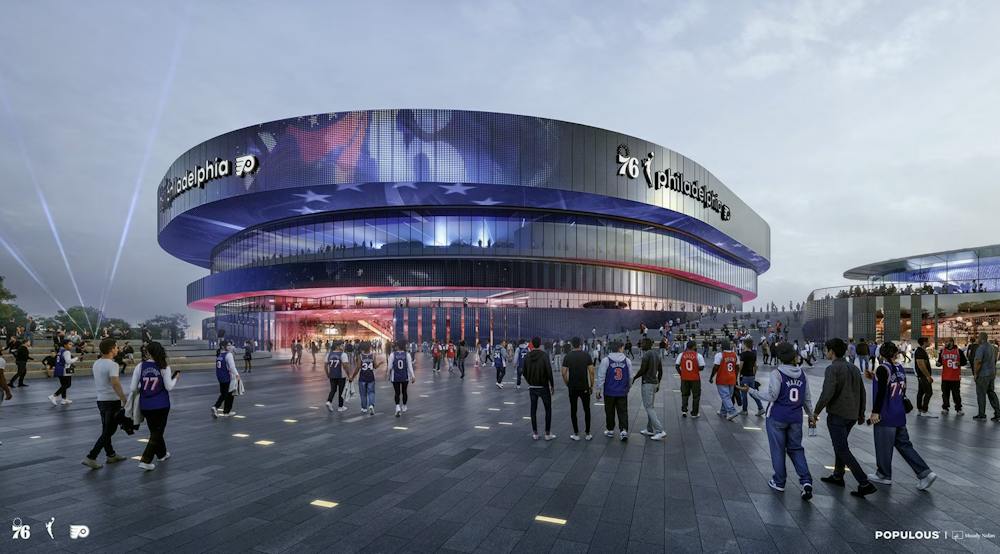
More than a year after the Philadelphia 76ers abandoned plans for a $1.55 billion venue in Center City, the city’s professional basketball and hockey teams released initial renderings for a new arena in South Philadelphia.
The arena, expected to open in 2030, will be home to both the 76ers and the Philadelphia Flyers. Urban planning experts told The Daily Pennsylvanian that the South Philadelphia site is a welcome change from the previously proposed location.
Despite years of opposition from Chinatown residents and the broader community, the Philadelphia City Council approved a legislative package for the proposal in December 2024 after a series of public hearings, impact studies, protests, and negotiations.
Less than a month later, the 76ers said it would drop the plans and partner with Comcast Spectacor on the South Philadelphia arena.
A marked improvement
Stuart Weitzman School of Design professor of urban design Zhongjie Lin, who openly opposed the Chinatown proposal, said the new location is much better in “almost all regards.”
Lin said arenas demand substantial infrastructure investment and coordination and that Market East lacked the space to accommodate a venue of that scale without disrupting transportation, local business, and the daily lives of nearby residents.
“The arena is not just a building. It’s an urban landmark; it’s an urban space,” Lin said. “In the original scheme there was not enough space — there was basically no condition to accommodate such a giant building.”
RELATED:
Philadelphia political parties can now spend unlimited money on candidates
Philadelphia advocacy groups call for citywide moratorium on data centers
2009 College graduate Arthur Acolin, a professor of real estate at the University of Washington, said that unlike the Chinatown proposal, the new arena makes sense from an “urban economic standpoint,” and will build on the strength of the existing stadium complex. Previously, he conducted an economic impact analysis of the Market East proposal that examined potential losses to existing businesses and tax revenue.
Domenic Vitiello, a School of Design professor of city planning and urban studies who also helped organize opposition to the Market East proposal, said concentrating another arena in South Philadelphia capitalizes on investments already made in highways, transit, utilities, and parking.
“It would be very inefficient for Philadelphia to locate its stadiums and arenas in multiple places after we have made that massive investment,” he argued.
The former plans called for construction between Market and Filbert streets and 10th and 11th streets in the Fashion District, bordering Chinatown. Since the proposal was announced in 2022, community members have raised concerns about gentrification, displacement, traffic, and the loss of Chinatown’s cultural identity.
Vitiello pointed to Washington, D.C.’s Chinatown, where introducing a sporting arena reshaped the neighborhood’s residential and commercial makeup. In that case, he said, just over two years later only a few hundred Chinese Americans remained in the area — most of them living in just two affordable housing buildings.
The future of the Sports Complex
Today, the Sports Complex consists of Citizens Bank Park, Lincoln Financial Field, and the Xfinity Mobile Arena. The area houses four major professional sports teams in the city — the Philadelphia Eagles, the Philadelphia Phillies, and the Flyers and 76ers, who both currently play in Xfinity Mobile.
Initial designs for the Spectrum-inspired arena — which will host both the 76ers and the Flyers — include more than a half-acre of outdoor gathering space, food and beverage options, and a grand entrance staircase inspired by the steps of the Philadelphia Museum of Art.
Experts agreed the new location improves on the prior proposal, but some said the South Philadelphia plan still leaves unanswered questions about transportation, pedestrian access, and how the arena will interact with the surrounding Sports Complex.
Lin said that the existing complex still leaves individual venues isolated from one another. He called for improvements to SEPTA’s Broad Street Line, better first- and last-mile transportation options, bike infrastructure, and additional development around the complex.
“We need to think about how we can connect them, how we can really form more walkable spaces and inviting spaces between these stadiums and arenas,” Lin said.
Acolin also cautioned that the Sports Complex remains “a very car-oriented destination.” But unlike Market East, he said, the area sees less everyday activity, so major events are less likely to disrupt nearby businesses and institutions.
“On most days, you don’t have a lot of existing traffic and existing congestion, while in Market East on any given day, you already have a lot of people coming through,” he said.
Vitiello agreed that the new arena presents an opportunity to create a more deliberately planned sports district around the existing venues. Offices, businesses, and even residences could generate activity beyond game days, he said, giving people the choice of living near major sports venues rather than dropping an arena into an established neighborhood.
“Most people don’t want that plunked down in their neighborhood,” Vitiello argued.
What’s next for Market East?
The move to South Philadelphia also leaves unanswered questions about Market East, which proponents of the former arena argued would have been revitalized by the project. At the time, developers said a Center City venue would strengthen Market East by generating economic activity and improving public safety.
Acolin, Lin, and Vitiello all said abandoning the arena does not eliminate the need to redevelop the corridor.
“The arena would have been empty most of the day, most days of the year,” Acolin said. “That was just not the right investment in that location.”
Instead, Acolin said he would like to see the area develop a mix of retail, food, and entertainment attractions that draw people from across the region at different times and price points.
Lin agreed, stating that the city should revitalize Market East while strengthening ties between Chinatown, Jefferson Station, historic sites, public spaces, and other Center City destinations. He cited Chinatown’s existing cultural and commercial activity as something future plans should reinforce.
“There’s no reason to kill it,” Lin said of Chinatown's cultural and commercial activity. “You actually need to boost it, you need to support it.”
Vitiello said a challenge of attracting vendors to the area is the high cost of real estate, which can narrow the range of possible businesses and residents. He said the corridor could build on eastern Center City’s existing strength in health and medical sciences while bringing more residents and workers downtown.
He pointed to Chinatown and Washington Square West as already active neighborhoods on either side of Market East and said future development should complement, rather than disrupt, the activity present in the area.
Acolin said the long-running debate over the former proposal underscores the city’s responsibility to include residents, workers, small businesses, and other stakeholders who may lack the financial resources or political access of major developers in future discussions.
For Vitiello, concentrating the venue in South Philadelphia will allow Chinatown’s established neighborhood to flourish independently.
“The arena is going in the right place,” he said.
RELATED:
Philadelphia political parties can now spend unlimited money on candidates
Philadelphia advocacy groups call for citywide moratorium on data centers
Senior reporter Phoebe Anagnos covers student life and can be reached at anagnos@thedp.com. At Penn, she studies architecture and earth science. Follow her on X @phoebeeanagnos.