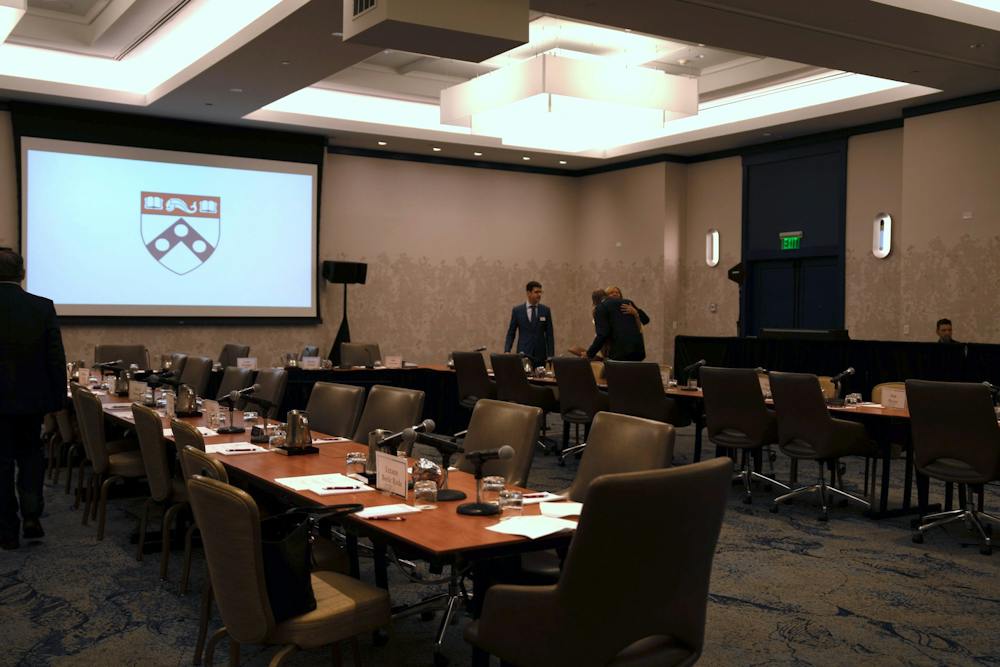
After a year of budget tightening, Penn’s Board of Trustees discussed the University’s financial outlook with an air of cautious optimism last week.
At the Budget and Finance Committee meeting on Sept. 24, administrators reported strong financial results for fiscal year 2026 and introduced resolutions concerning Penn Medicine and construction projects. The Executive Committee also approved an extension of Wharton School Dean Erika James’s term through June 2032.
Here’s what you need to know.
Strong financial performance
Penn ended FY26 with a $636 million operating margin, coming approximately $270 million ahead of budget. The University’s academic component generated a $185 million operating surplus, finishing $171 million ahead of budget.
Executive Vice President Mark Dingfield acknowledged that Penn entered the last fiscal year “in a period of pretty considerable uncertainty” caused by federal policy changes and macroeconomic factors. That forecast prompted the University to take “deliberate action” to contain costs.
“I just want to give credit to our deans and administrative leaders,” Dingfield said. “Doing both things at the same time — investing in our mission as well as managing cost — is not an easy balance to strike, and they all did that exceptionally well.”
In January, Dingfield and Provost John Jackson Jr. sent an email directing Penn’s schools and centers to reduce certain expenditures by 4%. Since then, at least two schools — the Graduate School of Education and the School of Nursing — have laid off several staff members.
Vice President for Budget Planning & Analysis Trevor Lewis highlighted that academic expenses were $17 million below the budget, which he said was “not a passive underspending.”
“It reflects the hiring freeze, the vacancy management, selective hiring, lower grant activity, benefit actions, and purposeful position management,” Lewis said.
Favorable revenue performance in the academic component was driven by gifts, sponsored programs, and investment income. Revenue from mRNA commercialization tapered off as expected after “unusually strong” performance in FY25, according to Lewis.
Dingfield said that the positive financial results “give us a little increased flexibility as we move into this year,” but cautioned that “a lot of those same macroeconomic and federal policy challenges remain.”
“None of this should be read as having solved those issues,” Dingfield stated. “We are very much still focused on managing the risks that exist in our current environment.”
That outlook is reflected in Penn’s FY27 operating budget, which recognizes an uncertain financial environment for higher education.
Penn’s endowment
Dingfield announced that Penn’s endowment increased by a record $6.3 billion in FY26, posting a return of 27.4% from $24.8 billion to $31.1 billion.
Last year, Penn held the seventh-largest endowment in the United States, behind Harvard University, Yale University, Stanford University, Princeton University, the Massachusetts Institute of Technology, and the University of Texas system. Penn’s endowment grew by 12.2% in FY25, outpacing a 7.5% increase in total endowment size across universities that participated in a national survey.
Much of the spendable income generated by the endowment will be used to support Penn’s financial aid programs, Dingfield said.
The trustees also acknowledged an increased federal excise tax on Penn’s endowment, a result of the One Big Beautiful Bill. Since July 1, Penn faces an endowment tax of 4%, up from 1.4% previously.
“Even though the endowment performance is exceptional and worth celebrating, some of that will need to be going to paying off that tax liability under the new tax policy,” Dingfield said.
Reappointing Erika James
At the Executive Committee meeting, Penn President Larry Jameson introduced a resolution to reappoint James for a second term as dean of Wharton.
“It takes exceptional leadership to advance the world’s best business school,” Jameson said. “Doing so through a global pandemic, against headwinds for all higher education, has made Dean James’ achievement at the Wharton School even more impressive.”
James spoke to The Daily Pennsylvanian last week about her tenure as dean and the future of higher education in an era of artificial intelligence.
“With skill and deliberation, she has championed Wharton’s investments in academic excellence, including innovative initiatives and new programs in areas like artificial intelligence, health care, and quantitative finance,” Jameson said during the meeting.
Under her leadership, Wharton “has recruited exceptional faculty and outstanding students, strengthened alumni relations and engagement, pursued curricular reforms and revenue growth, and increased operational efficiency and effectiveness,” according to Jameson.
James will continue to serve as Wharton dean through June 30, 2032.
Penn Medicine developments
Penn Medicine reported a $337 million operating margin for FY26, which compared favorably to its budget by $46 million.
The University of Pennsylvania Health System’s total assets exceeded $18 billion, while unrestricted cash and investments increased to $7.2 billion — a $1.4 billion increase from the previous year.
According to Health System Chief Financial Officer Julia Puchtler, the ambulatory pharmacy saw growth of $45 million. She also noted that the Health System outperformed clinical enterprise by $13 million compared to budget, driven by “traction” with the Repair, Refocus, Reimagine initiative.
Puchtler was also named executive vice president of the Health System earlier this month.
She outlined several financial pressures related to the malpractice environment in Pennsylvania, policy changes around site of care, and employee benefit costs. She also highlighted changes to reimbursement.
The board also approved a resolution authorizing Penn Med to enter a joint venture for regional ambulatory surgical centers. The Health System would be the majority owner of the venture, which is designed to expand ambulatory services closer to patients.
1920 Commons renovation
The Board also approved a resolution authorizing $105,371,000 to Business Services for the renovation of 1920 Commons, which began construction in June.
“The 1920 Commons does not need to remain being named as the 1920 Commons,” Dingfield said. “It’s open for new naming.”
The renovation will be financially supported by an internal capital loan, in addition to “Business Services revenue, operating support, and central funds,” he added.
The updated building is expected to facilitate a locker-based food pick-up system, group study pods, a new coffee shop, elevators, and an expanded Gourmet Grocer.
“It’s a logistically complicated project in that we are going to try to operate the dining facility while going through this expansion,” Dingfield said. “There’ll be a multi-phased approach to doing this construction work that will extend over the next several years.”
Staff reporter Emma Desmet contributed reporting.
Staff reporter Ryan Rucker covers administration and can be reached at rucker@thedp.com. At Penn, he studies political science.