
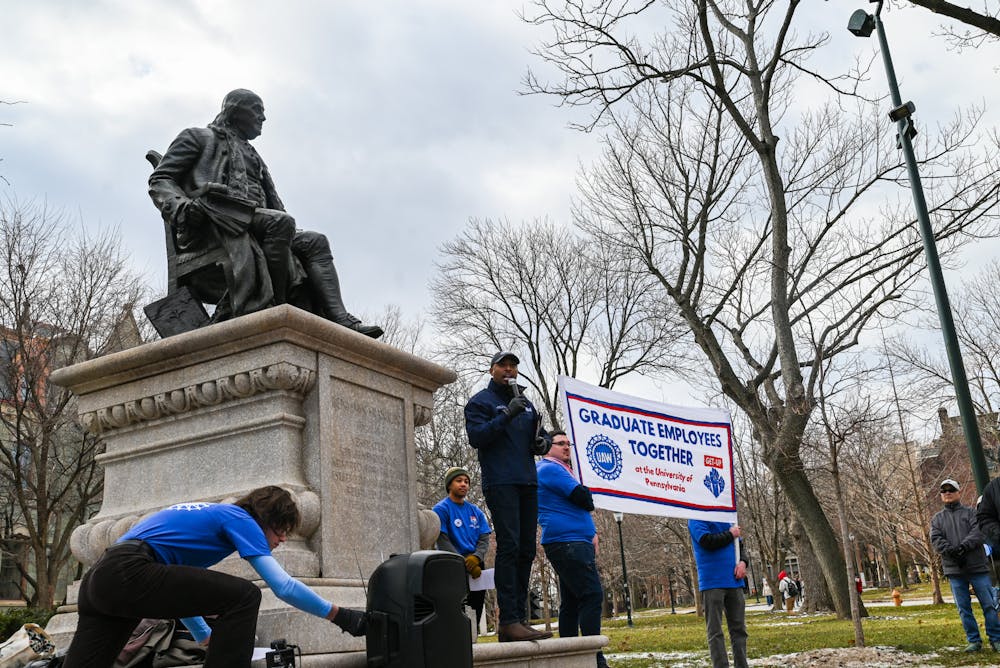
Graduate Employees Together — University of Pennsylvania, now on the heels of its tentative agreement with Penn, has gone through many phases in reshaping labor politics on campus.
The union is the latest in a wave of graduate worker organizations to secure agreements promising expanded health coverage and broader workplace protections. As members vote to ratify the agreement this week, GET-UP’s success represents the culmination of nearly 25 years of organizing at Penn.
Early unionization efforts
Graduate student unions at many private universities — including Penn — first achieved recognition following a 2016 ruling by the National Labor Relations Board. The decision overturned a 2004 NLRB ruling that prevented graduate students at Brown University and other private institutions from unionizing — which itself was a reversal of a 2000 NLRB ruling that allowed students at New York University to unionize.
Early attempts at unionization among graduate students emerged at private universities following the NYU ruling in October 2000. The first iteration of GET-UP was initially formed in April 2001 as a group pushing for unionization to negotiate increased benefits and improved working conditions at Penn. Affiliated with the American Federation of Teachers, the group was distinct from the current union.
Several of the priorities that defined this version of GET-UP — including stipends, health care, and child care — remain central in the Feb. 17 tentative agreement.
Penn’s administration attempted to halt these unionization efforts, sending an email to all graduate students in October 2001 to dissuade them from signing authorization cards, which give unions the right to represent signees in collective bargaining. Then-Deputy Provost Peter Conn emphasized that graduate students were students, “not employees.”
Still, GET-UP’s push to unionize gained momentum, visible in a November 2001 rally that used the slogan “Penn works because we do” — a phrase now echoed by the current union and similarly adopted by graduate workers at other universities.
RELATED:
The path leading up to GET-UP's tentative agreement with Penn
Penn’s graduate student union could strike next month. Here’s what we know
The group filed a petition to the NLRB in December 2001 to allow some graduate students to vote on unionization. Throughout the subsequent hearing process at the Philadelphia regional office of the NLRB, GET-UP and Penn presented their opposing cases in court and sparred in the press, accusing each other of employing stall tactics.
One primary point of contention was the scope of the bargaining unit — the employees who are represented by a union. In its initial petition, GET-UP excluded research assistants in the natural sciences from the unit. University administrators criticized the group for not fully representing graduate students, while GET-UP stated that it was maintaining precedent established by other student unionization cases.
The hearings concluded in March 2002. The NLRB later ruled in favor of GET-UP, making Penn the fifth private university — after NYU, Brown University, Columbia University, and Tufts University — where graduate students had won the right to vote on forming a union.
But the University quickly moved to appeal the decision two weeks later. Leading up to the election in February 2003, Penn’s administration continued to argue against unionization, as then-Provost Robert Barchi and then-Penn President Judith Rodin issued a letter reiterating the University’s belief that graduate students were not employees.
The official results of the election could not be released due to the unresolved nature of Penn’s appeal to the NLRB, creating a tense standstill between GET-UP and the University. A Daily Pennsylvanian exit poll found that 60.4% of surveyed eligible voters supported unionization.
But the election was complicated by questions of voter eligibility, leading to confusion among graduate students. Only members of the bargaining unit were allowed to cast regular votes, while those excluded from the unit but affected by possibility of unionization were forced to cast challenge ballots — which would only be evaluated and counted if needed.
A DP exit poll also found that 63.8% of surveyed voters who cast challenge ballots opposed unionization. With regular and challenge votes combined, the poll found support for unionization to be at 51%.
In the months following the election, GET-UP lobbied the University to drop its appeal so that the votes could be counted, including protests outside of Rodin’s house and at her Penn Bookstore book signing. The demonstrations culminated in a December 2003 meeting between GET-UP and Rodin, which resulted in little progress and left GET-UP looking to incoming Penn President Amy Gutmann for hope.
Due to Penn’s refusal to withdraw its appeal, GET-UP members approved a two-day strike to take place on the one-year anniversary of the unionization vote, though graduate students as a whole remained divided on the subject.
Not long after Gutmann became Penn’s president in July 2004, a new Republican majority on the NLRB ruled against Brown graduate students, overturning the 2000 NLRB ruling at NYU and affirming Penn’s position that graduate students were not employees. That September, the NLRB similarly ruled against GET-UP.
The unionization fight continued as GET-UP pushed for Gutmann to voluntarily recognize the union outside of NLRB arbitration. Gutmann, however, expressed her agreement with the Brown ruling — much to the disappointment of GET-UP organizers.
In the aftermath of the Brown decision, NYU did not renew the contract with its graduate student union — the first and only one at a private institution in the country.
The era of graduate unionization at private universities was over, and GET-UP faded into the background.
The return of GET-UP
GET-UP publicly reemerged in March 2017, again enlisting the help of the AFT. At the time, Gutmann and then-Provost Vincent Price sent an email to graduate students asking them to reconsider unionization — citing Penn’s long-held stance that the University and graduate students did not have an employer-employee relationship.
In May 2017, GET-UP filed a petition to the NLRB for a union recognition election, though the organization faced pushback from the University and graduate student groups that opposed unionization. The NLRB approved the petition in 2018, setting up a vote that spring.
But the vote never happened. Like other graduate worker groups pushing for unionization, GET-UP withdrew its petition that February over fears that the vote could give Penn the ability to challenge the Columbia ruling with an incoming Republican-majority NLRB.
As GET-UP halted its unionization efforts, it placed its focus on advocating for better procedures for reporting sexual harassment to the Graduate School of Education.
Unionization faced further setbacks after the NLRB proposed legislation in 2019 that would overturn the Columbia ruling.
The GET-UP of today
According to GET-UP organizer Sam Schirvar, who is a Ph.D. candidate in history and sociology of science, the current union — which he described as a separate organization that uses the name of previous unionization efforts — has its roots in the summer of 2020.
“The big push for us was the COVID pandemic,” Schirvar said. “Many people were basically forced to go back into work in potentially unsafe working conditions before vaccines were available.”
Schirvar additionally noted that vaccines were first made available to faculty before graduate workers despite the latter group being “more exposed to potential transmission.”
For the third time, graduate workers at Penn announced a unionization campaign in April 2023, now planning to join the United Auto Workers, GET-UP’s current affiliation. The new push followed a wave of organizing at other private universities under the Biden administration’s NLRB.
In October 2023, GET-UP delivered a letter directed to then-Penn President Liz Magill and Provost John Jackson Jr., announcing the organization’s intention to file a petition with the NLRB, which occurred two days later. During the review process, Penn and GET-UP disagreed on whether educational fellowship recipients — first- and second-year biomedical graduate students and first-year biology graduate students — should count as part of the bargaining unit.
The NLRB ruled that educational fellowship recipients should be excluded in March 2024, but GET-UP won an appeal in April 2024 that allowed those students to vote in the upcoming unionization election while also leaving their status up for future debate.
The NLRB postponed the April 2024 election after a request from Penn that cited the short timeframe for compiling a new voter list and a lack of space availability.
The two parties agreed to reschedule the election to May 2024, resulting in an overwhelming win for unionization. Contract negotiations began in October 2024 and lasted 16 months until GET-UP and Penn reached a tentative agreement.
Recent unionization trends
By the time GET-UP secured recognition in 2024, most of its private peer institutions had already unionized their graduate workers. According to a DP analysis of select other universities, Penn was the last to formally recognize a graduate worker union, with others having done so in 2023 or earlier.
Schirvar stated that “Penn advanced a lot of spurious legal challenges to our union election,” resulting in the delayed election.
Since the 2016 Columbia ruling, graduate worker unionization at private universities unfolded in two waves: an initial surge from 2016 to 2018 and a second from 2022 to 2024 during the Biden administration. The gap in between, Schirvar said, “roughly lines up with the first Trump administration” and fears of a “potentially hostile” NLRB.
“After Biden was elected, it became clear that the National Labor Relations Board was once again going to enforce the 2016 Columbia decision,” Schirvar said. “That’s when you saw that huge wave of new unions being formed.”
The subsequent negotiations between GET-UP and the University lasted the fourth longest compared to peer institutions. Negotiations at Columbia, Duke University, and Harvard University took even longer.
According to Emily Aunins — a bargaining committee member and Ph.D. candidate in biomedical graduate studies — “the mood on campus is high for graduate workers.”
“I think people are really excited,” Aunins told the DP. “This is going to be a life-changing contract for a lot of people who are grad workers right now at Penn.”
A University spokesperson wrote to the DP that “Penn will continue to work with GETUP-UAW to advance what is important to all of us — a dynamic and supportive academic environment.”
In reference to previous points of contention — including the components of the bargaining unit — the spokesperson wrote that “this was one of the many issues the University and GETUP-UAW resolved through negotiations.”
Schirvar and Aunins both emphasized the importance of unionization at other universities, providing GET-UP with “inspirational” models for its own bargaining.
Aunins also expressed hope that aspects of GET-UP’s tentative agreement with Penn, such as six weeks of paid medical leave and retirement benefits, would be able to influence contract negotiations elsewhere.
“We hope that other grad workers will have better chances of winning that now that that’s becoming more common in higher ed contracts,” she said. “We’re excited about the cooperative effects of grad worker unionization.”
Lauren Chua, the president of the Massachusetts Institute of Technology Graduate Student Union and a 2022 Engineering graduate, wrote to the DP that “GET-UP’s tentative agreement is a historic win for graduate workers across higher education, raising the industry standard on many issues such as fair wages, fellows inclusion, and union security.”
“We hope to build even further off of GET-UP’s gains as we, over 3000 graduate workers at MIT, prepare to go into negotiations for our second contract this spring,” Chua added.
As contracts expire, the unions will have to return to negotiating. That process is already underway at Harvard and Columbia, where graduate worker contracts expired in 2025.
Many of the analyzed contracts will be expiring in 2027, aligning with the wave of unions that gained recognition in 2023 and later reached agreements with their universities. If GET-UP ratifies its contract, it will last until June 1, 2028 — the second-shortest duration among the analyzed agreements.
“It’s generally to workers’ benefit to have a shorter contract duration,” Schirvar said. “Because that means we can negotiate another strong contract as soon as possible.”
As GET-UP looks ahead, Aunins expressed optimism about all unionization at institutions of higher education, noting that research associates and postdoctoral workers at Penn are currently bargaining.
“We’ll continue fighting for and making sure that all workers have the right to participate in the union,” Schirvar added.
Senior reporter James Wan leads administration reporting and can be reached at wan@thedp.com. At Penn, he studies communication and computer science. Follow him on X @JamesWan__.


