

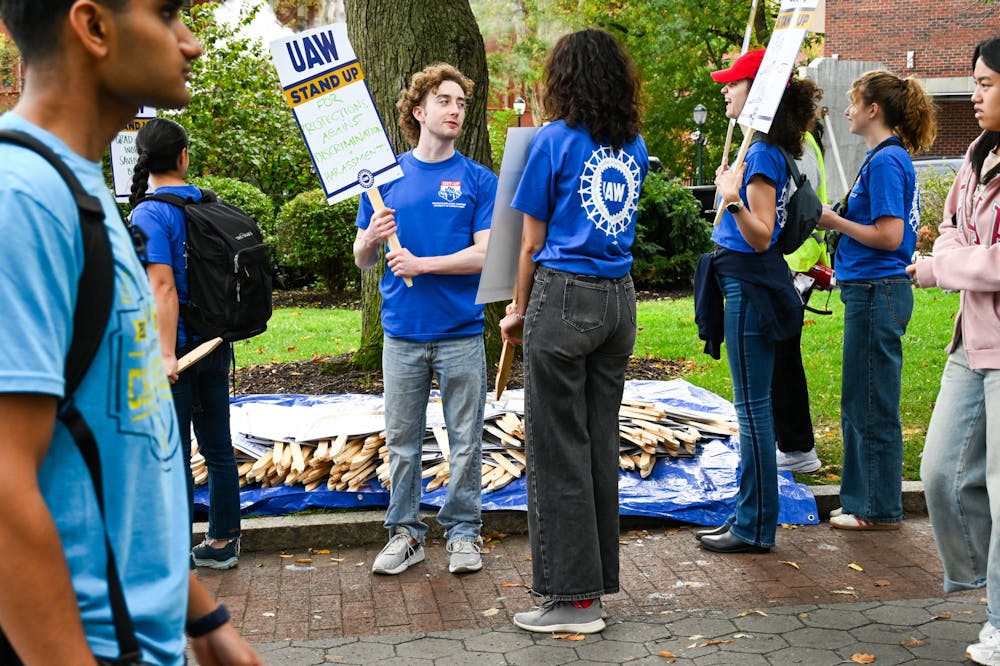
After more than a year of negotiations, Penn’s graduate worker union voted to ratify its first contract with the University on Friday.
The union — which represents over 3,700 graduate workers — reached a tentative agreement with Penn on Feb. 16, narrowly averting a strike that would have had widespread impacts on teaching and research across campus. On Feb. 27, Graduate Employees Together — University of Pennsylvania announced 77% of graduate workers participated in the vote and an overwhelming 99% voted in favor of ratifying the contract.
Under the new agreement, graduate workers will receive enhanced child care and medical benefits, insurance benefits, and support for international workers, along with several provisions Penn had not previously guaranteed — including paid holidays, paid leave, disability accommodations, and tuition remission.
“Grad Workers should not forget that we won these things because of our collective power,” a GET-UP announcement read. “And thousands of us signed petitions, voted to authorize a strike, and ultimately prepared to withhold our labor together to win what we deserve.”
2,604 graduate workers voted to ratify the agreement and 31 voted against ratification.
In a statement to The Daily Pennsylvanian, Vice Provost for Graduate Education Kelly Jordan-Sciutto wrote that “I am pleased that an agreement has been reached with GETUP-UAW.”
“Penn is a student-forward environment, rooted in the values of our scholarly community,” she added. “Graduate students are my colleagues, and I am proud to work alongside them, prioritizing their needs as scholars, researchers, and leaders. Collaboration is critical to our collective success and ultimately strengthens the entire the Penn community.”
According to a GET-UP webpage, wage increases outlined in the contract will take effect on April 1, an immigration legal fund will be established within 90 days of ratification, and the new dependent health care fund will take effect in August.
RELATED:
Nearly 25 years after graduate workers began organizing at Penn, GET-UP is making history
The path leading up to GET-UP’s tentative agreement with Penn
The contract expires on June 1, 2028. University administrators and GET-UP are required to enter contract renewal negotiations in April of that year.
“It is clear that to enforce this agreement and win another in two years, we must continue to build our power,” GET-UP’s announcement read. “Now we will do so as union members, under a strong, transformative contract.”
“This is the conclusion of a long fight for this first contract; it’s also the start of another fight,” history and sociology of science Ph.D. candidate and GET-UP organizer Sam Schirvar told the DP.
He added that they “will have to enforce this contract over the next couple of years,” and “look forward to negotiating another contract in just under two years when this one expires.”
Schirvar described the campaign as a “really incredible experience to be part of,” adding that he is “very proud of what we’ve learned together.”
Graduate workers at Penn will see their minimum annual stipend rise to $49,000 starting April 1, followed by a 3% raise on July 1, 2027. This pay increase — a 21% jump from the previous minimum of $40,608 — brings Penn closer to the stipend levels offered by peer institutions.
Emily Aunins — a member of GET-UP’s bargaining committee and a Ph.D. candidate in biomedical graduate studies — described the pay increase as “life-changing” for many graduate workers at Penn.
“We’ve just moved a lot of people into the living wage category, which is huge,” she said. “It’s huge for me. Personally, I know that money has been really stressful the past couple of years — so I think people are excited.”
Representatives from GET-UP overwhelmingly authorized a strike in November 2025, giving the union authority to call a work stoppage if negotiations failed. In January, GET-UP announced it would suspend all teaching and research duties if the University did not reach a contract agreement by Feb. 17.
According to GET-UP’s website, a strike would have meant that graduate workers holding teaching and research positions would suspend their work responsibilities — including grading, leading recitations, holding office hours, and conducting certain research activities.
Aunins emphasized the union’s commitment to sustained collective engagement.
“We’ve been really focused on always building majorities and having majority participation in everything we do,” Aunins said. “We’re going to continue having that be our goal and guidepost going forward.”
RELATED:
Nearly 25 years after graduate workers began organizing at Penn, GET-UP is making history
The path leading up to GET-UP’s tentative agreement with Penn
Senior reporter James Wan leads administration reporting and can be reached at wan@thedp.com. At Penn, he studies communication and computer science. Follow him on X @JamesWan__.
Senior reporter Ananya Karthik covers central administration and can be reached at karthik@thedp.com. At Penn, she studies communication and economics. Follow her on X @ananyaakarthik.


