Stephen Burbank had barely begun his legal career when he was made Penn’s in-house lawyer, a title no one had held before.
Burbank was 27, two years out of law school, and, by his own admission, a little naive. But in 1975, he became the person Penn called when the University had a problem.
“It was just nonsense to hire somebody who’d never really had a job,” Burbank said in an interview with The Daily Pennsylvanian. “But at that time, the position of general counsel of universities was a fairly uncommon one.”
For decades, Penn relied primarily on outside counsel to handle whatever legal questions came its way. But in the 1970s, when the billable hour became the industry standard, the University grew “reluctant” to continue relying on those longstanding practices, Burbank said.
By hiring its own legal team, Penn could not only avoid rising costs, but also maintain access to “specialized knowledge” that was harder to gain from an external law firm.
Today, Penn’s Office of General Counsel is a far cry from Burbank’s one-man operation. Nearly 40 lawyers and more than 30 staff members oversee the University’s sprawling legal affairs, responsible for everything from enforcing research patents to litigating employment disputes.
The following is a glimpse into an intentionally opaque yet increasingly powerful arm of the University based on accounts from nearly two dozen members of the Penn community. Citing fears of retribution, some spoke on the condition of anonymity.
As threats to higher education have mounted, so too has the Office’s influence over major administrative decisions. Many credit OGC with steering Penn through a legal minefield. Others worry that efforts by the Office to shield the University from institutional risk have hampered longstanding democratic processes.
Penn’s new open expression guidelines centralize power with administrators, committee members say
Five key takeaways from Penn’s open expression guidelines draft
***
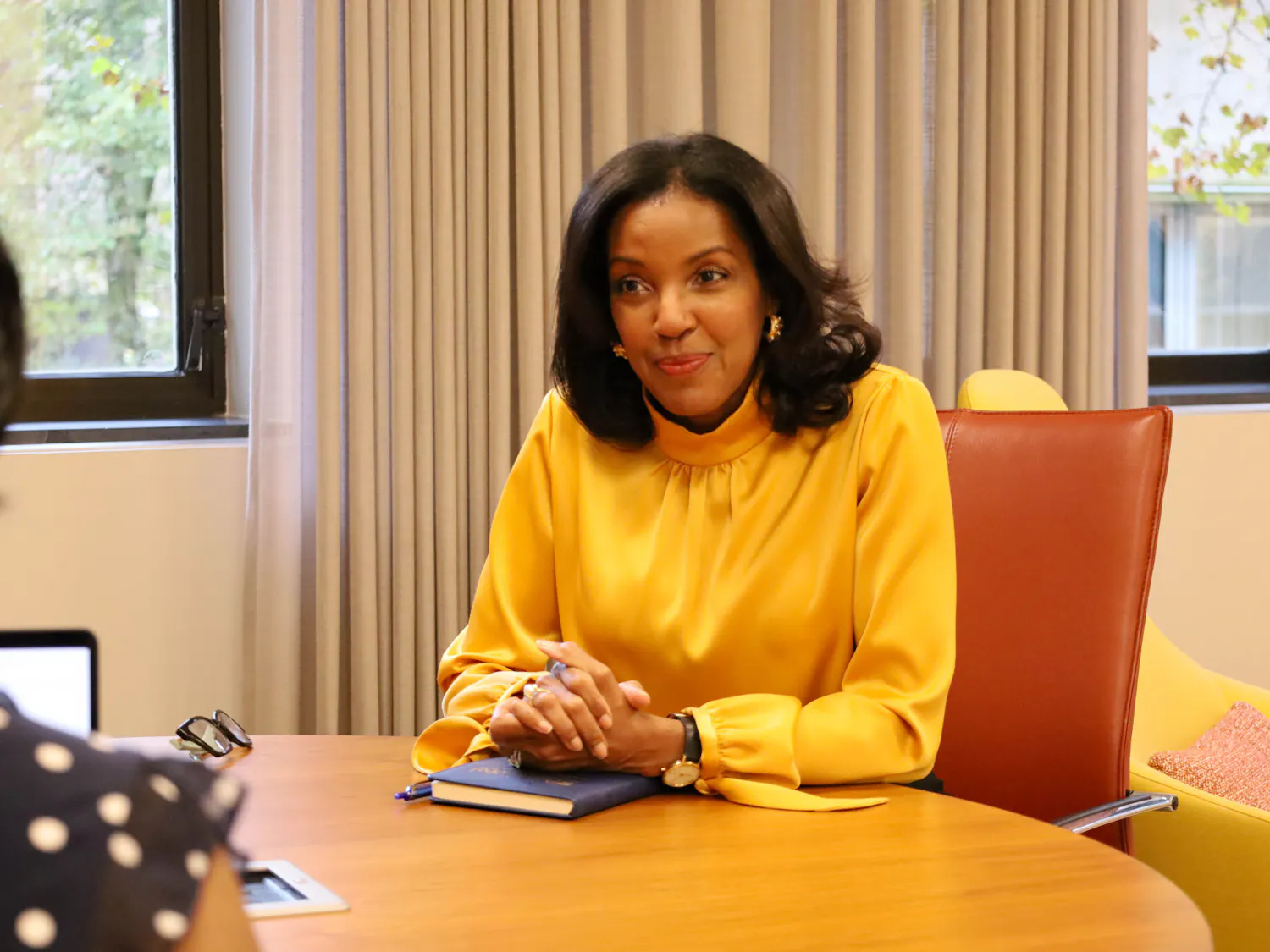
Wendy White, who currently leads the Office as the University’s senior vice president and general counsel, prefers working behind the scenes.
A Penn-educated attorney, White previously worked as associate counsel under the Clinton administration and represented corporations in Washington. In 2003, she was hired by the University.
“It’s a very different world,” White said in a rare interview with The Daily Pennsylvanian. “We have shareholders. We have a community. Our job is to protect our mission and our values.”
That mandate makes for an ever-changing set of responsibilities.
According to Craig Carnaroli, who worked closely with White during his 25-year stint as Penn’s executive vice president, the general counsel might have the “hardest job” at the University.
“My phone rings a lot,” White said. Day to day, she might meet with leaders across campus, speak with outside counsel, or host “therapy sessions” with her counterparts across the Ivy League.
Her favorite part of the week comes on Friday, when White and her staff gather to compete for the “story of the week.”
“What is the most amazing thing that your client did this week?” White asks her attorneys.
Their client, of course, is the University. Not just the academic institution’s 12 schools, but the University of Pennsylvania Health System’s seven hospitals too.
The Office trains its staff to look for risks and opportunities in “pretty much any situation,” according to one former OGC attorney. Their job is to ensure senior administrators understand potential legal, contractual, or reputational costs of a decision, the attorney said.
In one professor’s words, OGC lawyers are “zealous advocates” for the University, but their priorities can differ greatly from those of students and faculty.
The Office’s work involves tactics the public might view as unsavory or even unethical, according to several legal experts familiar with the role of a general counsel. Advocating for the University’s interests might involve thwarting union organizing or quietly resolving allegations of discrimination, they said.
One member of Penn’s Faculty Senate said that in situations that might be considered legally precarious, OGC urges employees to say things in “exactly the right way.” As a result, faculty members have become “very cautious and careful,” the professor added.
“OGC is the one entity on campus that I really don’t feel comfortable talking about,” another professor wrote in response to a request for comment.
***
Still, there is a difference between the role of general counsel and that of other administrators, Carnaroli said in an interview.
“It’s not their way or the highway,” he said of White and her team. “They’re partners, and so they’re giving you the pros and cons.”
White described her role in the same way: “We advise, and sometimes people take our advice.”
As general counsel, White is one of the few people on campus with a direct line of communication to Penn President Larry Jameson.
“When legal issues come up, you need to get legal opinions that you can trust and rely on,” Jameson explained in an August interview. “We’ve had more of those in the last few years.”
Burbank is familiar with Jameson’s inclination. Even now, he remembers trying to convince then-Penn President Martin Meyerson to stop deferring to him whenever a problem arose. Meyerson “tended to rely too much” on OGC, even when decisions did not call for a lawyerly instinct, he recalled.
“It’s one thing to keep your lawyers apprised of what’s going on so they can tell you when you’re likely to get in trouble,” Burbank said. “It’s another to give a lot of responsibility to lawyers in situations where you really need to hear from others.”
***
White’s office, as she put it, is tasked with managing the “latest crisis of the moment” — and at Penn, the next crisis is never far away.
A lot of what OGC deals with is the Trump administration’s torrent of “inquiries and investigations,” Carnaroli stated.
“I think it’s pretty important in dealing with these very challenging, incredibly important — to some extent, existential — issues, that the lawyer’s voice is heard,” White said.
Her attorneys are not the only ones shaping Penn’s response. The University also retains outside counsel — whose assistance White says she needs now more than ever — to advise on federal matters, including government investigations and executive orders.
Keeping pace with a volatile political environment has not been cheap for Penn and other universities. White was paid well over $1 million in 2024, and Penn has reported rising “legal and insurance” costs in recent budget briefings.
Carnaroli said that relative to when the Office was first created, the landscape Penn now faces is “more complex and regulatory-oriented.”
“The stakes have gotten a lot higher,” he said, citing the “overturning of long-established precedents” and the “shifting nature” of Penn’s relationship with the federal government.
Those conditions make having an “established, seasoned general counsel” all the more necessary, he added.
***
For Penn’s Faculty Senate tri-chairs — Neurology professor Roy Hamilton, History professor Kathleen Brown and Nursing professor Eileen Lake — OGC’s growing prominence has clear repercussions for “shared governance, academic freedom, and a culture of inquiry.”
Faculty have alleged in recent years that it has become harder than ever to reach central administrators. In December 2024, retired Political Science professor Anne Norton — who was also a Faculty Senate Executive Committee member — told the DP that power at Penn “rests almost completely with three individuals: the President, the General Counsel and the Provost.”
“The challenge is not determining whether legal guidance is essential; it clearly is,” the tri-chairs wrote in a statement. “Rather, the challenge is to determine how institutions can best integrate that guidance while preserving the distinctive culture and collaborative decision-making processes that are central to University life.”
In March 2025, the federal government froze more than $175 million in funding to Penn, citing the University’s failure to bar transgender athletes from women’s sports.
The move spurred months of negotiations between Penn and the Trump administration to recover the lost money. When a resolution came that July, a senior Department of Education official told the DP they had dealt directly with the University’s attorneys. Brown, who was chairing the Faculty Senate at the time, was not privy to the negotiation process.
The Title IX settlement exemplified what some consider to be OGC’s modus operandi. One source familiar with the Office said it tends to not “seek input from faculty.”
At the time, an overwhelming number of professors and staff members condemned the resolution, arguing that Penn entered into an agreement with the government without properly fielding faculty concerns.
Annenberg School for Communication professor Kathleen Hall Jamieson, who served as the school’s dean for 14 years, said that her administrative role provided insight into OGC’s involvement in “very important” issues that she “wouldn’t have known about” as a faculty member. Often, there was “no reason for them to be public-facing,” Jamieson said in an interview.
History and Sociology of Science professor Harun Küçük described OGC’s expanded authority as a “net stressor for shared governance.”
“Fending off existing and potential lawsuits has a different logic than what is right and good for the Penn community,” Küçük, who worked with the Office on a number of occasions during his time on SEC, wrote in a statement.
On Jan. 20, 2025, President Donald Trump signed an executive order requiring Penn and other federally funded universities terminate their diversity programs. Trump graduated from the Wharton School in 1968 with a bachelor’s degree in economics. Per the Office’s recommendation, the University quickly wiped nearly all references to diversity, equity, and inclusion across its graduate and undergraduate schools.
Penn’s attorneys said the eliminated programs were “not compliant with how the Trump administration reads the 14th Amendment,” according to College senior and Undergraduate Assembly President Musab Chummun. One casualty of Penn’s compliance with the order was the University Council’s diversity committee.
When students and administrators came to a head over the issue again last winter, the OGC’s “risk-averse” recommendation prevailed, Chummun said.
He met with members of OGC again this year to discuss the possibility of federal immigration enforcement officials on campus.
Chummun said he and others pressed the University to provide more resources for undocumented students, but OGC feared that bringing attention to their presence on campus could draw the ire of the federal government.
When student leaders advocate for something they know to be “a bit legally risky,” Chummun said, Penn’s attorneys often shut them down.
“They always approach it from ‘This is what we can and cannot do as per the law,’” he said. “We want Penn to be making choices that benefit the students, not capitulating to laws that we don’t think are good.”
***
Penn has repeatedly confronted questions about the limits of academic freedom and open expression in recent years.
After the spring 2024 Gaza Solidarity Encampment, administrators looked to quell the campus turmoil that had drawn national attention while preventing such a protest from recurring.
In a move characterized by some as an overstep by University administrators, Penn unveiled a set of temporary open expression guidelines that June.
The temporary procedures were based on recommendations made by the University Task Force on Antisemitism and the Presidential Commission on Countering Hate and Building Community.
As an ex-officio member of the task force, White has remained a key figure in many of the conversations on Penn’s new speech policies — even after the tents on College Green were removed and campus turmoil mellowed.
Michael Weisberg, a Philosophy professor who currently oversees the task force and commission, said he regularly reaches out to OGC for advice.
“The General Counsel doesn’t have an office in College Hall, so it’s not like she’s in every meeting,” Weisberg said of White. “But I’ve always found it very useful to discuss things with her, even when I knew we were going to disagree.”
Penn released another revision of its open expression guidelines earlier this year, again in consultation with OGC. According to several faculty, the new policies enshrine restrictions first seen in the temporary policies and signal a further step toward centralizing administrative power.
***
Last October, the Trump administration appeared to switch up its strategy — and Penn did too.
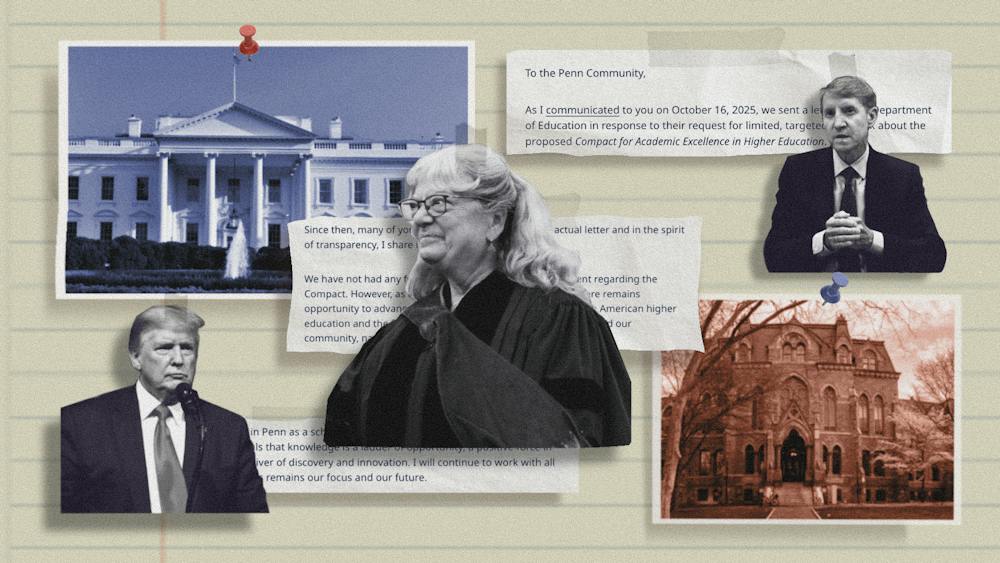
Rather than targeting individual schools with investigations or litigation, the White House sent the “Compact for Academic Excellence in Higher Education” to nine universities, including Penn. The document laid out sweeping guidelines governing admissions, tuition, and hiring practices that institutions could agree to in exchange for federal funding benefits.
Penn rejected the federal government’s proposal just 16 days later. Prior to making that decision, the University explicitly sought out the input of faculty and students. Jameson issued Penn’s rejection on the heels of a recommendation from the Faculty Senate.
At the time, a White House official suggested that the University’s decision not to sign on might jeopardize its federal funding. Nearly a year later, Penn’s funding has not been impacted.
One professor said Penn’s approach to the compact was evidence the Office has room to challenge the federal government even when legal risks are high.
Unlike OGC’s usual strategy of keeping its “head down a tiny bit lower than the next guy,” the professor said a lack of retribution from the White House showed that universities can act collectively to resist “unlawful and unconstitutional” orders.
For Penn Medicine professor Scott Halpern, OGC’s guidance has proven vital.
When the federal government moved to restrict research funding on the basis of “woke” or “questionable” topics, Halpern turned to OGC for support. He worked with the Office to develop a machine learning algorithm that flags language in grant applications that could lead to funding being denied or revoked.
“I and others in the Office of Research Services really relied on OGC for confirmation that what we were doing was not going to put the University at risk,” Halpern said.
The frequency of his interactions with the Office has “at least doubled, if not much more than that,” since January 2024.
“These past few years have been extraordinarily challenging for the higher education, and many of the challenges have been legal,” University of Pennsylvania Carey Law School professor Eric Feldman wrote in a statement.
Despite those pressures, Feldman thinks White has maneuvered this onslaught with grace.
“Based upon my interactions with GC’s at other schools, I know that Penn’s OGC is held in high regard, and I think that its reputation is well deserved,” he wrote.
Feldman, who’s known White for a number of years, is not alone in singing her praises. Several other faculty members and administrators commended White’s leadership.
Steve MacCarthy, who served as the University’s vice president of communications until 2025, wrote that White is “most likely the best general counsel in American higher education.”
“We’re always making really tough decisions,” White said. “It’s not always easy, and the approach doesn’t always please everybody.”
“But part of that decision,” she added, “and I can’t say it strongly enough, is that we are protecting our values.”
Isha Chitirala is a News Editor at The Daily Pennsylvanian and can be reached at chitirala@thedp.com. At Penn, she studies economics and political science. Follow her on X @IshaChitirala.
Finn Ryan is a News Editor at The Daily Pennsylvanian and can be reached at ryan@thedp.com. At Penn, he studies political science and Russian. Follow him on X @FinnRyan_.