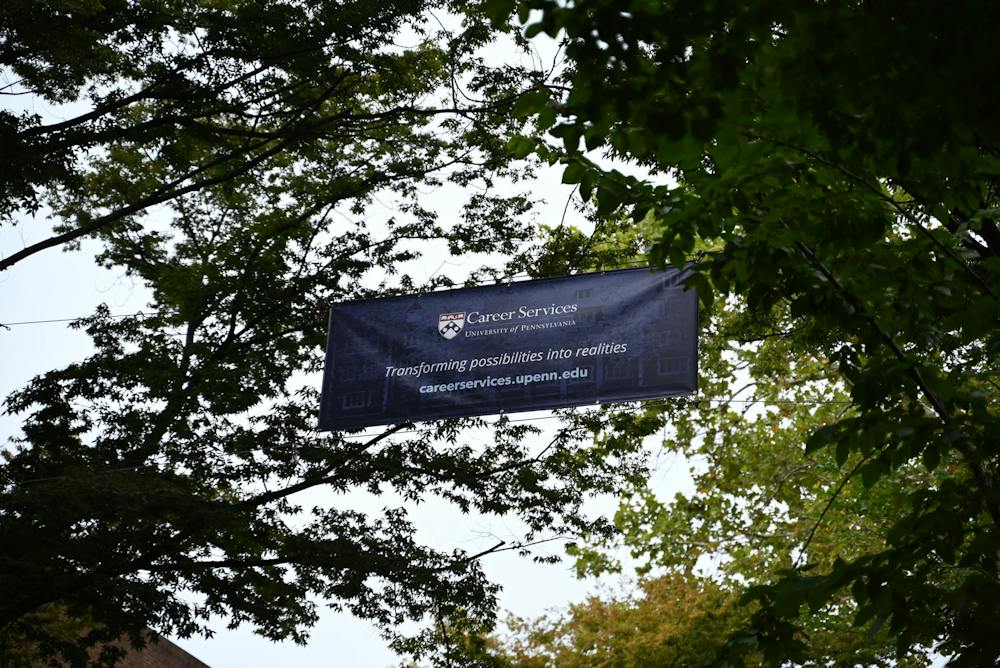
Penn Career Services celebrated its 100th anniversary last Friday alongside student leadership, office staff, and University administrators.
The Sept. 25 event was held at the organization’s 3935 Walnut St. office and included remarks from members of Career Services, Penn President Larry Jameson, and Senior Associate Vice Provost of Student Affairs Tamara Greenfield King. The speakers discussed the organization’s development over the past century and its current operating practices.
Penn Career Services Executive Director Barbara Hewitt kicked off the celebration with a discussion about various challenges the organization faced during its “early years,” and a look into how the office has adapted over time. Originally called the University Placement Office, she explained that the department was tasked with sending placement registration forms to employers for students.
In an interview, former Career Services Director Patricia Rose reflected on how technological developments impacted the office and freed employees from “drudge work” on a daily basis.
“We had slots like at a post office, and people would throw resumes in the hopper,” Rose, who managed the department from 1982 to 2018, said. “It was a very mechanical process, and that all went away when people submitted resumes electronically.”
Hewitt echoed her sentiment in an interview.
“The whole process of applying for jobs has been much different than it used to be,” she said. “I think Career Services throughout the years has really tried to keep up with how things have changed and meet students and employers where they are.”
She also spoke to the perceived preprofessional nature of the University’s student body.
RELATED:
Penn resumes Curricular Practical Training review for federally-compliant international students
Federal policy changes jeopardize career plans, Penn international students say
“Penn students are thinking a lot about what they’re going to do after Penn and how they’re going to use their education, and that is preprofessional,” Hewitt said in an interview. “I don’t really see that as a negative thing, because I think wondering about the world of work is positive.”
During the event, speakers discussed the process of networking at Penn.
Jameson first shared a definition for the term, saying that people “often focus on the technical aspects” instead of the “human-to-human connections.”
“Learning to interact with your classmates, learning to work as peers, with your professors, and ultimately with the people that you’ll be in the job market with, is a critical skill,” he added.
Career Services provides students with advising, both through professional staff and peer mentorship. In an interview, Hewitt shared the importance of this counseling providing “personal connection” and “support.”
“Sometimes students are really unsure where they fit in the world and if they’re doing the right things, and just having that advising relationship can be helpful,” Hewitt stated.
Peer advice, specifically, can serve as a guiding tool for students.
“Being a peer, you can have empathy towards them and understand the stress and uncertainty,” Wharton senior Robert Melsom — a Career Services peer advisor — said in an interview.
The office also hosts several career fairs each year where it connects students with employers from a variety of fields. The first of these events for the 2026-27 academic year was held at Houston Hall on Sept. 10.
Jameson and King shared information about where Penn undergraduates end up after leaving campus during the event.
“95% of Penn students, within a very short period of time after graduating, land in the place they want to be,” Jameson said.
King added that over 93% of Penn’s Class of 2025 was employed or continuing education within six months of commencement. The class also had 85% and 79% acceptance rates to medical and law schools, respectively.