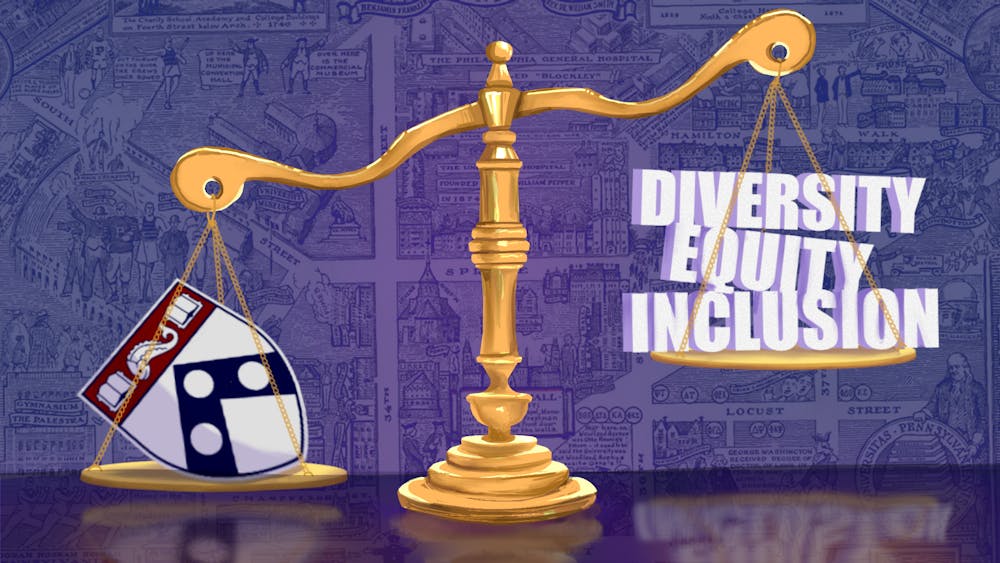
If I weren’t in the newsroom last week making the graphic for the article “Inside the dismantling of Penn’s last major DEI holdout,” I never would have known what the Committee on Equity and Diversity was, or that it counted as the University’s final major Diversity, Equity, and Inclusion body — intended to report on and foster a diverse campus community. I don’t expect I’m alone in that, either. That obscurity is the first of many signs that the fight over DEI has long been a symbolic one rather than a substantive one — and that Penn was right to concede to the removal of DEI.
Over the past year, Penn has gradually acceded to the Trump administration’s executive orders and federal guidelines by systematically scrubbing DEI-related language and programs from its policies. Administrators have claimed that these changes were made to bring Penn in line with federal policy and the Trump administration’s executive orders, under threat of federal funding cuts. At the same time, many criticized these actions as capitulation to unfair demands, claiming that the loss of DEI policy would be devastating to the Penn community.
But now that the fight over DEI has seemingly come to an anticlimactic end, it’s time to come to terms with the fact that the University’s decision was the right one. The reasoning is simple: DEI, at least in the form it took at Penn, never justified the attention or risk it demanded. For the vast majority of students, it was more relevant as a buzzword than a policy that would actually influence their day-to-day life. This is evidenced nowhere more clearly than in The Daily Pennsylvanian’s own reporting, which focused on naming conventions rather than changes to specific services.
Real issues on campus are present in other forms — demanding improvements that require the resources and attention that were directed towards DEI. Take graduate student compensation, for example. The University’s graduate workers have spent years arguing for stipends that cover basic living expenses, and they offer services that are vital for advanced study at Penn. As such, protecting the funding streams that makes negotiations possible matters more than preserving a framework that never addressed compensation in the first place.
The same applies to mental health services and academic counseling. Penn has historically struggled with managing its wellness resources, creating a notoriously stressful academic environment among its community. Worse, these shortcomings disproportionately affect first-generation, low-income, and international students who lack appropriate resources, yet DEI policies have failed to address them. Improvements to these issues require funding and administrative focus, not symbolic commitments to these communities.
These points are perhaps encapsulated best by the case of Lia Thomas, when the 2022 College graduate and transgender athlete’s participation on the Penn women’s swim team placed the University in opposition to the Department of Education. The decision to settle with the Trump administration instead of pursuing extended litigation drew sharp criticism from many, who argued that the University was prioritizing economic incentives over the wellbeing of its students. However, contesting the ruling would have placed federal funding — necessary for financial aid, research grants, and more — at risk and thrown Penn’s campus into a state of uncertainty, harming many more.
To be clear, I don’t mean to say that the values of DEI don’t matter. I am arguing that they were never well served by the DEI framework. These values are best represented when students can afford to stay enrolled, when they receive the help they deserve, and when administrators appropriately respond when problems arise. Ultimately, those outcomes are only possible if the University is given the necessary funds and bandwidth to resolve such concerns. Now that the last vestiges of DEI are beginning to be let go, Penn has the opportunity to leave branding behind and focus its attention on the issues that matter.
In order for Penn to create real positive change, the path forward is clear. Grant graduate student workers proper compensation for their efforts. Expand counseling services so students can be better seen when they need help. Improve academic support across all four undergraduate schools, especially for the students who need it most. Create a campus culture that addresses discrimination and harassment quickly rather than letting it get swept under the rug or caught up in bureaucracy.
SEE MORE FROM ANDY MEI:
DEI was never worth its cost because it asked the University to fight a symbolic battle that left real problems unresolved. Now, the question is whether the University is willing to follow that realization to its logical conclusion and commit resources to the issues students deal with every day. If it does, the end of DEI may mark the beginning of something more valuable.
ANDY MEI is a College first year studying economics and history from Palo Alto, Calif. His email is andymei@sas.upenn.edu.

Andy Mei is a College sophomore studying economics and history from Palo Alto, Calif. His column focuses on University administration. He currently serves as a Deputy Opinion Editor and can be reached at andymei@sas.upenn.edu.