
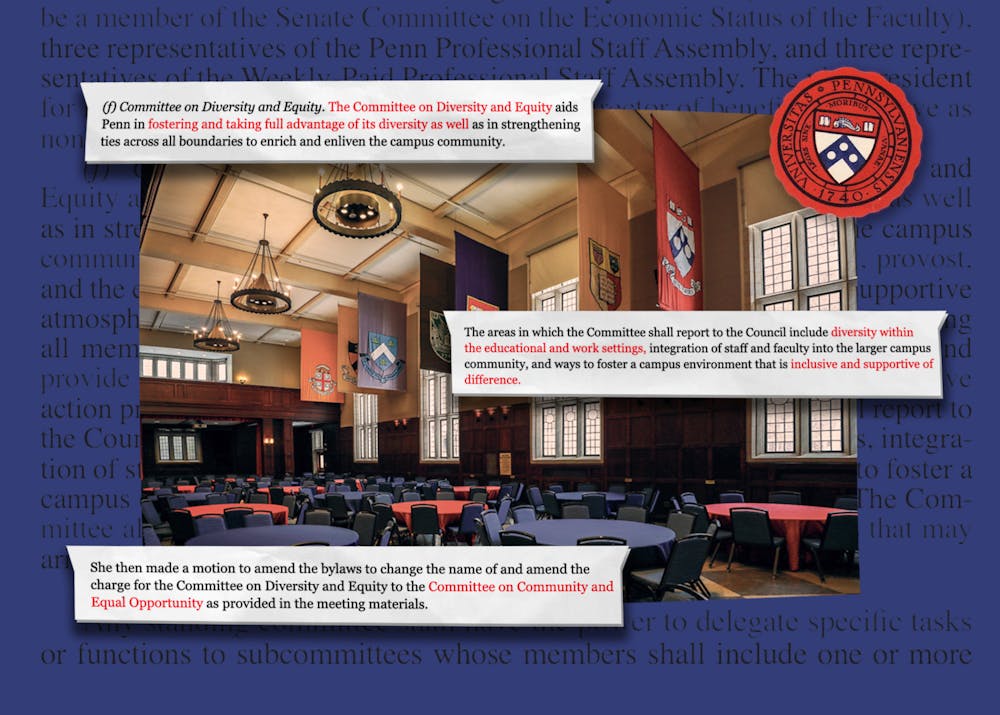
On the evening of Dec. 3, 2025, Penn dismantled its last major vestige of diversity, equity, and inclusion — but only temporarily.
Earlier that afternoon, members of the University Council filed into Houston Hall to vote on a motion renaming its “Committee on Diversity and Equity” to the “Committee on Community and Equal Opportunity.” The December meeting marked the second time the Council convened over the matter — and it wouldn’t be the last.
The room split sharply over the potential renaming. Members, including many student representatives, warned that such a change would undermine the Committee’s values. Others asserted it was necessary to comply with pressure from 1968 Wharton graduate and President Donald Trump’s administration.
As the debate wore on, however, conversation shifted away from the merits of either side’s arguments and towards the council’s parliamentary procedure. A misunderstanding of Robert’s Rules of Order — the procedural playbook used by the University Council — left members playing catch up after a premature vote to rename the Committee was called.
“Many people in this audience were confused, likely because of their familiarity with this version of Robert’s Rules,” Executive Vice President of Penn’s Graduate and Professional Student Assembly Adam Ziada said during the meeting. “My assumption was that the vote was on whether or not to call the question, not whether or not to adopt the resolution.”
In an interview with The Daily Pennsylvanian, Faculty Senate Chair-Elect Roy Hamilton called the moment a “parliamentary snafu.”
“I will be the first to volunteer that I was not born with a working knowledge of Robert’s Rules,” Hamilton — who formerly chaired the Committee in question — said. “I now understand that if you want to bring the discussion to an end before everyone’s had a chance to speak their piece, then you must make a motion to do just that.”
A University spokesperson wrote to the DP that the University Council serves as a “function of Penn’s shared governance and, thus, is governed by a prescribed process.”
RELATED:
Independence National Park dismantles slavery exhibits following Trump directive
Trump administration drops appeal in case blocking educational funding cuts for DEI programs
While the initial vote passed that evening and effectively renamed the Committee, Hamilton said the “slip up” meant “a number of people afterwards were quite clear that they didn’t know that that’s what they were voting for.”
Before stepping into his leadership role on the Faculty Senate, Hamilton held “a number of DEI-related positions” at the University. He most recently served as Penn Medicine’s vice dean for inclusion, diversity, and equity until that title was scrubbed in March 2025.
“I’ve seen how the school has felt constrained,” Hamilton said while describing “what’s happened to these programs” under the Trump administration’s current guidance.
On Jan. 20, 2025, Trump signed an executive order requiring Penn and other federally funded universities to terminate any DEI programs to comply with his administration’s interpretation of long-standing federal civil rights laws.
Less than a month later, the Department of Education published a letter threatening to revoke funding for all schools and universities that retained DEI initiatives.
The memo — which came to be known as “the Dear Colleague letter” — expanded the interpretation of the United States Supreme Court’s 2023 decision in Students for Fair Admissions v. Harvard, which struck down affirmative action, to apply more broadly across academic programming.
“The Department will no longer tolerate the overt and covert racial discrimination that has become widespread in this Nation’s educational institutions,” the February 2025 letter read. “The law is clear: treating students differently on the basis of race to achieve nebulous goals such as diversity, racial balancing, social justice, or equity is illegal under controlling Supreme Court precedent.”
By the time the Education Department published the “Dear Colleague” letter, Penn had quietly retreated from most of its DEI programs and initiatives. In the weeks that followed, the University enacted sweeping changes to longstanding policies — wiping nearly all references to diversity across its graduate and undergraduate schools.
The Committee’s name was the one major remnant of Penn’s former commitments to DEI that held out for months to come.
According to Hamilton, the Committee operated on a “somewhat different timeline than some of the committees that are affiliated with the individual schools in the University.”
The University Council first convened to discuss the vote to rename the Committee in October 2025 — and once again that December. But after the procedural disruption, administrators determined that the Committee’s name warranted a third and final deliberation.
“The very correct decision was made, in that circumstance, that we have to do this over,” Hamilton said. “That requires another University Council meeting.”
Pushed to the next semester, the vote returned to the University Council’s agenda on Jan. 21.
While most speakers reiterated their previous talking points at that meeting, the discussion diverged when Wharton junior and Undergraduate Assembly President Nia Matthews received a news alert that the Education Department had abandoned its attempt to uphold anti-DEI directives in court.
“We very quickly did some secondary research and verified it,” College senior and University Council representative Anna Bellows said. “The thing that was going through my head at that point was ‘this is a sign that resistance could work.’”
According to Bellows, the news seemed like “a vote-changing piece of information.”
“I was thrilled,” she stated. “I was over the moon. I thought it was going to be a game changer. It did not work out that way.”
Even after students interjected, the council voted in favor of renaming the Committee — a decision Hamilton attributed to lingering uncertainty over the lengths the Trump administration would go to stamp out DEI.
“I think that we are still constrained to, at the end of the day, act in ways that allow us to preserve the values that undergird the Committees and structures that we had,” he said.
Ludwig Zhao — who serves as the president GAPSA — wrote in a statement that the group recognized that “the landscape for DEI-related matters” extends “beyond any single action by the Department of Education.”
In a statement to the DP, Education Department Press Secretary Julie Hartman reiterated the government’s authority to “target impermissible DEI initiatives that discriminate on the basis of race, color, or national origin.”
“Title VI has always prohibited schools from racial preferencing and stereotyping, and it continues to do so with or without the February 14th Dear Colleague Letter,” Hartman wrote. “OCR will continue to vigorously enforce Title VI to protect all students and hold violators accountable.”
“I think what ended up happening was people voted in line with their suspicions,” Hamilton said while describing the last meeting. “It seemed unlikely to me that this is the end of this issue.”
The campaign against DEI extends broadly within the Trump administration. His Department of Justice has also threatened to revoke federal funding from colleges and universities that do not remove their references to DEI.
College junior and UA Vice President Musab Chummun told the DP that he “fears that actions taken by the University are a very slippery slope.” He urged the University to “take a higher moral stance” and “just say ‘no’ to all of it.”
University Council graduate representative Mário Junqueira spoke more broadly about the relationship between the White House and DEI projects on college campuses.
Junqueira — who attends the University of Pennsylvania Carey Law School — specifically pointed to “how quickly campus conversations get redirected by federal signals and legal developments.”
“Even when courts block one action, it’s reasonable to expect additional measures or pressure points later, which can keep universities in a constant cycle of reacting rather than focusing on core priorities,” Junqueira said.
In this political “context,” Hamilton affirmed he felt the name change was made “in the best interest” of the Committee. However, he stated that this was not a “conclusion that I welcome.”
“I think symbols, names, titles, they’re important,” Hamilton said. “The old name of this Committee was a concise reflection of the values that it stood for — that’s not to be done away with lightly, and it’s not to be treated as if it’s trivial.”
Isha Chitirala is a News Editor at The Daily Pennsylvanian and can be reached at chitirala@thedp.com. At Penn, she studies economics and political science. Follow her on X @IshaChitirala.
Finn Ryan is a News Editor at The Daily Pennsylvanian and can be reached at ryan@thedp.com. At Penn, he studies political science and Russian. Follow him on X @FinnRyan_.





