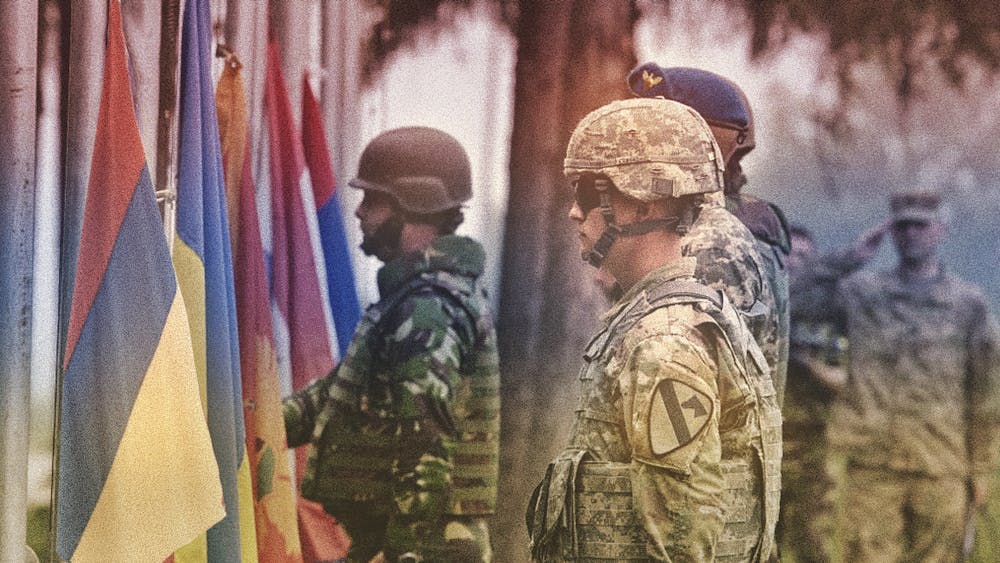
I have always considered myself a nationalist. To me, that has meant being proud of my people and my history, culture, and heritage. I come from a people whose past is marked by genocide, displacement, and loss — where nationalism and national pride were not about dominance, but survival. For Armenians, nationalism has often been the force that allowed us to endure as the world tried to erase us.
Last fall, I enrolled in COMM 4460, a SNF Paideia course focused on media industries and nationalism. Taught by lecturer Murali Balaji, who strives to be as unbiased as possible, the course explored the vast meaning and reach of the word ‘nationalism,’ and its place in society through media. I was drawn to it because it felt like one of the few spaces at Penn where my identity as an American Armenian would not feel peripheral, but relevant. What I did not expect was for it to unsettle my understanding of nationalism as deeply as it did.
On the first day of class, Balaji asked us to go around the room and explain what nationalism meant to us. I answered early, sharing my Armenian nationalism with pride and little hesitation. As the conversation continued, however, it became clear that many of my classmates understood nationalism very differently. They described it as inherently destructive, a force tied to war, exclusion, superiority, and violence.
Listening to them, I felt a mix of shock and defensiveness. How could something that had kept my people alive be understood as inherently immoral? It soon became clear that we were not simply disagreeing on a superficial level. We were speaking from fundamentally different histories, using the same word to describe experiences shaped by very different relationships to power.
For much of my life, I understood nationalism as a source of empowerment, the force that kept my community intact after genocide and dispersion. What I had not fully reckoned with was that it was also nationalism, specifically Turkish nationalism, that enabled the Armenian Genocide, and that it is ongoing pan-Turkic nationalism that has driven the displacement and ethnic cleansing of indigenous Armenians from the Republic of Artsakh today. Sitting in that classroom forced me to hold both truths at once.
Nationalism can function as a lifeline for targeted and marginalized peoples, and it can also be wielded by states and empires to justify violence and exclusion. These realities are not contradictory, but rather context dependent. When all forms of nationalism are flattened into a single moral category, histories shaped by vulnerability and power are erased. I came to this realization not by abandoning my own understanding of nationalism, but by recognizing how partial it had been.
What made this tension productive rather than divisive was the structure of the course itself. As a Paideia seminar, the class prioritized dialogue over consensus. Discomfort was treated as something to sit with rather than something to resolve quickly. Instead of rushing toward neat conclusions, we were encouraged to slow down and ask why we were hearing the same word so differently.
Conversations about nationalism tend to polarize quickly because the term is most visible in its most violent forms. For many people, nationalism is associated with war, exclusion, and state power, so moral alarm becomes the default response. That reaction is understandable. But when nationalism is reduced only to what it looks like at its worst, it leaves little room to consider how it has also functioned as a means of survival for communities whose existence has been systematically threatened.
SEE MORE FROM SOSE HOVANNISIAN:
Code-switching: An act of sincerity or supremacy?
Silence kills: Exposing Azerbaijan’s persecution of Armenians
I remain an Armenian nationalist. That identity is rooted in survival, memory, and the refusal to disappear, and that has not changed. What has changed is my understanding of how easily the word nationalism becomes flattened into a single moral category. At Penn, where students bring vastly different histories into shared spaces, conversations about nationalism cannot stop at instinctive condemnation or unquestioned pride. If we want meaningful dialogue, we have to ask not only what people believe, but what histories have shaped the way they understand nationalism in the first place.
SOSE HOVANNISIAN is a College senior majoring in communication and minoring in history and consumer psychology from Los Angeles. Her email is sosehova@sas.upenn.edu.
SEE MORE FROM SOSE HOVANNISIAN:
Code-switching: An act of sincerity or supremacy?
Silence kills: Exposing Azerbaijan’s persecution of Armenians