

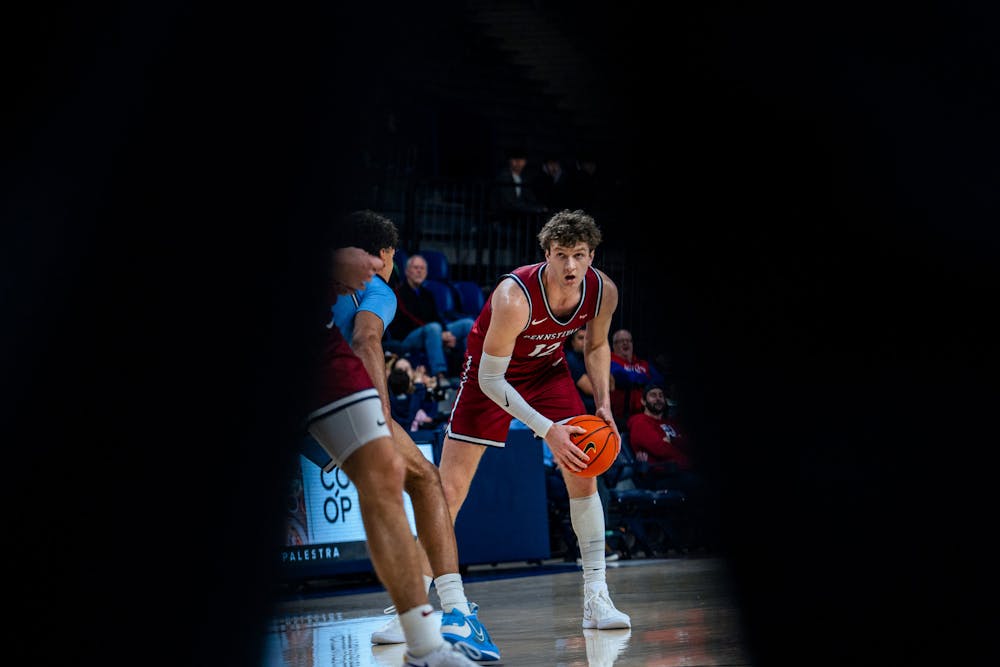
All roads lead to Ithaca.
This weekend, Penn men’s basketball will make the trip to upstate New York to play for a championship in Ivy Madness, marking the team’s first time in the tournament since 2023. After a 9-5 regular season that saw the Quakers finish third in the Ancient Eight table, they’ll match up with second-seed Harvard on Saturday at 2 p.m. for a chance to advance to Sunday’s final.
From key contributors to major competitors, let’s break down everything you need to know as the program vies for its first NCAA tournament berth since 2018.
How Penn got here
A year ago, the Quakers watched the tournament from home after a second straight seventh-place finish left the program in limbo. Penn ultimately moved on from longtime head coach Steve Donahue and hired alumnus Fran McCaffery, who arrived fresh off a 15-year, 297-win stint at Iowa.
Penn’s turnaround under the high-major veteran has been nothing short of remarkable. After opening league play 2-4, Penn found its stride and rattled off seven wins in its final eight games to punch its ticket to the conference dance.
“I think new transfers, the new staff has certainly helped,” senior guard/forward Ethan Roberts said of Penn’s rise from last season to this one. “But also, I think our team chemistry has built. [It] just feels like we have a winning culture. So that helps a lot when games are close, especially in the Ivy League.”
The Quakers’ offense has been led by two of the league’s top scorers — Roberts and junior forward TJ Power, a former five-star recruit who transferred to Penn from Virginia last spring — who are the primary on-ball creators for McCaffery’s group. Since the start of conference play, Power ranks seventh in the league in scoring at 16.9 points per game, while Roberts is eighth with 16.2. On Wednesday, Power was named first team All-Ivy, while Roberts earned a second team nod.
RELATED:
Third time’s the charm: Penn men’s basketball clinches Ivy Madness berth
Carnathan | Penn men’s basketball can win the Ivy League title
Both players have also received national recognition — in November, Roberts was named the Lou Henson National Mid-Major Player of the Week following a pair of 30-point performances against Saint Joseph’s and Drexel. And just two weeks ago, Power earned USBWA Oscar Robertson National Player of the Week honors after notching 38 points in a win over Dartmouth.
“[McCaffery] allows me to just be myself, play instinctually,” Power said. “How fast we play, it’s really easy to just be confident and trust yourself and trust your shots.”
Penn’s quick-paced, motion-heavy scheme prioritizes perimeter play and quality decision-making. The Quakers rank 18th in the nation in three-point percentage (38.17%) and have committed the second-fewest turnovers of any Ivy League team. Two major factors in those figures are senior guard/forward Michael Zanoni, Penn’s resident catch-and-shoot flamethrower who converts 38.2% of his looks from beyond the arc, and sophomore guard AJ Levine, the Quakers’ starting point guard, whose development as a passer and slasher has helped keep Penn’s offense afloat when its stars slump.
Other key contributors include the Red and Blue’s big-man duo — offensive-rebounding junior forward/center Augustus Gerhart and post-scoring freshman forward/center Dalton Scantlebury — as well as do-it-all sophomore forward Lucas Leuth, hot-shooting senior guard Cam Thrower, and hard-driving freshman guard Jay Jones.
“Even when I wasn’t really playing too much, [the coaching staff was] still encouraging me, giving me confidence every day in practice,” Jones said. “My teammates, too, just how much confidence they instill in me, it’s really been helping.”
Despite their offensive repertoire, the Quakers will tell you that their mid-season surge was spurred by their play on the other end. In the first six games of league play, Penn allowed opponent averages of 73 points per game, 47.7% from the field, and 38 points in the paint. In the eight games since, those averages are down to 68.9 points per game, 44.7%, and 34.5 points, respectively.
The Quakers are aggressive on the ball — they lead the conference in forced turnovers during league play (13.5 per game), while Levine leads the league in steals during that stretch (2.4 per game). Penn ranks second among Ivy teams in KenPom defensive rating, a dramatic jump from their seventh-place finish in the same metric in 2025.
“I’d say the biggest thing that’s changed in the past couple weeks: our defense. We’ve stepped it up a bunch,” Levine said. “It feels way better in practice. It feels way better in games. We’re talking way more. We’re flying around. It’s a full team effort.”
“I think it started with that Cornell win, honestly,” Power said. “Our defense was so good that game and we carried it into Princeton the next game and then we just kept stacking wins together. … I think it’s because of our defense. Our offense has been good all year, and I think our offense just gets better when we get stops on the defensive end.”
Meet the Madness
The Ivy is the lone league in Division I that sends just half its teams to the conference tournament. For Penn to claim the crown, it will have to win its way through the Ancient Eight’s best.
Yale (23-5, 11-3 Ivy)
Top-seeded Yale is seeking a three-peat after winning Ivy Madness titles in 2024 and 2025. The Bulldogs are fourth in the country in three-point percentage (40.1%) and have outscored their opponents by an Ivy-best average of 13.1 points per game. Yale coach James Jones’ squad plays at a slower tempo (306th out of 365 Division I teams in possessions per game) but methodically probes opposing defenses for great shots. In conference play, they also lead the league in opponent field goal percentage (42.3%) and rebounding margin (+3.4).
Leading players: The Bulldogs feature the conference Player of the Year in play-making center Nick Townsend as well as formidable 6-foot-10 center Samson Aletan, who is second in the league in blocks, and versatile forward Isaac Celiscar, a second team selection. Then there’s forward Casey Simmons, the Ivy Defensive Player of the Year who also brings hyper-efficient wing shooting. Aletan, Celiscar, and Simmons rank first, second, and fifth in the conference in field goal percentage, respectively.
Season series with Penn: Yale swept Penn in their two matchups this season. First, the Bulldogs held the Quakers to a conference-season low of 60 points on 38.2% shooting on Jan. 24. Then, on Feb. 21, Yale used a big game from Celiscar (16 points, 14 rebounds) to overcome an early Penn lead and eke out a 74-70 win. The Bulldogs were also notably without Townsend for that matchup.
Yale will face off with Cornell in the first semifinal at 11 a.m. on Saturday.
Harvard (17-11, 10-4)
Harvard returns to Ivy Madness after a seven-year absence — the Crimson have not played for the title since 2019, when they fell to Yale in the championship game. Coach Tommy Amaker has rebuilt the program with defense as the focal point: Harvard surrendered just 66.9 points per game in the regular season along with an opponent three-point average of 31.5%.
Leading players: Defensively, the Crimson are led by stout guard Chandler Pigge (third in Ivy in steals per game) and forward Thomas Batties II (first in blocks per game). But on offense, guard Robert Hinton is the star of the show. The 2025 Ivy Rookie of the Year has emerged as one of the league’s top talents, finishing third in scoring (17.3 points per game) on an efficient 50% shooting clip.
Season series with Penn: Harvard split its two matchups with Penn this season, beating the Quakers by a single point on Jan. 19 before falling at the Palestra on Feb. 28.
Cornell (15-12, 8-6)
After starting conference play 0-3, the hosts of Ivy Madness were in danger of missing the tournament for the first time since 2021. But the Big Red quickly rounded into form, using their blistering offense to win eight of 11 games and secure the final seed. Coach Jon Jaques’ group plays an exciting brand of basketball that runs, shoots, and asks questions later — Cornell ranks seventh in the nation in three-point attempts (31.6 per game) and 34th in pace. They score and allow the most points in the Ivy, and their constant off-ball screening to set up their shooters wears down opposing defenses with impunity.
Leading players: The Big Red are led by guard Cooper Noard, the league’s leading scorer at 18.5 points per game, as well as guard Jake Fiegen, who notched 18.5 points per game in conference play. Both seniors shoot better than 39% from three on over five attempts per game, while guard Adam Hinton — brother of Harvard’s Robert Hinton — is Cornell’s third primary scorer and a 42% shooter from deep.
Season series with Penn: Cornell fell to Penn on both occasions this season. The Quakers shot 55.6% from the field and 47.4% from three to earn a double-digit win in Ithaca, then exploited the Big Red’s undersized lineup for 41 free throw attempts in the rematch on Feb. 14.
Cornell will play Yale in the first semifinal at 11 a.m. on Saturday.
The Harvard File
A combined margin of just four points separated Penn from Harvard as they split their regular season series. Now, the two teams will face off with a spot in the conference championship game on the line.
Across both matchups, several common trends emerged that could define the rubber match. First, something that Penn will look to reverse: slow starts. The Quakers’ two lowest scoring first halves of the season came in their two games against Harvard, and the latter was particularly stagnant, as Penn scored just six points in the first 10:51.
Pigge, a second team All-Ivy selection, was able to limit Power’s isolation scoring with his combination of strength and lateral quickness. The Crimson also smothered every jump-shooter, resulting in just one first-half three for Penn.
But, in that second matchup, Penn also seemed to find a reliable pathway through Harvard’s front: the lane. As the second half began, Penn used penetrating drives from Roberts and Levine to facilitate effective offense, ultimately uncorking for a 43-point second half that included a 60% field goal shooting clip.
“We just noticed that they were taking some of the stuff away in our motion, so we were aggressive getting downhill,” assistant coach Tristan Spurlock said of Penn’s second-half adjustments in their win over Harvard. “[Levine] did a good job pushing the ball, [Roberts], [Power], and they just drove the ball strong and took advantage of it.”
“But they [Harvard] are definitely a really good defensive team,” Spurlock added.
“In the second half, we picked up our pace a lot,” Power said. “They’re a really good and a really unique defense to play against, so that’s why this week of practice is nice. We’ve only played them on back-to-backs, so we haven’t really had a lot of prep time. … We’re really diving into the film and trying to come up with a game plan that’s hopefully going to put together two halves this time.”
Defensively, Penn was effective at limiting Hinton during the teams’ first faceoff, but the All-Ivy first teamer got to the paint whenever he wanted in the rematch, racking up 20 points with no made threes or free throws.
Batties II was also a thorn in the Quakers’ side, scoring at least 17 points in both matchups. Batties II is one of the Ivy League’s few true stretch bigs — his 45.9% three-point clip ranks second in the conference — which poses a challenge for Gerhart, Scantlebury, and Penn’s defense as a whole. When the rim protector gets pulled out on the perimeter, it opens the gate for Hinton and others to attack.
But all told, the biggest difference for Penn from this season to last, and the reason they held on to beat Harvard in February, has been its late-game execution. In previous years, the team was maligned by blown leads and clutch blunders, including a 3-9 record in games decided by 10 points or fewer in 2025. That has not been the case under McCaffery.
This year’s Quakers are 11-7 in such games, and their play against Harvard showed why. Leading by one point in the final minute, Penn produced layups on its final two unfouled possessions, including a series of quality passes to set up a Roberts drive that put Penn ahead by three with 20 seconds to play.
“I just plan to be aggressive. That’s really it,” Roberts said of his mindset heading into Penn’s semifinal matchup. Roberts scored 17 of his 21 points in the second half of the Quakers’ last win over the Crimson. “That worked for me [during the last Harvard game].”
Penn’s ability to muster late offense will likely determine their fate in the single-elimination tournament. Of the 12 Ivy Madness games played since 2022, 10 have been decided by single digits, including four by five points or less.
For the Quakers, a season’s worth of work will hinge on their ability to win a few key moments. They wouldn’t have it any other way.
“With [Harvard], it’s a battle of who’s tougher, who’s got more will,” Power said. “We’ll be ready from that standpoint.”
“We have a vision for this program and what we can do this year, but also what we can build for future years,” Power added. “And it starts with an Ivy League championship this year.”
Sports Editor Hannah Chang contributed reporting.


