There is this adage that “a team is only as strong as its weakest link.” In the case of Penn’s student group infrastructure, the Student Allocations Commission has become that weak link, one whose failures ripple outward to affect hundreds of organizations and thousands of students.
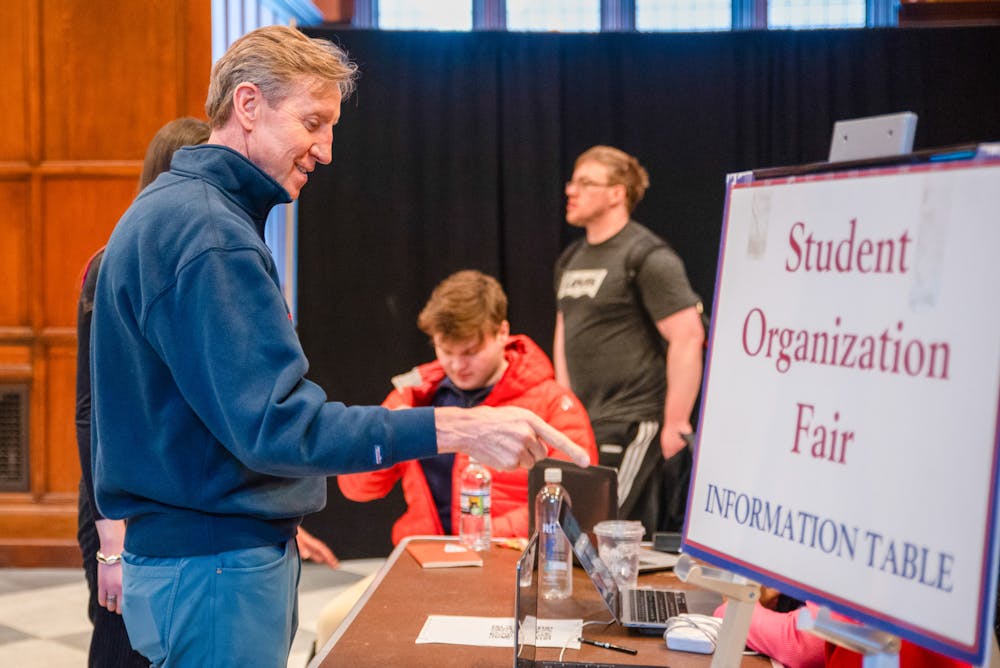
The Student Activities Fair has always been a staple of student life here at Penn. Clubs table on Locust Walk, making their case to the students walking by, hoping to attract their attention. This event is not only a core part of the rhythm of Penn, but a vital part of the recruitment strategy for student groups, many of which structure programming around the fair. Given their track record, nobody expected SAC to pull off a well-organized fair this semester, but the extent to which they botched the execution was beyond anyone’s wildest presumptions.
Throughout the first week back on campus, clubs received no information about when the Student Activities Fair would be held. Those who asked were met with a response from a similarly unaware Office of Student Affairs, which told clubs, “SAC should reach out directly when dates/times/signups are available.” By Jan. 23, the entire event, which was scheduled to be held over the upcoming weekend, was called off indefinitely. Beyond the lack of communication in the early weeks about a date, the only reason many student groups even found out about the fair’s supposed date was because of an email notifying them of its cancellation. Oh, the irony.
A month later, SAC announced that funding awards for their seventh funding round were to be delayed until the backlog from the previous three funding rounds could be cleared, putting every single event happening after March 16 in jeopardy. Since the start of the school year, SAC has centralized funding awards into different rounds where student groups submitted applications to receive financial support. Given the backlog, events that were supposed to have their funding amounts released on the evening of Nov. 13, 2025 — a full three and a half months ago — have already either taken place under severe budget cuts or been scrapped entirely as a result of these delays. If the past rounds are anything to go by, funding awards for round seven will be issued at the same snailish pace, and every treasurer and president can only hope the previous semester’s issues don’t repeat themselves.
It is not lost on anyone that the funding cycles are not an easy task to handle. SAC is composed of students who have schoolwork to deal with and other engagements. These are not full-time bureaucrats who devote every hour of the workday to handling the financial applications of over 200 constituents. But the issue remains: With so much at stake, why place all this responsibility on an institution that has already shown itself incapable of overseeing the increased workload?
The current structure is unsustainable. When funding decisions arrive months late, they cease to be funding decisions at all — they become postmortems. When communication collapses, trust follows suit. And when trust erodes, the very legitimacy of the institution begins to fray. Student organizations cannot operate on uncertainty. Contracts must be signed, venues reserved, and speakers confirmed. Delayed funding is not merely an inconvenience. Rather, it materially alters what programming is possible.
If SAC is to remain the gatekeeper of student activity funding, then structural reform is not optional — it is necessary. Whether that means implementing rolling approvals, restructuring internal deadlines, or further decentralizing allocations to funding boards — like the Asian Pacific Student Coalition and the United Minorities Council — that have a track record of delivering at a quicker pace, something must change. Transparency about timelines, enforceable release dates, and contingency mechanisms for backlog must become the norm rather than the exception.
Strain is not isolated. It is borne by every club that cancels a speaker, every cultural group that scales back a celebration, every academic organization that cannot host a conference, and every student who loses an opportunity as a result. A team is only as strong as its weakest link. If Penn values its vibrant student life as much as it should, then it must strengthen the link upon which so much of that life depends.
SEE MORE FROM EDEN LIU:
EDEN LIU is a College sophomore studying philosophy, politics, and economics from Taipei, Taiwan. His email is edenliu@sas.upenn.edu.

Eden Liu is a College sophomore studying philosophy, politics, and economics from Taipei, Taiwan. His column focuses on civil engagement and University policy. He can be reached at edenliu@sas.upenn.edu.