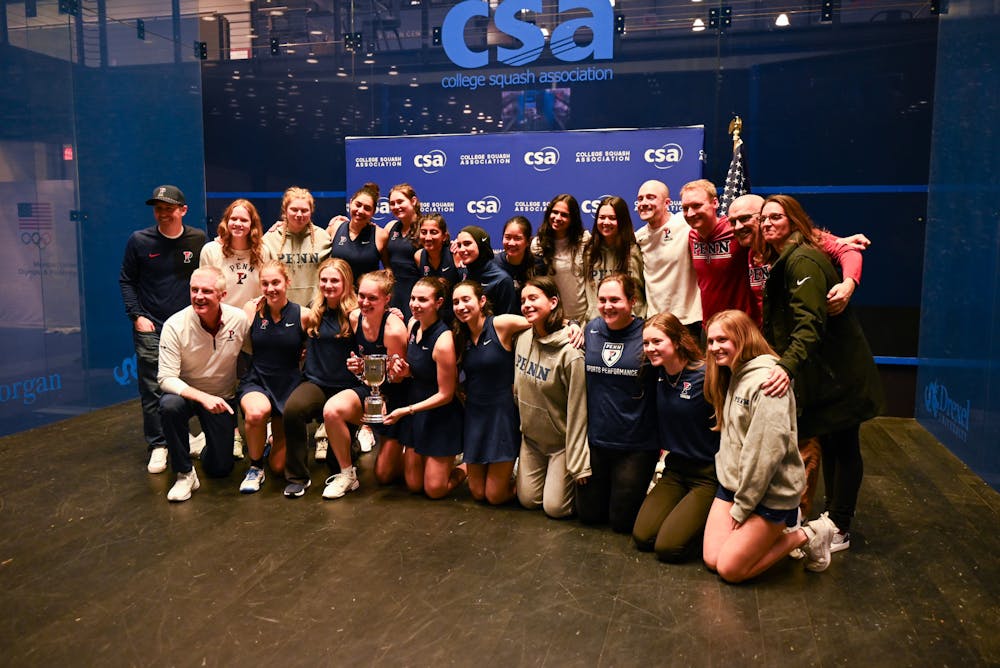
Penn women’s squash won the College Squash Association national team championship for the first time since 2000, beating No.1 Princeton with a score of 5-4 to bring the Howe Cup back to Philadelphia.
Twelve men’s and women’s squash teams from across the country came to compete for the CSA national team championship title from March 5-8. On the women’s side, the Quakers (17-2, 5-1 Ivy) had lost to the Tigers (15-2, 6-0) twice earlier in the season, but that only served as extra fuel in the finals.
“We have nothing to lose at this point … they’re the ones that have to be nervous, not us,” junior Malak Khafagy said. “We are the team that will literally empty that tank.”
The fearlessness came after a weekend of injuries and tough losses — all while several players on the team were fasting for Ramadan.
For men’s squash senior captain Omar Hafez, the weekend held a little more weight. The two-time defending Potter Cup champion took the court for the last time in his Penn career, looking to secure the title once again during his senior season.
Though the men quickly dispatched Drexel 7-2 and the women beat Cornell 8-1 in their quarterfinals, neither win came as easily as the scores indicated. Hafez, junior Salman Khalil, sophomore Marwan Abdelsalam, and Khafagy were fasting, so they didn’t eat or drink from sunrise to sunset.
“I fasted during [the] Ivy tournament,” Khafagy said, where the women’s team finished second after losing to Princeton in the championship. “I kept making excuses in my head, being like, ‘Oh, yeah, it’s fine to lose because you’re fasting.’ But I was like … ‘Okay, what you’re doing right now is just excuses. If I get in there, win in three sets, I will be out as soon as possible, and that fasting factor will not annoy me as much.’ So that’s what happened.”
In a sport where the athletes constantly wipe their hands on the glass after each point because of sweat, Hafez, Khalil, Abdelsalam, and Khafagy drank no water and kept lunging.
RELATED:
The Red and Blue reign: Penn men's squash crowned ivy tournament champions
After the quarterfinals against Cornell on March 6, Khafagy eagerly waited until 6 p.m. so she could eat dinner with the team at La Scala’s.
“I remember [eating there] before our Harvard match, and we won for the first time in a while,” Khafagy said. “It is actually a good luck charm.”
Senior Jana Dweek, who came back from a bulging disc injury earlier in the year, also had a crucial win in a tense back-and-forth match against Cornell’s Lamees Shalaby.
“I think for her to play five games was actually a good thing,” Penn women’s squash coach Jack Wyant said. “She needed that. She needed to be in that fire and get the feeling back.”
In the semifinals, women’s squash beat Stanford with a score of 5-4 to advance to the finals, while the men had a different fate.
***
Hafez stood in the center glass court at Arlen Specter US Squash Center. Win or lose, he was aware that it would be one of his last times standing in the glass court with a Penn jersey.
Though Hafez went on to win his match swiftly, No. 2 Penn fell by a score of 5-4 in the semifinals to No. 3 Harvard, losing to the team that it had beaten twice before in the season.
“They just played the bigger points today better than us,” Penn men’s squash coach Gilly Lane said. “I think it’s really hard to beat a team three times in one season, specifically in four weeks.”
He added that the team has “been clipped from our perch for the last two years.”
“And that’s okay,” Lane said. “I think it’s actually really healthy and a really good thing, so we’re gonna use it as motivation.”
“Everyone left everything on the court,” Hafez said. “Definitely hurts, but it’s good that those young guys get this experience of losing something that hurts a little bit, but they can come back [stronger].”
Though Hafez won his individual match, his concern was about the team.
“He is the consummate team player, he’s someone that I would pick on my team any day of the week and place on Sunday,” Lane said of Hafez. “I always want him on my team.”
As Hafez prepares to move on from Penn squash to a full-time professional career, he leaves a team grateful for his leadership and example.
“I think he’s probably one of the grittiest players out there,” junior Varun Chitturi said regarding Hafez. “He’s gone through some really, really, really tough times over the year.”
Chitturi spoke about when Hafez had to return to Egypt for personal reasons when the team faced an important match against Yale the following week.
“I distinctly remember him saying … ‘No, I’m gonna be back for the Yale match. No matter what,’” Chitturi said. “That just shows how much he dedicates to this team, how much he’s invested in it, how much grit he has. Even though all this shit he’s been through, he still comes back, and he’s for this team, and so that’s something he taught me.”
Though the team wasn’t able to capture the national title, Hafez remains grateful for the incredible senior season he had and notes that finishing third in the country “is not [a] bad thing at all.”
He said that “a lot of the down moments” were among his favorite memories “more than the up moments” because that was when he felt “how close the team is and how everyone cares about each other and how, actually, this team is just meant to be a family, not teammates only.”
“When I wake up every day, I’m really proud of the choice that I chose Penn and chose this team,” Hafez said.
***
With every stroke of Dweek’s racket, the crowd held its breath and collectively sighed when she returned Princeton player Sonya Sasson’s tricky shots. Teammates and friends cheered “Dweek, Dweek, Dweek!” and then hushed instantly when she bent down to serve.
With Penn and Princeton tied at 4-4 in the finals, the women’s championship came down to one game: Dweek versus Sasson.
In the final round, Dweek and Sasson continuously tied, and each rally drew louder screams. After a bout of hard slashes and light taps, quick sprints and lunges, Dweek sealed it with a 11-9 score, securing the round and the championship for Penn.
“If I’m being honest, I didn’t know if this day would ever come for me, because when you finish, when you’re a runner up so many times in a row, you just think maybe it’s not gonna happen,” Wyant said. “We were pretty broken and pretty fractured in October. … We had a choice to come together and try to build something great or to fracture, and you can see the results.”
Wyant added that he’s “happy for the program” and is “thinking a lot about the teams that were close to achieving this and didn’t do it,” saying, “I can tell you that today wouldn’t have happened without the successes in the past and what they’ve done.”
As players and friends were being ushered out of the squash center postgame, Wyant found a racket left on a bench, which turned out to be Dweek’s.
“She wants to keep this one!” he said.
“I’m overwhelmed,” Dweek said. “I honestly feel like I have so many emotions going through my mind. Just so proud of this team. We’ve come a long, long way. We started D-II my freshman year, so we played in our back courts, in our dungeon, and we watched Princeton and Harvard battle it out on our glass court, so I think we just had all the motivation coming in today.”
Junior Anne Leakey, who tore her ACL while competing in the quarterfinals against Cornell, served as another motivation for the team.
“Today’s win was basically for Anne … She’s doing a really good job at not really showing that she’s hurting,” Khafagy said.
Wyant said that squash is an “exceptionally difficult sport, and there’s often times where you need extra motivation. And [Leakey is] sitting outside the court, and you know that she’s given her knee for this team in the most inopportune moment.”
“Anne, this is for you,” Dweek said, leaning closer to the voice recorder, “If you ever hear this, I hope we made you proud and we’re so happy to have you on our team.”
Leakey, sitting on a chair after the win, said with tears still in her eyes, “I’m tired but I’m so happy … The trophy’s coming home, so nothing more to say.”
The men’s team came to cheer the women on. They high-fived Dweek and lifted Wyant into the air. When the women posed with the trophy for a picture, they invited the men over. Some were still sweaty from competing, others were in knee braces or street clothes, but all fist bumped the air. The women’s team ate at La Scala’s again that night.
About the game itself, Wyant made it clear.
“Princeton didn’t lose it. Princeton didn’t choke it. We won it.”