

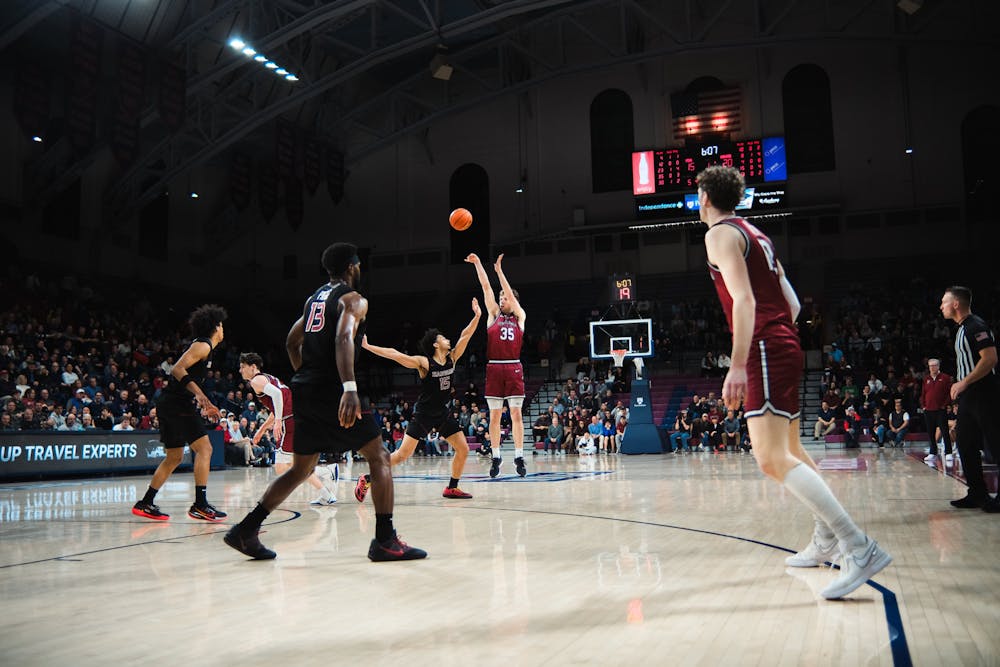
Though not considered among the goliaths of NCAA basketball, there is something brewing in the Ivy League: teams are shooting lights out from three-point range.
The Ivy League is the only Division I conference with more than two teams ranking among the top 20 programs in three-point percentage. Penn is ranked 18th in three-point efficiency, according to the NCAA, the first time the Quakers have been inside the top 20 in over two decades.
But it’s not just the Quakers. Several of Penn’s in‑conference rivals have also been snipers from downtown.
The Yale Bulldogs lead the Ivy League in three-point percentage, as well as ranking second in the nation, scorching more than 40% from beyond the arc. This has no doubt been a key to their success this season as they sit comfortably with the No. 1 seed in Ivy League. The Bulldogs are also shooting nearly 50% from the field, making them one of the most efficient scoring teams in the nation.
The Cornell Big Red aren’t far behind Yale, shooting over 39% on three-pointers, ranking sixth in the nation. Perhaps the most impressive part of Cornell's efficiency is the rate at which they take three-pointers. The Big Red are ranked eight in the nation in three-point attempts per contest, putting up more than 29 three-pointers a game, at the time of this writing.
Penn has been deadly from the three-pointer all season as well. Though they rank third in the Ivy League in three-point efficiency, Penn men’s basketball’s elite long-range shooting this year is far more remarkable than the impressive statistics suggest. Penn men’s basketball jumped an inconceivable 238 spots in the NCAA’s three-point shooting team ranking in just their first season under coach Fran McCaffery. The Quakers have gone from being a painfully average average three-point team to making opponents pay for every missed switch and defensive miscommunication.
This change in shot-making isn’t due to any one member of the coaching staff. Senior guard Dylan Williams said, “We don’t have a particular assistant saying anything in specific, but [the coaching staff] definitely value the three-ball. … They want us to just get the best shot per possession, so if that’s a three-pointer, then they want us to shoot it with confidence. It really is just a confidence thing for us and knowing that we have each other’s back.”
One key to Penn’s three-point success is that all three of their top scorers (by points per game) are shooting above 38% from beyond the arc. Penn’s three-headed snake of senior forwards Michael Zanoni, Ethan Roberts, and TJ Power each surpass this mark while averaging double digits. Any member of the sharpshooting trio can go off on any given night.
RELATED:
Carnathan | Penn men’s basketball can win the Ivy League title
Madness Managed: Everything you need to know for Penn men’s basketball’s Ivy League tournament trip
In their wins against Harvard and Dartmouth that clinched their spot in the Ivy Madness tournament, it was Power who, across the two games, made nine of his 14 shots from downtown. In the narrow loss to Yale the prior weekend, it was both Power and Zanoni that shot a combined to go 8-for-15 from deep. The weekend before that, it was Ethan Roberts who shot over 42% on his seven three-point attempts in a win against Columbia.
As Williams said, confidence seems to be the difference-maker in the Quakers’ approach to the long ball. On the Quaker Nation podcast, Zanoni spoke about bouncing back from tough shooting nights, saying, “That’s something that I had to work on over time. I think freshman year, I kind of fell victim to it, of letting it linger [into] days after the game. I think over time, and just going through it, I’ve gotten better at kind of flushing it away right after, even during a game I’ll start 0-for-4, it’s always next-one’s-going-in mentality.”
Zanoni credited to the coaching staff for encouraging him to keep shooting the ball even on off nights.
“I got to give credit to my coaches.” he said. “They’re still telling me on the sidelines they want me to shoot. … So a lot plays into it, but I’d say a big part is having the confidence from the coaches and knowing you have that green light.”
It’s not just the confidence the Quakers have in their own abilities, but also the confidence the coaching staff has in its players.
In the recent victory over Harvard, in which Penn clinched Ivy Madness for the first time in three seasons, the Red and Blue had a rough first half from beyond the arc, connecting on just one of their six attempts. The squad recovered in the second half and made five of their 11 three-point attempts.
“Well, we have really good three point shooters. We provide them with a philosophy to let it go. It’s never ‘Coach is going to get mad at me because I shot that one,’” McCaffery said after the Feb. 28 game. “I want them to have the philosophy … [that] it’s a good shot because I picked it and I fully tend to make it. If I don’t make it, I’m going to make the next one. I want to make the next five. It’s the mentality we have. So even if we’re off, like we were in the first half, I knew we’d make more in the second half.”
This surprising development is in large part due to the coaching staff encouraging their players to shoot with confidence. And so far, it’s working. The Quakers have a winning record for the first time in three seasons and have clinched a postseason appearance. Penn men’s basketball is among the elite three-point shooting teams in the nation. Their formidable long-range scoring will be a huge factor as they look to contend for the Ivy League championship.


