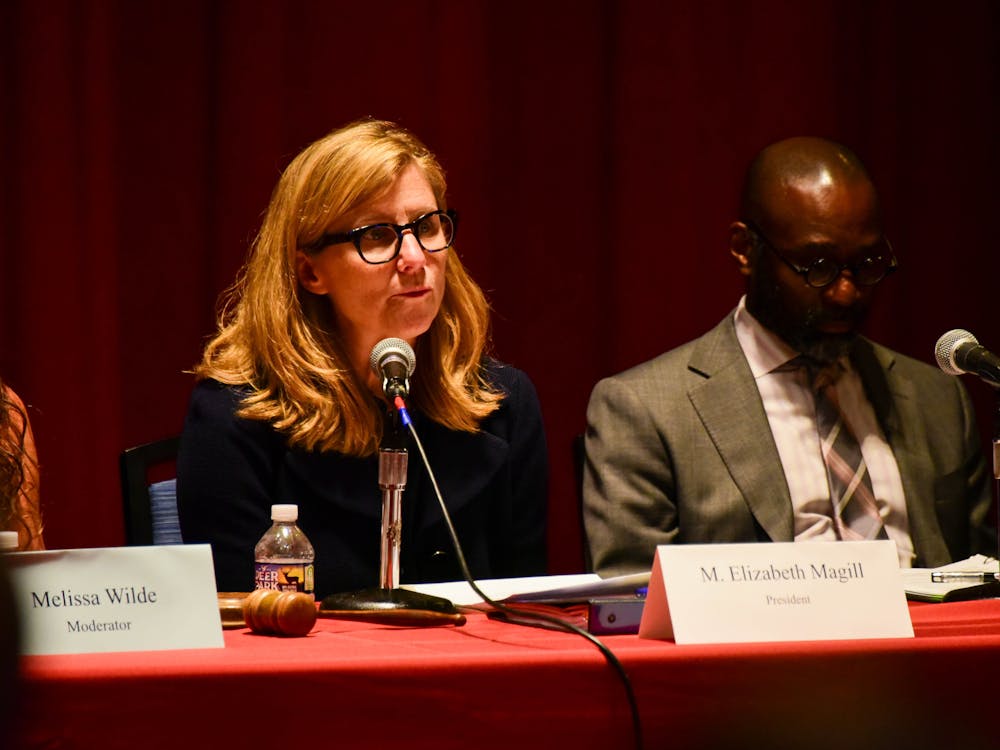
Just over two years ago, former Penn President Liz Magill stepped down days after her congressional testimony on antisemitism — the culmination of months of upheaval at Penn and across the broader landscape of higher education.
Magill will begin her tenure as the dean of Georgetown University’s law school in August, making her one of the first of several university administrators who resigned during that time to return to a position of higher education leadership. Ahead of Magill’s new appointment, administrators and donors shared reflections on her presidency with The Daily Pennsylvanian.
Magill — who will also serve as Georgetown Law’s executive vice president — previously served as dean of Stanford Law and provost of the University of Virginia before arriving at Penn in 2022.
University of Pennsylvania Carey Law School professor Eric Feldman — who was the chair of the Faculty Senate at the time of Magill’s presidency — said Magill’s appointment reflects leadership abilities she demonstrated earlier in her career.
“She showed through the deanship there that she has all the skills and more to do a spectacular job running a law school,” Feldman said, adding that Georgetown is “incredibly lucky to hire somebody seasoned as she is in that position.”
Feldman explained that while Georgetown Law differs from Stanford in size and institutional structure, Magill is prepared to take the helm of a law school.
“When one is good at running a law school, raising money, creating new programs, supporting faculty, supporting scholarship, those skills are going to be easily transferred,” he said.
Craig Carnaroli, who served as Penn’s executive vice president during Magill’s presidency, similarly described Magill’s appointment as a return to “her sweet spot” in higher education.
RELATED:
Liz Magill named Georgetown Law dean nearly three years after historic resignation from Penn
Perry World House hosts Holocaust scholars to discuss genocide accusations against Israel
“I can’t imagine anyone more qualified than Liz for the leadership role at Georgetown Law,” Former Board of Trustees Chair Scott Bok wrote in a statement to the DP, expressing a similar sentiment to Feldman and Carnaroli.
“Liz can have a big impact leading Georgetown Law, given all the complex constitutional and international law issues that are currently in play in America,” Bok continued.
Magill’s resignation in December 2023 came after she testified before Congress alongside several other university presidents. During her testimony, when asked by Rep. Elise Stefanik (R-N.Y.) whether “calling for the genocide of Jews” violated Penn’s code of conduct, Magill responded that such speech would be “context dependent.”
“I’m sure she has relived the testimony in her mind many, many times, and she’s spoken very publicly about what she regrets and what she would do differently,” Feldman said. “People sometimes have those experiences and have a very hard time ever getting back on their feet professionally.”
Carnaroli said that her presidency at Penn unfolded during a “relentless” period during which people “were looking to really challenge leadership and governance of the institution.”
“Onboarding a new president is challenging,” Carnaroli added.
At Penn, Magill launched a campuswide strategic planning process to guide the University’s long-term priorities. Carnaroli said that those planning efforts were “disrupted” by a series of controversies and protests.
In early fall 2023, writers and performers gathered in Irvine Auditorium to celebrate Palestinian art and culture and discuss their right to national independence. The event, titled the Palestine Writes Literature Festival, immediately drew criticism from students, alumni, and national Jewish groups who objected to the inclusion of speakers who they alleged had made antisemitic remarks.
Despite a statement from Magill condemning antisemitism, many faculty members and prominent alumni donors urged the University to take a stronger position against the festival. As tensions escalated following Hamas’ Oct. 7, 2023 attack on Israel, members of the University Board of Trustees called for the resignations of Magill and the Board of Trustees’ then-Chair Scott Bok.
The controversy erupted on the national stage on Nov. 1, 2023, when more than 20 members of Congress sent a letter to Magill criticizing the University. Fifteen days later, the Department of Education launched an investigation into Penn over allegations of campus antisemitism.
“It was just hard to get things off on a unified note,” Carnaroli said. “It was just a fractured time.”
Feldman described Magill’s appointment as a “well-deserved” opportunity following a “tough period of time” after the hearing. He added that he is “proud” of Georgetown’s decision to do “what no other school had done until now” by rehiring Magill to a senior administrative role.
In a separate statement to the DP, Carnaroli wrote that he views Magill’s appointment as a reflection of her “resilience as a leader,” adding that she “will not let herself be defined by one sentence.”
He also noted that Magill has publicly acknowledged she “wished she had answered the question differently.”
“How many of us haven’t experienced a similar moment at some point in our lives,” he added.
At the time, many donors and community members criticized Magill’s response to allegations of antisemitism at Penn. In the months that followed, protests on campus — including the Gaza Solidarity Encampment — fostered further discontent among University alumni and donors.
For some, such as 1960 and 1961 Engineering graduate and donor Melvyn Miller — who criticized the University’s handling of campus protests in 2024 — Penn has not recovered from the events.
“Following Liz’s resignation, Penn has tried to paper over the problems caused by those problems but not sufficiently to convince our three generations of Penn alumni to reinstate our previous seven figure support,” he wrote.
1984 College graduate David Dormont told the DP that Magill “became completely ineffective” before her resignation.
“She lost the alumni, she lost the students, she lost the faculty,” he said. “It’s not easy to lead any higher education institution. It’s hard to make great institutions if you constantly have changes in leadership.”
1992 Wharton graduate Jackie Reses wrote to the DP that Magill “missed the moment, as did others, by not realizing how challenging the environment was on campus for Jewish students,” but added that Magill’s departure allowed the University to “move forward with a new President.”
On Dec. 9, 2023, Magill stepped down from her role as Penn’s president. Minutes later, Bok announced his own resignation as chair of the Board of Trustees. Several other university presidents stepped down from their positions in 2023, including Harvard President Claudine Gay and Northwestern President Michael Schill.
“As for the several contentious weeks leading up to her resignation as Penn’s president, I think pretty much everyone has reevaluated what happened then in light of what is now more than two years of political attacks that have touched nearly every elite American university,” Bok wrote.
He added, “Few such institutions and few of their leaders have emerged from that unscathed.”
Now, Carnaroli said that Magill’s appointment could be a “healing moment” in higher education after a period of sustained upheaval.
“Life isn’t fair, and we get a speed bump, and we’re not our best selves, and yet, you’re not put in the penalty box forever,” Carnaroli said. “You are given another chance.”
RELATED:
Liz Magill named Georgetown Law dean nearly three years after historic resignation from Penn
Perry World House hosts Holocaust scholars to discuss genocide accusations against Israel
Staff reporter Luke Petersen covers politics and can be reached at petersen@thedp.com. At Penn, he studies philosophy, politics, and economics. Follow him on X @LukePetersen06.
Senior reporter Ananya Karthik covers central administration and can be reached at karthik@thedp.com. At Penn, she studies communication and economics. Follow her on X @ananyaakarthik.