Content warning: This article contains mentions of suicide and suicidal ideation that can be disturbing and/or triggering for some readers.
My best friend told me a week ago that she would be dead once her birthday passed on the first of November.
For a long time, she had been struggling with her mental health and the pressures of perfection, wearing her down over time to the point of seriously considering the possibility of suicide. Thankfully, through calls made daily over the last week and the compassion I offered her, I was able to convince my friend to seek out help.
It is only through our conversations that I’ve come to realize that the vast majority of the frequently repeated advice for combating suicide is wholly unhelpful. In my friend’s words, anyone who aims to prevent suicide first and understand the source of depression second would never be able to truly empathize with the plight of a depressed individual. Though I take a few issues with her belief, I do agree that resources like the Suicide Prevention Hotline and mental health books are unable to relate to anyone’s individual experiences, rendering them unhelpful for decoding suicidal ideation.
At Penn, suicide is similarly swept under the rug almost every time it happens — a horrible, sickening reality masked by the pervasive veneer of perfection that is expected of us at Penn. A little over a decade ago, in 2014, then-College first year Madison Holleran committed suicide, followed by ten more suicides over the next year. This string of deaths continued through to 2017 with the suicide of Wharton junior Ao “Olivia” Kong and College senior Nicholas Moya, totalling 14 deaths over four years before Penn took measures to address mental health. After each and every one of these tragedies, Penn highlighted the same resources and preached about suicide prevention — providing helplines and referring students to the Student Health and Counseling office.
Ultimately, such discussions of suicide fail because they aren’t open-ended. As with the discussion of any other topic, the best method for a conversation to be conducive towards compromise is for both parties to be forthcoming, yet receptive to the other’s views. As such, any resource that can only one-sidedly spew arguments against suicide is bound to fall on deaf ears. And unfortunately, due to the Suicide Prevention Hotline and mental health book authors’ mission being advocacy against suicide, common resources are doomed to be one-sided.
National Suicide Prevention Month, though well-intentioned, only furthers this issue. Though it is certainly capable of spreading awareness of the prevalence of suicide as well as resources to learn more about it, the month doesn’t particularly excel at creating actual dialogue between people. There’s also the issue that designating a single month for the sake of suicide awareness creates the impression that there is less of a need to discuss such a pressing matter outside of September, a narrative which is entirely false.
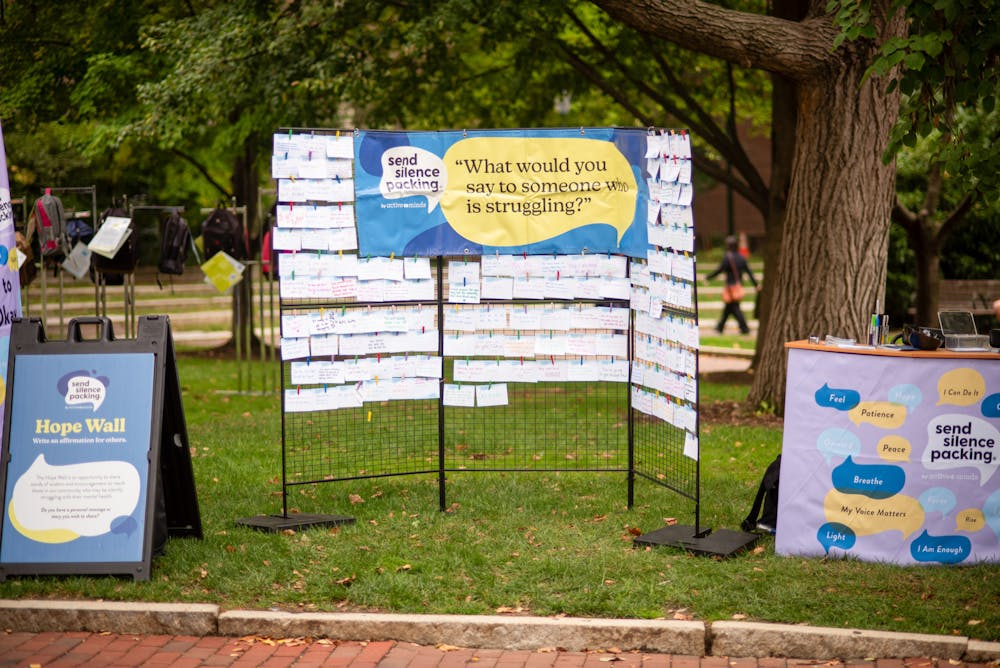
Especially at Penn, suicide prevention campaigns are awfully scant. This year, Wellness at Penn offered a grand total of three Instagram posts dedicated to National Suicide Prevention Month — two of which highlighted a single exhibit held on College Green held annually which has always gleaned minimal attention from students. The remaining post was a mish-mash of cliches, spouting phrases like “We’re here for you” and “You’re not alone” as if they were attempting to check boxes rather than create positive change.
I don’t want to suggest that these observances are entirely useless, however. Reducing the stigma surrounding mental illness is an indispensable outcome of raising awareness. But when it comes to actually helping people, raising awareness and reducing stigma are merely a means to an end. As far as I can tell, the most important thing that we can do to help each other through dark times is to simply sit, listen, and offer unconditional support. Unfortunately, such skills are far from common here since Penn Face and grueling academic pressure can cause us to become isolated and to neglect our communal well-being.
Therefore, if suicide awareness campaigns were to really be helpful, they should drop the preachy act and encourage quietude instead. We should be taught how to become safe spaces for our friends, not how to recite the digits for the Suicide Prevention Hotline. And more than anything, we must gradually and constantly build trust and empathy with our friends, something that can’t be rushed during a single month, much less a single day.
ANDY MEI is a College first year studying Economics and History from Palo Alto, Calif. His email is andymei@sas.upenn.edu.

Andy Mei is a College sophomore studying economics and history from Palo Alto, Calif. His column focuses on University administration. He currently serves as a Deputy Opinion Editor and can be reached at andymei@sas.upenn.edu.