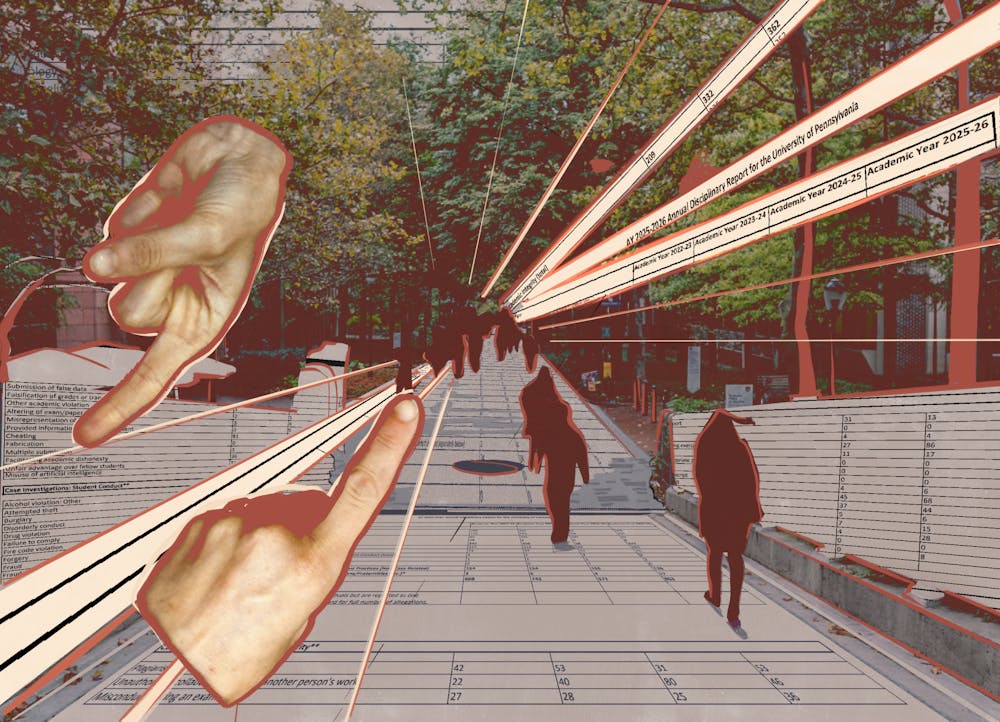
A few weeks ago, The Daily Pennsylvanian reported that the number of disciplinary cases against Penn students is on the rise, especially those related to student conduct. Despite this, Penn students don’t actually “get in trouble” very much. Expulsions are nonexistent, sanctions are rare, and students don’t tend to fear the fallout of their actions. Despite increasing academic dishonesty and student conduct violations, virtually no one on our campus has faced serious consequences in recent history.
Disciplinary incidents at Penn are documented as either “Student Conduct” or “Academic Integrity” cases. The former includes behavioral issues such as alcohol violations and disorderly conduct, while the latter covers various types of cheating. When a disciplinary complaint has been filed against a student, the Center of Community Standards and Accountability can resolve it in a few ways. If the CSA determines that a student has violated the Code of Student Conduct or the Code of Academic Integrity, they may choose to either file formal charges or resolve the matter through informal “mediation.” Further, if charges are filed, students may voluntarily agree to accept a sanction, or alternatively, should the student maintain their innocence, a formal hearing is held.
Such hearings are wildly infrequent. A striking finding from the CSA’s annual disciplinary report is that less than 0.5% of cases resulted in a hearing by the CSA. Many more — almost 75% — are resolved through voluntary agreements by students who admit to their wrongdoing. The other significant mode of resolution (with a 17% share of the caseload) was mediation through Restorative Practices, which manages wrongdoing through the use of “facilitated dialogue.”
By these numbers alone, one might suggest that the system is working as intended: When Penn students are caught, they maintain their integrity by owning up to their mistake and accepting the consequences. But that doesn’t capture the entirety of the situation. In the vast majority of resolved cases, the sanctions placed against students are entirely insignificant. They’re slaps on the wrist.
We argue that the system as it stands is plainly ineffective. The majority of sanctions given are warnings and reprimands, as opposed to more severe punishments like probation, suspension, and expulsion. This reality is apparent in academic dishonesty cases last year, where “decision-mapping exercises” outnumber probations and reprimands, and in student conduct cases, where reprimands and restorative practices exceed the number of all other punishments.
Sanctions data show the same pattern in both case types: The softest available outcome is often the most common one. In academic integrity cases, 155 students got a decision-mapping exercise. Student conduct cases lean less on any single soft option — reprimand and probation are the top two — but restorative resolutions and warnings round out a list that, notably, doesn’t include many suspensions. This analysis points out that most students, even when caught violating Penn’s policies for behavior and academic integrity, are not met with serious repercussions.
SEE MORE FROM THE DAILY PENNSYLVANIAN EDITORIAL BOARD:
That’s not to say that students are in need of heavy surveillance or strict scrutiny. In fact, the use of restorative practices has proven effective in educational settings. Yet, a system that does not enforce some punishment when met with flagrant violation cannot be one that serves its students. Penn has no incentive to punish students. Doing so opens up the University to scandal and reputational risk. Instead, Penn’s CSA chooses to stay quiet and avoid confronting misconduct.
When actions are left without consequences, we allow our disciplinary system to descend into uselessness. The CSA’s apathy toward holding students accountable means their work is simply wasteful bureaucracy, instead of the meaningful moral enforcement it could provide. If you just agree to taking part in “decision-mapping” to get off scot-free, who wouldn’t admit to their wrongdoing? There’s no real, lasting consequence involved.
At a school that has produced violent offenders, white collar criminals, and America’s first felon president, we need to hold our students accountable. Perhaps our time at Penn is so formative that our alumni end up with the belief that it’s possible to avoid punishment even later in life. If we’ve never faced consequences, why would we fear them now? Moral enforcement, now more than ever, is not something we can give up. The CSA should consider this a call to action: Give Penn students due consequences now, before it’s too late.
Editorials represent the majority view of members of The Daily Pennsylvanian Editorial Board, who meet regularly to discuss issues relevant to the Penn community. This body is led by Editorial Board Chair Jack Lakis and overseen by Opinion Editor Ingrid Holmquist. It is entirely separate from the newsroom. Questions or comments should be directed to letters@thedp.com.