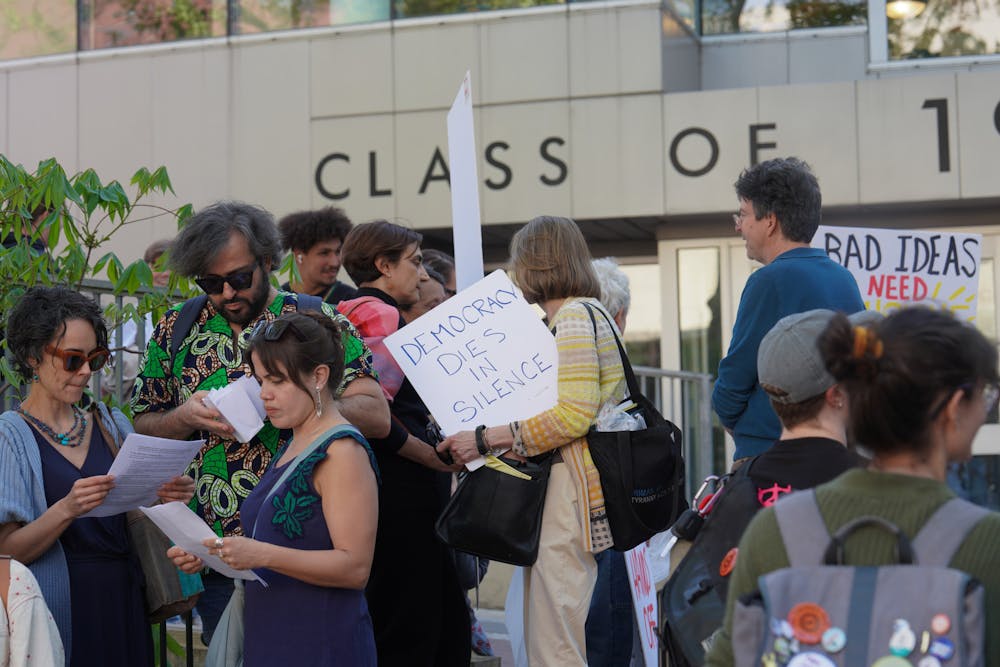
This August, Penn’s administration quietly reissued its “Special Event Review Process.” The policy mandates that any event touching on “open expression,” featuring “notable or controversial speakers,” or raising potential “public relations challenges” must first secure approval from the Special Event Review Group. This policy is an affront to the core values of our institution: intellectual freedom and shared governance.
For years, Penn has had a process for “reviewing” events. What separates this 2026 policy from those in the past are the direct references to open expression, the emphasis on preclearance and increasingly vague language. It’s easy to let policies slide off the radar because they’re, you know, boring. But let’s be clear: This is administrative overreach that’s being laundered through bureaucracy. It is designed to shift power away from faculty and students and towards the administration. This policy limits faculty’s ability to teach and students’ capacity to learn. It strikes yet another blow to shared governance and threatens to chill intellectual inquiry across our campus.
The Special Event Review Group is composed entirely of staff members — there are no students or faculty, but plenty of administrators from the Office of General Counsel, the Division of Public Safety, and the Office of Risk Management and Insurance. Leaving decisions about academic events, guest lectures, and campus gatherings solely to administrative staff prioritizes brand management and risk mitigation over our fundamental educational mission. It treats faculty and students like children who need permission to do the core parts of our job rather than essential members of an intellectual community.
Then there’s the issue of how this document is written. The vague criteria and sweeping scope of this policy mean that any event requires approval. I teach classes on feminism. Every semester, I invite speakers whose work and expertise are by their nature controversial. My expertise on feminist theory is why I have a job at Penn, why I’m given the incredible responsibility of teaching students who want to learn about their world through a critical, cultural lens. It’s this same expertise that makes it literally impossible for me to organize an event or structure a class that doesn’t have “open expression implications.”
What’s truly enraging about this language is that it shows that the administration has learned nothing from the widespread community backlash over the proposed Open Expression Guidelines. In listening sessions last spring, community partners rightly identified how chilling the guidelines would be for freedom to teach and freedom to learn because almost anything could fall afoul of the guidelines. That this renewed policy makes the same mistake shows that vague language and obfuscated processes aren’t a bug of the administration’s policies — they’re a feature.
This policy must be overturned. We have to go back to having faith in faculty and students to organize events without fear of violating poorly worded policies overseen by invisible administrators. More than ever, we need to transform bodies like the Faculty Senate and University Council into elected, representative bodies that have power to create and enforce policies.
The administration will likely argue that objecting to this policy shows naivety, that the climate of higher education is hopelessly politicized and that the institution must act cautiously in order to continue its mission of education. But it is precisely because of the current climate that we have to be clearer than ever about what our university’s values are, and be willing to fight for them.
Allegedly, Penn is guided by the motto, leges sine moribus vanae, which translates to “laws without morals are useless.” These guidelines are laws for our community members that don’t just lack morals, they betray our morals. Academic freedom cannot be a nice-to-have luxury of a liberal arts education. Shared governance cannot be outsourced to a group of administrators who lack transparency and exclude the people most affected by their decisions. If Penn wants to remain a world-class research university, leadership must live up to its values instead of accidentally surrendering them.
JESSA LINGEL is a professor at the Annenberg School for Communication. Her email is lingel@upenn.edu.