What happens when you put 30 Ivy League students in a classroom and ask them a question? Apparently, nothing.
Whether it’s a first-year seminar with 10 students or a lecture hall with over 100, we’ve all watched as our professor posed a question and was met with an awkward silence. We’ll stare at our computers, pretending we’re deep in thought or entrenched in our notes, and wait for someone to break the tension. It may not be every question or every class, but it’s enough to create an environment where we’ve simply gotten used to not responding. Humanities and seminar-based classes are supposed to thrive off of conversation, discussion, and even contention. But unfortunately, none of that can happen if students don’t feel the need to participate.
It’s hard to believe that Penn students have nothing to say or no opinions to share. As a matter of fact, it seems that Penn students always have something to say. The dead air isn’t necessarily caused by a lack of interesting thoughts or comments, but rather the ever-present technology we can’t seem to go without anymore, and with it comes an increasingly accurate idea: technology has made us boring.
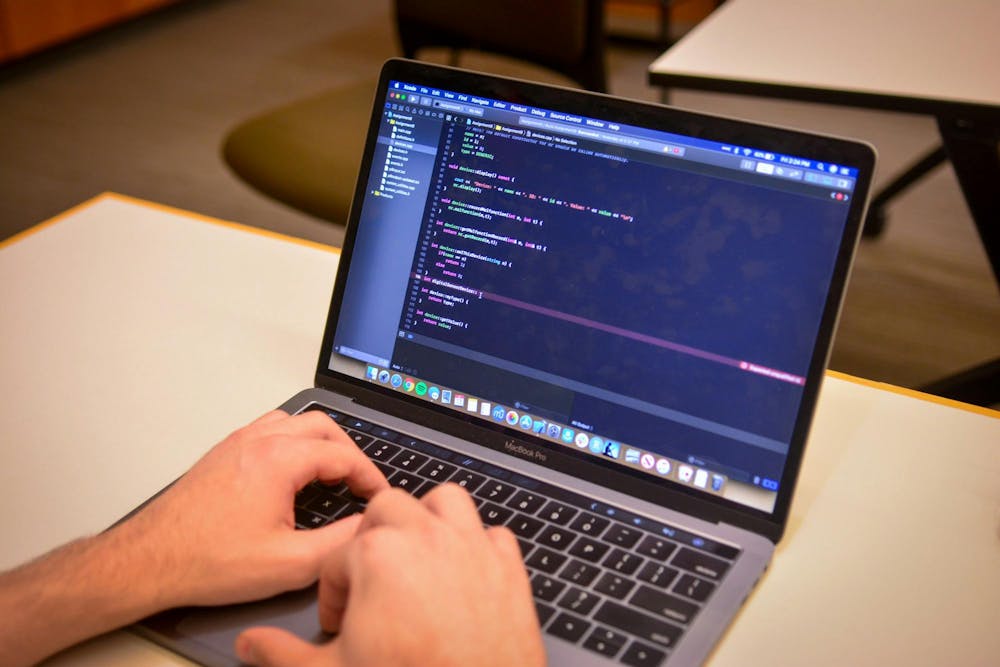
It’s not that Penn students are unintelligent or unable to answer a question if a computer is in front of them. But the presence of tech in class, even if it’s just for note taking, has been proven to produce worse outcomes for students. The result is often a combination of increased distractions, decreased satisfaction with the class, and an overall lack of understanding when it comes to the course material. It’s becoming clear that classes have become a competition between the course material and our screens, and everybody is losing in the process.
Penn’s solution? An increase in professors creating a “no-tech” policy for their classroom. No phones, no iPads, no laptops — a completely analog transformation. I’ve experienced my fair share of tech-free classes in both humanities and STEM courses, and although I’ve noticed a general disapproval from students (including, occasionally, myself), I’ve also noticed something much more thought-provoking: everyone and everything seemed less boring. Without the physical barrier of a screen taking up everyone’s view, the only thing left to focus on was the class itself.
It’s easy to fall into the justification of foundational and major requirements and only see a class as a means to an end. Especially with discussion-based courses, when you have your laptop right in front of you, why not finish that problem set or reply to that email? Sometimes it can feel more efficient to treat a class like a study hall, and we’re all guilty of it. But in those moments when your focus is on a screen instead of the professor, a whole possibility of education is lost.
The reason we don’t just take online classes, sequester ourselves in our dorms, and bury ourselves in self-produced research in order to graduate is because that’s not the point of Penn. We’re meant to collaborate and converse with people with completely different experiences and backgrounds under the mentorship of world class professors. And the truth is, that’s harder to do when there’s a screen blocking your view and constantly fighting for your attention.
Sure, it might take a little extra effort to take notes with a pen and paper rather than typing on a laptop, but it’s definitely not without reward. Students do much better on exams and with information retention in general when they handwrite their notes compared to using tech, and without the added distraction, you’re able to focus on the class at hand rather than the screen in front of you. And if all we care about is trying to minimize the amount of time and work we put into everything, why even bother coming to Penn? If not to educate and better ourselves, are we really paying $100,000 a year just to reorganize our Google Calendar during a lecture?
SEE MORE FROM CHARLOTTE PULICA:
No-tech classes might feel over the top or annoying, but when it comes to a discussion-based class or a seminar, they’re starting to feel essential. Participating in discussions, answering questions, retaining and interacting with the content — these are the qualities that make a course truly educational. Yes, technology is always going to be a part of our lives and our education, and yes, it might feel easier in the moment to rely on it, but we have an opportunity to take classes that are meant to expand our perspectives and challenge our ideas, which seems a lot more valuable than whatever is on our screen.
Classes can feel boring. Discussions can feel boring. Required readings can feel boring. But in a world where we have a constant stream of dopamine-inducing content inches away from our faces, being forced to confront that feeling might be the only way to realize that it was really us being boring the entire time.
CHARLOTTE PULICA is a College sophomore studying Cognitive Science from Enoch, Utah. Her email is cpulica1@sas.upenn.edu.

Charlotte Pulica is a College first year studying communications and consumer psychology from Enoch, Utah. Her column focuses on student life and administrative policy. She currently serves as a Deputy Opinion Editor and can be reached at cpulica1@sas.upenn.edu .