

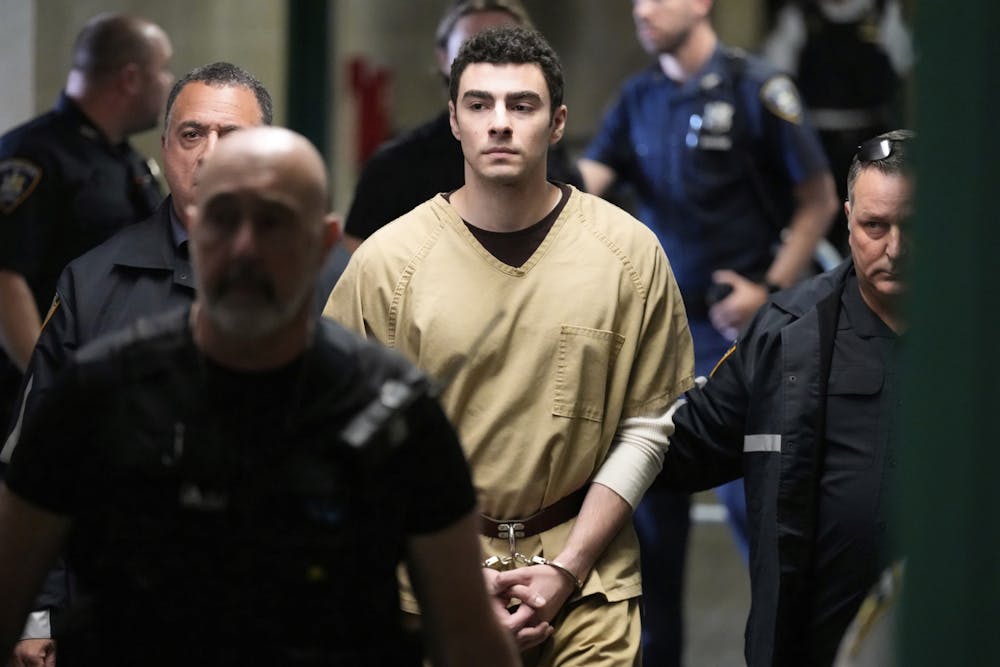
2020 Engineering graduate Luigi Mangione pleaded guilty to two federal stalking charges connected to the death of UnitedHealthcare CEO Brian Thompson on Friday.
United States District Judge Margaret Garnett announced that Mangione will be sentenced on Dec. 18 and will serve at least 85% of the maximum time. He is still scheduled to be tried next month in the state of New York for several charges, including second-degree murder — though his lawyers may challenge his ability to stand trial now that his federal case has ended.
In his statement, Mangione said that he posed as an investor to obtain information about a conference and 3D printed a gun.
“I shot Mr. Thompson in Manhattan,” Mangione told Garnett. “I understood that my actions would place him in fear of death or bodily injury. I knew what I was doing was illegal.”
The announcement came after reports on Thursday indicated that a guilty plea was imminent. The maximum possible sentence for the two stalking charges is life in prison without the possibility of parole.
The guilty plea in Mangione’s federal case largely brings one chapter of the Penn graduate’s court saga to a close. However, it also opens questions about double jeopardy — a constitutional protection preventing defendants from being prosecuted twice for the same offense.
Mangione and his lawyers have long opposed the simultaneous prosecutions. State prosecutors could argue that the offenses are different, meaning that Mangione’s New York case could still move forward.
Mangione’s state trial is scheduled to begin jury selection on Sept. 8.
His federal case was heavily politicized in April 2025, when then-U.S. Attorney General Pam Bondi announced that she had directed federal prosecutors to seek the death penalty, citing “President Trump’s agenda to stop violent crime.”
Weeks later, he was federally indicted on two counts of stalking, a firearms offense, and murder through the use of a firearm — the last of which carries a possible death penalty. He pleaded not guilty at his arraignment, where Garnett cautioned the Department of Justice against making public commentary on the case that could hamper a fair trial.
Mangione’s lawyers asked Garnett last September to prevent federal prosecutors from seeking the death penalty due to Bondi’s remarks, arguing that authorities turned his arrest into a “Marvel movie” spectacle. The motion submitted by his lawyers also cited his academic accomplishments and his time at Penn.
Prosecutors contested the defense’s claims, arguing that “pretrial publicity, even when intense, is not itself a constitutional defect.”
In January, Garnett dismissed the firearms and murder charges, taking capital punishment off the table.
Mangione’s federal trial was scheduled to begin in January 2027.
Senior reporter James Wan leads administration reporting and can be reached at wan@thedp.com. At Penn, he studies communication and computer science. Follow him on X @JamesWan__.


