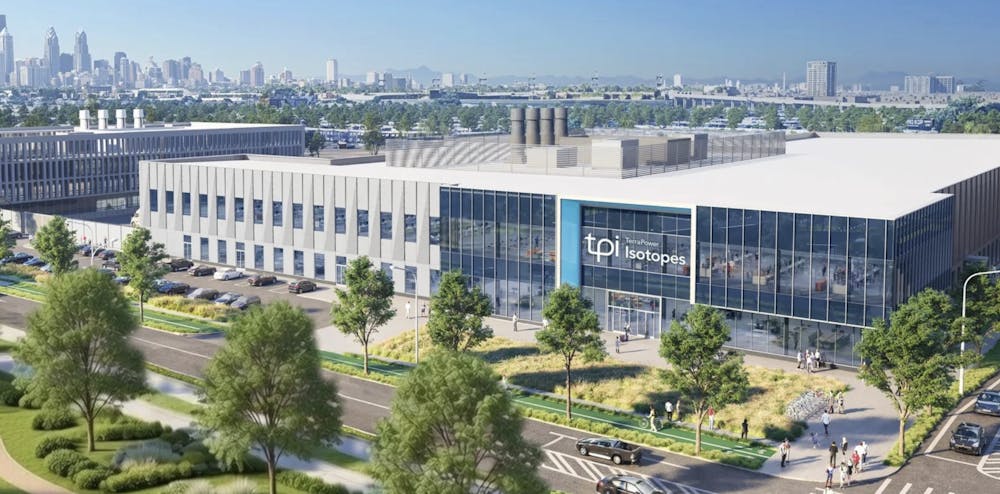
Just south of Penn’s campus, construction began in May on a new manufacturing facility dedicated to producing actinium-225 — a radioactive isotope used in cancer treatments.
Located in Philadelphia’s Bellwether District, the $450 million plant spans 250,000 square feet and is expected to create 225 full-time jobs within the next three years. The TerraPower Isotopes facility is scheduled to begin operations in 2029.
“TerraPower Isotopes’ presence in Philadelphia will strengthen a place where health, science, and technology converge to address some of the world’s most pressing challenges,” Chief Executive Officer of the University of Pennsylvania Health System Kevin Mahoney wrote in a press release.
Mahoney added that Philadelphia “has a long history of turning ideas and discoveries into advances that accelerate progress, and TerraPower Isotopes’ arrival brings new expertise and momentum to the region’s dynamic research community.”
Ac-225 is harvested from Uranium-233 — which begins its journey to TerraPower from storage at Oak Ridge National Laboratory in Tennessee. The Oak Ridge Office of Environmental Management then converts that material into a form safe for shipment and disposal with the help of a company called Isotek.
Isotek then extracts thorium-229 from the U-233, which is then passed along to TerraPower, which harvests the Ac-225 from the Th-229. TerraPower goes on to supply pharmaceutical companies with Ac-225, which incorporate it into drugs called targeted alpha therapies.
Ac-225 is particularly valuable because it is an alpha particle emitter — an isotope that can be used for targeted alpha therapies that selectively target and kill cancer cells by emitting alpha radiation. Targeted alpha therapies provide a specific tumor-cell-killing ability that does not damage the surrounding normal tissue and are “ideal” for treating smaller tumor burdens.
TerraPower Senior External Communications Manager Allison Finder emphasized that the company was “looking for a place with world-class researchers, clinical trial infrastructure, the manufacturing know-how,” and a “talent pipeline.”
“One of the things about the region and the city in particular is that it’s a great center for medicine, life science — not just in the U.S. but for the world,” Finder said, adding that “UPenn is down the road.”
In March, the Pennsylvania Department of Community and Economic Development invested $10 million to support the construction. Philadelphia Mayor and 2016 Fels Institute of Government graduate Cherelle Parker attended the facility’s groundbreaking ceremony earlier this year.
Finder emphasized that the company has “had nothing but positive welcome” from “the mayor as well as the state.”