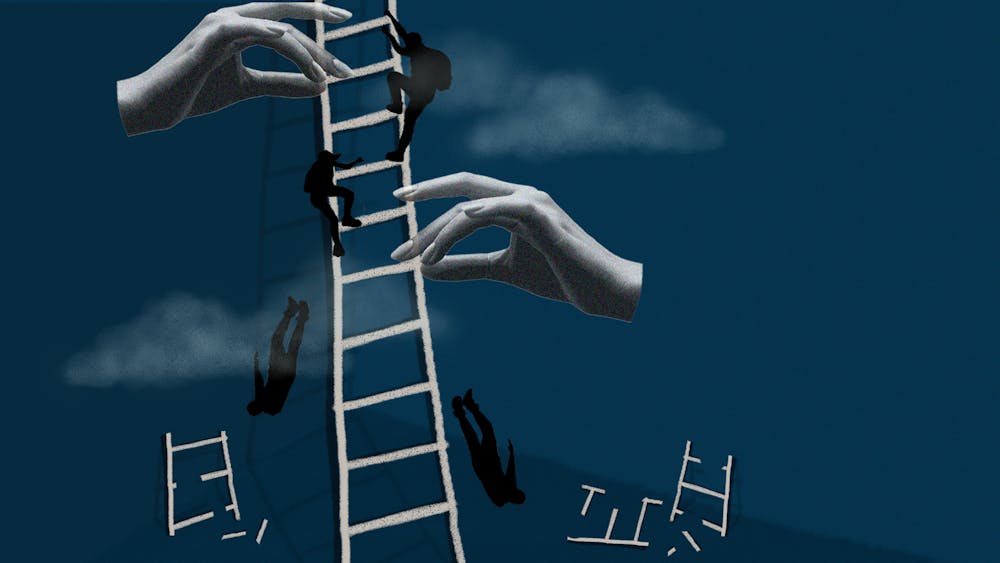
Ever heard the phrase, “College will be the best years of your life?” Or perhaps, “High school is the experience of a lifetime?” Maybe, instead, the anticipated stereotype had a more melancholic connotation, such as, “Adulting sucks,” or “I would give anything to be 18 again.” Whatever the saying, college has long been romanticized.
Why do we buy into this predetermined ranking? It may be because they’re our parents, our siblings, our teachers, a TEDx speaker, or simply because they have seen the sun rise more times than we have.
But the status quo doesn’t have to be followed. We can create our own normal.
There is a futility in letting “convention” make our choices before allowing ourselves to engage in personal cultivation. For first-years about to enter college, new graduates about to start a job, and all the remarkable people who are beginning new chapters, the expectation to conform to a standardized ladder can be incredibly intimidating.
This prescribed path for our future outlooks is a form of temporal-comparison culture. Temporal-comparison culture is “a societal mindset where individuals constantly measure their current achievements, wealth, and life stages against their own past selves or projected future selves.” It’s a grandiloquent term for something that we instinctively do as a society. To me, the trend seems to be that society only places our early educational years on a pedestal, deeming the rest “hard,” “miserable,” and a stage where everyone wishes they could time travel.
But as an incoming Penn first-year this fall, I think that adherence to this absolute fate creates a toxic and inauthentic illusion for us. Everyone sees Penn as “preprofessional,” a school that fosters a fast-paced pipeline culture where everyone seems to have everything figured out. On the other hand, true to its “work hard, play hard” reputation, Penn is also known as the “Social Ivy.” It’s a special kind of paradox, where we are walking in with both academic and social pressures.
In a place already shaped by a melting pot of perspectives, diversity, academic competition, and rigor, having to ensure that our college experience lives up to its glorious reputation can feel overwhelming. It’s a preemptive characterization that pressures us into feeling obligated to pursue experiences rather than choosing them for ourselves.
Dutifully abiding by this societal ladder results in accepting limitations. Post-grad isn’t going to be as fun as undergrad, so why even try? The nine-to-five is just a mindless, monotonous system, so why even try? These resignations lead us to inadvertently cap our personal growth.
We keep climbing the ladder in search of the perfect rung, forgetting that growth was never about reaching a final destination. College doesn’t define us, and there is no singular version of the “college experience” that we are obligated to pursue. What matters is that, with every step we take, we continue to climb higher than where we stood before, whatever that means on our own personal terms. A 2024 study by the Centers for Disease Control and Prevention (CDC) found that 96% of adults in the United States were very satisfied or satisfied with their lives. Clearly, we recognize our own personal agency, and all we need to do is embrace it.
In the age of influencers waking up at 5 a.m. to work out before documenting their marathon training on Strava, or when everyone seems to be completing four internships while still finding time to go out with friends and post the most aesthetic photo dumps on Instagram, it’s easy to feel like the bar is impossibly high.
But it’s important to ask ourselves: Why is that the bar? Someone else’s life, someone else's opinions, and someone else’s rigid structure have nothing to do with our own. It’s unproductive to model our own future entirely off the standards of others. We should enter college feeling completely comfortable doing what feels right for us and have the confidence to uphold that mindset throughout our undergraduate journey.
Joining random clubs, feeling okay about missing a morning workout, not feeling pressured to go out with friends all the time, or simply enjoying the solitude of silence — none of these quiet pleasures should become a lost art because we feel compelled to chase the highs that other people insist we should pursue. Throughout my own college application process, one thing I repeatedly saw on TikTok and rolled my eyes at countless times on Reddit, but now strangely find myself believing, is that you truly are exactly where you’re supposed to be.
In the words of Albert Einstein, “Those who walk alone are likely to find themselves in places no one has ever been before.” Chase your own highs. Create your own balance. Life should be a personal mosaic, not a hierarchy.
Saanvi Vinod is a rising first-year student studying neuroscience from Frisco, Texas. Her email is saanviv@sas.upenn.edu.