The 2025-26 academic year brought increased federal scrutiny, cybersecurity concerns, labor movements, and multiple strategic plans to Penn.
Heightened federal pressure
In July 2025, Penn reached a resolution agreement with the Department of Education to settle a Title IX investigation, becoming the first Ivy League university to do so. As part of the agreement, Penn stripped 2022 College graduate and former swimmer Lia Thomas’ individual records.
At the time, Penn adopted “biology-based definitions” of sex, complying with Title IX “as interpreted by the Education Department.” The changes restored $175 million in previously frozen funding.
Last October, Penn once again dealt with the federal government when it was one of nine universities offered a “Compact for Academic Excellence in Higher Education.” The proposal tied preferential federal funding to significant structural changes, including a five-year tuition freeze, limits on international undergraduate enrollment, and restrictions on the use of race or sex in hiring and admissions.
The University “respectfully” declined to sign the compact the same month, according to an email from Penn President Larry Jameson. He added that Penn had submitted “focused feedback highlighting areas of existing alignment as well as substantive concerns.”
Penn also faced legal scrutiny over alleged campus antisemitism. Last November, the University was sued by the United States Equal Employment Opportunity Commission over a subpoena seeking information related to Jewish employees and campus groups.
Penn argued in December 2026 that it had “cooperated extensively” but would not provide personal information without consent.
RELATED:
Graduate workers overwhelmingly vote to ratify union contract with Penn
Penn rejects White House proposal for special funding treatment
In March, Penn was ordered to comply with the subpoena by May 1. At the time, U.S. District Court Judge Gerald Pappert wrote that the EEOC’s request “easily clears” the legal threshold for relevance.
Last month, Penn’s motion for a stay was granted, allowing the University to refrain from providing information requested by the EEOC until the appeals process is complete.
Cybersecurity concerns
On Oct. 31, Penn experienced a cybersecurity breach after mass emails were sent from University-affiliated accounts linked to the Graduate School of Education. The emails — received by students, faculty, alumni, and parents — contained explicit language criticizing the University.
At the time, a GSE spokesperson called the messages “highly offensive” and “in no way reflective of Penn or Penn GSE’s mission or actions.”
Days later, the University reported the incident to the FBI.
In February, cybercrime group ShinyHunters claimed responsibility for the breach. At the time, the alleged hackers released thousands of pages of internal University files — including donor records, internal communications, and documents related to Penn’s antisemitism response. ShinyHunters wrote in a post on the group’s forum that it leaked the data because the University “did not pay a ransom or cooperate and comply.”
Following the breach, numerous alumni filed class-action lawsuits alleging that the University failed to protect sensitive data and accurately represent the scope of the breach. The petitions were later withdrawn or consolidated by a federal judge.
In April, the Annenberg School for Communication warned its community about separate “advanced social engineering attacks” targeting Penn. The attacks included phone calls and text messages impersonating University information technology services.
Penn also investigated a December 2025 cybersecurity breach involving its Oracle E-Business Suite servers.
Wave of labor organizing
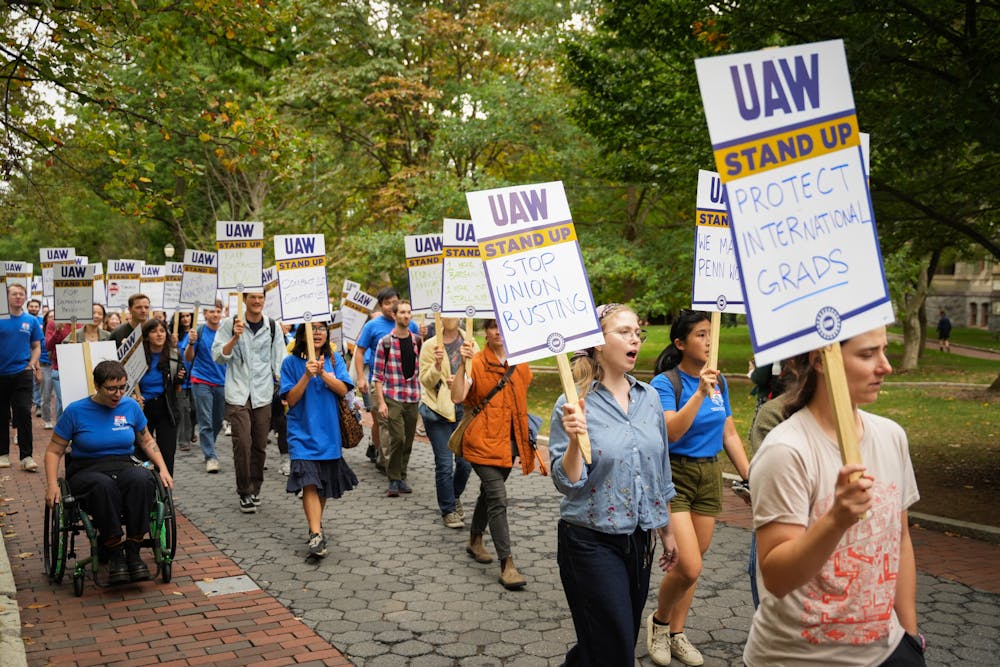
In February, Graduate Employees Together — University of Pennsylvania moved toward a potential strike after over a year of negotiations.
In November, GET-UP — which represents more than 3,700 graduate workers — voted overwhelmingly to authorize a strike. Earlier this year, the union announced that it would indefinitely suspend teaching and research duties if a contract was not met by Feb. 17.
Had a strike taken place, graduate workers would have stopped grading, leading recitations, holding office hours, and conducting certain research activities. Research workers also indicated they would halt new experiments and lab work during the strike period.
Negotiations continued through early February as the University and GET-UP disagreed over compensation, healthcare, childcare, and support for international students.
The groups reached a tentative agreement on Feb. 16, narrowly averting the strike. The ratified contract raised the minimum doctoral stipend and enhanced childcare and medical benefits.
GET-UP later became chartered as UAW Local 5124, formalizing its status within the national labor organization.
Research Associates and Postdocs United at Penn also pushed the University to improve worker conditions. The union proposed a minimum salary of $85,000 for postdoctoral researchers and $103,210 for research associates, in addition to expanded benefits.
Last month, workers at Penn Libraries and the Penn Museum raised concerns over possible changes to employee benefits, including healthcare and retirement plans. A union representative told The Daily Pennsylvanian at the time that the proposed changes signaled a “big red flag” and could reduce existing benefits.
New strategic plans
The University, as well as several individual schools, announced strategic frameworks during the academic year.
In September 2025, Jameson unveiled “Penn Forward,” his first major institutional initiative. The plan — which seeks to address both the “challenges and opportunities” facing higher education — came amid mounting external pressures about the industry’s value.
The framework created six working groups tasked with proposing “bold, implementable strategies” to address current challenges and long-term goals. The initiative solicited input from students, faculty, and staff.
Earlier this year, the School of Arts and Sciences announced its new framework titled “SAS Horizons: Pathways for a Changing World.” The plan included a reimagining of the College of Arts and Sciences’ curriculum, the creation of the Dean’s Horizons Fund, and future renovations to classrooms and labs.
The Annenberg School also introduced “Connected Futures,” its first strategic vision, in April. Dean Sarah Banet-Weiser told the DP at the time that part of her goal was to “remind people why they should have trust in higher education.”
Athletic success
Penn men’s basketball punched their ticket to March Madness this year after a thrilling upset against Yale in the Ivy League championship. The Quakers’ season came to a close in Greenville, S.C., with a 105-70 loss to Illinois in the first round of the NCAA tournament.
Penn women’s squash also won the College Squash Association national team championship for the first time since 2000, beating No.1 Princeton with a score of 5-4 to bring the Howe Cup back to Philadelphia.
The 130th running of The Penn Relay Carnival took place from April 23 to April 25 and saw Penn track and field athletes joined by competitors of all ages on the hill, the field, and the oval. The three days of competition featured new meet and NCAA records, along with three Quakers who took home first place in their respective events.
RELATED:
Graduate workers overwhelmingly vote to ratify union contract with Penn
Penn rejects White House proposal for special funding treatment
Senior reporter Ananya Karthik covers central administration and can be reached at karthik@thedp.com. At Penn, she studies communication and economics. Follow her on X @ananyaakarthik.