

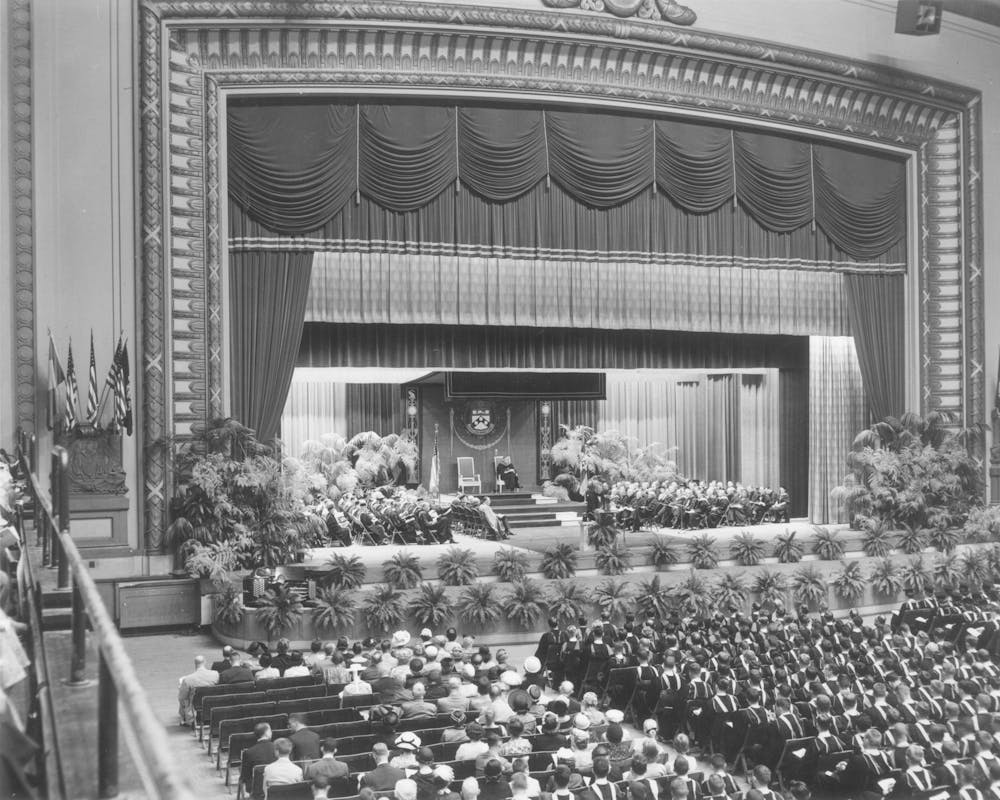
Ahead of Penn’s 270th Commencement, The Daily Pennsylvanian analyzed how the graduation ceremony has evolved over nearly three centuries.
The University held its first Commencement in 1757 at its original Old City campus, just two years after Penn’s charter was established. This year, the ceremony is scheduled for May 18 on Franklin Field and will grant degrees to graduates, recognize honorary recipients, and feature remarks from various speakers.
At the time of Penn’s founding, commencement ceremonies began with a procession from the building now known as Independence Hall in downtown Philadelphia.
Historically, graduating students delivered orations, debates, and poems in languages such as English, Latin, and Greek during the event. The ceremony also included sermons from Anglican officials — reflecting Penn’s early ties to the Church of England.
Following the American Revolution, Penn revised graduation protocols under its 1780 rechartering as the “University of the State of Pennsylvania.”
Public officials, including members of the Continental Congress and Pennsylvania Assembly, increasingly attended the ceremonies — although student achievement remained the central focus.
The University also began awarding honorary degrees to “heroes of American independence,” including George Washington, Thomas Paine, and the Marquis de Lafayette — all of whom were bestowed with the distinction in the 1780s.
Following Penn’s 1802 relocation to Philadelphia’s Ninth Street, the ceremony was held in numerous venues. Rather than following the traditional route through the city, the University Board of Trustees introduced processional stops at Washington Hall and Masonic Hall, among other downtown locations.
RELATED:
Presidential historian, author Michael Beschloss to deliver 2026 Commencement address
Pennsylvania Gov. Josh Shapiro to address Penn Carey Law graduates at 2026 Commencement
The University regularly hosted Commencement at the Musical Fund Society by the 1830s. During that time, the ceremony often featured speeches from 10 graduating students, which concluded with a valedictorian address. This tradition continued into the Civil War, despite the Confederacy’s threats to break through Union defenses and into Philadelphia.
“Even as soldiers massed for Pickett’s Charge, Penn’s Trustees and faculty conducted the Commencement of 1863 and the candidates for degrees demonstrated their well-earned mastery of the liberal arts and sciences,” a Penn Libraries Commencement note stated. “It was an incredible moment in the history of the University of Pennsylvania.”
Although the University moved to West Philadelphia in 1872, its Commencement did not follow suit until the next century. During the late 19th century, the ceremony expanded to include graduating women and students of color — as well as graduates from all academic programs.
The procession — which traveled from 34th and Walnut streets to the Academy at Broad and Locust streets — was a “public spectacle.” University officials led the graduates in the 20-block march by horse-drawn carriage. However, the march was discontinued in 1922 due to complications of coordinating thousands of participants.
The late 19th century also saw structural changes in the ceremony. In 1895, the University removed student speeches from the program, adding opening remarks by the provost. An honorary degree recipient began delivering the keynote address — a role now held by the annual Commencement speaker.
Since 1910, the ceremony has remained largely unchanged — though Commencement speakers have become more diverse. The share of women speakers has increased by 22% since the early-to-mid 1900s, while 38% of speakers since 2000 have been non-white.
There has also been an increase in speakers representing more diverse fields — such as advocacy and the arts — though politicians continue to constitute a significant portion.
The ceremony was later hosted at both the Palestra and Convention Hall, before settling into its permanent home at Franklin Field in 1986.
The COVID-19 pandemic marked the graduation tradition’s most recent disruption. Penn held Commencement virtually in 2020, honoring its graduates during an in-person ceremony two years later — in May 2022.
This year, United States presidential scholar and best-selling author Michael Beschloss is set to deliver Penn’s Commencement speech.
RELATED:
Presidential historian, author Michael Beschloss to deliver 2026 Commencement address
Pennsylvania Gov. Josh Shapiro to address Penn Carey Law graduates at 2026 Commencement
Senior reporter Aidan Shaughnessy covers student life and can be reached at shaughnessy@thedp.com. At Penn, he studies philosophy, politics, and economics. Follow him on X @aidannsh.


