

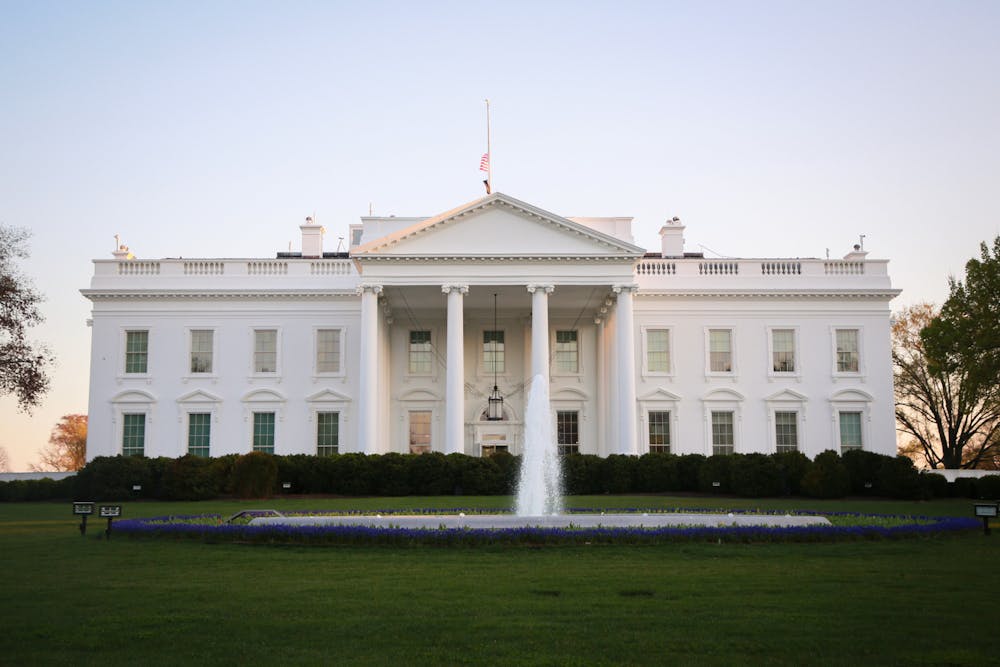
Penn is one of nine schools that the White House approached on Wednesday requesting adherence to a set of principles in order to receive preferential funding treatment, according to The Wall Street Journal.
The memo — titled the “Compact for Academic Excellence in Higher Education” — laid forth guidelines that would govern Penn’s admissions, pricing, and hiring practices. In exchange, higher education institutions that sign the agreement will receive “multiple positive benefits,” including “substantial and meaningful federal grants.”
Universities are “free to develop models and values other than those” offered in the memo, but only if the institution chooses to forgo federal benefits, the document stated.
A University spokesperson declined The Daily Pennsylvanian’s request for comment. The White House could not be reached for comment amid the ongoing government shutdown.
On Sept. 28, The Washington Post reported preliminary details about the compact agreement from two senior White House officials. Three days later, The Wall Street Journal reported the contents of the memo — and the delivery of the letters — in full.
If Penn signs the compact, the University would be required to ban the use of race or sex in hiring and admissions, and to disclose all foreign funding records.
In April, 1968 Wharton graduate and President Donald Trump announced a new policy requiring universities to disclose sources of foreign funding in greater detail.
A month later, the Department of Education opened an investigation into Penn’s foreign funding records, claiming that a review of the University’s financial reports revealed “inaccurate” and “incomplete” disclosures.
According to Bloomberg News, the pledge instructed universities to adopt policies that protect academic freedom and abolish “institutional units that purposefully punish, belittle, and even spark violence against conservative ideas.”
The emphasis on “conservative ideas” comes amid several moves by the Trump administration intended to crack down on “Radical Left violence.” A Sept. 25 White House memo was criticized by Penn faculty and legal experts, who warned it may have a “chilling effect on free speech” at Penn and other universities.
In addition, the Oct. 1 memo also requested that employees of the universities abstain in their official capacity from actions or speech related to politics.
Bloomberg also reported that schools entering the compact must ban political demonstrations with the potential to disrupt study locations or harass students.
The memo additionally outlined a requirement that universities freeze tuition for five years, the WSJ reported. In February, the University Board of Trustees voted to raise tuition costs by 3.7% for the 2025-26 academic year — a practice that has been consistent across recent years.
It also included a provision instructing institutions to cap international undergraduate enrollment at 15% and require that applicants take the SAT or a similar standardized test.
According to University demographic reports, 15% of both of Penn’s undergraduate classes in 2028 and 2029 were composed of international students. Penn reinstated the standardized testing requirement for all undergraduate applicants on Feb. 14 for the 2025-26 admissions cycle.
In a statement to the WSJ, White House Senior Advisor for Special Projects May Mailman said the schools were "good actors" — adding that each has a “president who is a reformer or a board that has really indicated they are committed to a higher-quality education."
She added that the Trump administration does not plan to limit federal funding to schools that sign the compact, but that the selected universities would be given priority for grants when possible and provided with invitations for White House events and discussions with officials.
Mailman previously told the DP that Penn set a positive tone during negotiations with the federal government this summer by recognizing it had an “unavoidable need for a relationship” with agencies in Washington. The University’s understanding and ability to “have a conversation like adults” earned it a place on the government’s “listening side,” Mailman said in July.
That month, Penn reached a resolution agreement with the Department of Education to settle ongoing Title IX violations. As part of the resolution, the University removed 2022 College graduate and former Penn swimmer Lia Thomas’ individual records, issued a public statement specifying that Penn Athletics “will adopt biology-based definitions for the words ‘male’ and ‘female’ pursuant to Title IX and consistent with President Trump’s Executive Orders,” and privately apologized to affected athletes.
The recent memo asks schools to maintain “single-sex spaces” in on-campus locker rooms and bathrooms — going beyond the settlement’s requirement that athletic “intimate facilities” be separated by sex.
Vanderbilt University, Dartmouth College, the University of Southern California, Massachusetts Institute of Technology, the University of Texas at Austin, the University of Arizona, Brown University, and the University of Virginia were also named in the memo.
Of the schools that were offered an agreement, Penn and Brown were the only ones to face investigations from the White House regarding their federal Title IX compliance. Brown negotiated terms with the federal government to settle investigations into its compliance with Title IX in July.
Several other universities asked to join the “compact” were investigated due to their response to federal orders mandating the elimination of diversity, equity, and inclusion programs.
Former UVA President James Ryan faced criticism for the school’s resistance to federal orders mandating the elimination of DEI policies. After opening a civil rights investigation into the university, the Department of Justice offered a settlement conditional on Ryan’s resignation.
Both Vanderbilt and MIT also faced investigations into their alleged “race-exclusionary practices” within graduate programs. In response to federal pressure, MIT shut down its DEI office in May.
Dartmouth has largely remained out of the federal government’s crosshairs. The university — which was the only Ivy League school not to sign a letter in April opposing the Trump administration — has also avoided investigations from both the DOJ and the Education Department in contrast to peer institutions.
Isha Chitirala is a News Editor at The Daily Pennsylvanian and can be reached at chitirala@thedp.com. At Penn, she studies economics and political science. Follow her on X @IshaChitirala.
Finn Ryan is a News Editor at The Daily Pennsylvanian and can be reached at ryan@thedp.com. At Penn, he studies political science and Russian. Follow him on X @FinnRyan_.


