

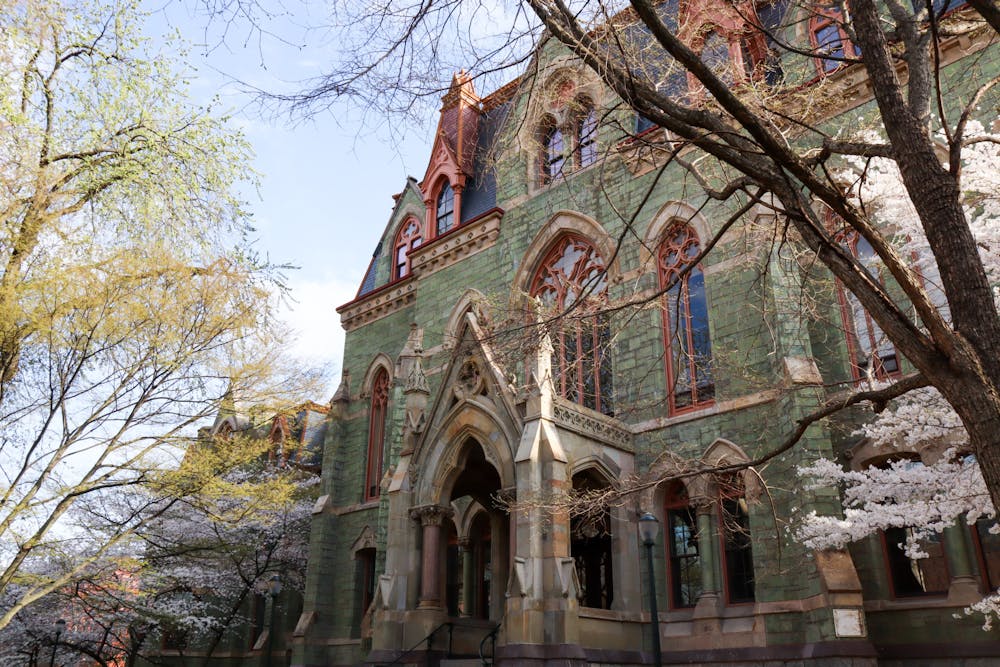
Penn launched a variety of academic initiatives across its four undergraduate and 12 graduate schools this academic year.
These changes — ranging from strategic frameworks to curriculum revisions — came amid new technological developments, mounting external pressures, and intensifying questions about the value of higher education. The Daily Pennsylvanian looked back at the initiatives Penn launched in the past year and how they will impact the University’s academic landscape.
Last September, Penn President Larry Jameson announced a new University-wide strategic framework titled “Penn Forward.” The framework, Jameson’s first major institutional effort as Penn’s 10th president, established six working groups designed to help the University adapt to “new challenges and opportunities” facing higher education.
At the time, Jameson told the DP that the framework, which builds on the 2023 “In Principle and Practice” strategic vision established by former Penn President Liz Magill, aims to “develop more tangible, concrete, actionable, timely projects and activities.”
The working groups — which are comprised of undergraduate, graduate, and postdoctoral students as well as faculty, staff, and administrators — developed strategies to address undergraduate education, graduate training, academic research, global opportunity, affordability and access, and University operations. The six groups were also responsible for developing policies on artificial intelligence use on campus.
Earlier this year, the groups concluded their work and submitted recommendations to the Penn Forward steering committee for review.
Jameson updated the Penn community on the framework’s rollout in an April 15 email. The message outlined nine new initiatives — including programs to redesign tuition and financial aid, strengthen Penn’s position as a national AI leader, and expand the University’s global influence.
The College of Arts and Sciences also launched several school-specific initiatives this past year.
RELATED:
Meet the team behind a Penn student’s award-winning veterinary AI startup
How Penn retains ownership of federally funded research, encourages commercialization
The school piloted its College Foundations program during the 2025-26 academic year, introducing first-year students to a “broad liberal arts education” through an updated curriculum.
With four new courses, the curriculum allowed students to fulfill six College requirements in their first year. The courses included a writing seminar, a first-year seminar, a qualitative “Kite” course, and a quantitative “Key” course.
According to College Dean Peter Struck, the program aimed to help students explore a broad range of subjects during their first year and gain exposure to a variety of possible majors. Last year, students expressed initial mixed reactions to the pilot program in conversations with the DP.
In April, College faculty voted to adopt a new curriculum that featured the College Foundations program alongside changes to the distribution of general education requirements and a restructuring of elective choices. The revised program — set to take effect for the Class of 2031 — passed with 70% approval.
Under the new general education requirements, courses will fall under three divisions: humanities and arts, social sciences, and natural sciences. College students will be required to take at least 12 courses in one division, five in another, and three in the third.
The College also announced a new strategic vision titled “SAS Horizons: Pathways for a Changing World” in February.
SAS Horizons outlined a reimagined undergraduate curriculum, established the “Dean’s Horizons Fund” to support on-campus research, and launched a project to renovate Penn’s laboratories and classrooms.
Among the buildings to be renovated is David Rittenhouse Laboratory, whose facilities, according to the project description, “no longer meet the demands of modern science.”
Aligning with the SAS Horizons framework, the College also announced a new academic initiative — “SAS Commons” — last month.
Slated to launch in August, SAS Commons will include several “courses, symposia, workshops,” and other initiatives centered around a single theme that will change biennially.
The inaugural theme, “Democracy and Knowledge,” will be led by history professor Sophia Rosenfeld. School of Arts and Sciences Dean Mark Trodden wrote to the DP in April that the theme aims to encourage incorporating natural science disciplines with humanities topics.
On April 13, Annenberg School for Communication Dean Sarah Banet-Weiser announced the release of the school’s first strategic vision, “Connected Futures.” The framework stemmed from a two-year-long ideation process that consulted students, faculty, and staff to identify potential areas of improvement.
After the announcement, Banet-Weiser told the DP that the plan seeks “to tell the story of what Annenberg does.”
The vision consists of four pillars centered on creating new research networks, strengthening the school’s physical resources, developing academic programming, and fostering partnerships beyond the University.
In addition to strategic frameworks, several of Penn’s schools established plans to support research efforts and curriculum development this year.
This January, the Perelman School of Medicine received an $8 million gift to integrate AI, data science, and other technologies into the school’s curriculum.
RTW Foundation founder and co-chair Rod Wong, who provided the donation, told the DP that the gift was intended to help “prepare students for a career in innovation.”
“President Jameson and Penn leadership have kept what unleashes the potential of students a top priority, and are putting their energy into making learning more efficient,” Wong — who graduated from the Medical School in 2003 and serves as a Penn Medicine Board of Trustees member — wrote in January.
That same month, the University also launched a $10 million StartUP Fund program to invest in startups founded by Penn researchers.
According to Chief Innovation Officer John Swartley, the program will serve as a resource not only for biotechnology and pharmaceutical companies, but also for AI, energy, and financial technology.
“The fund is intended to be the earliest stage capital for ideas that are coming out of the entire University,” Swartley explained in a January interview.
In March, the School of Engineering and Applied Science launched the Futures Fund, which will “provide timely, flexible support for leading-edge research and educational advancements over the next five years."
Amid an uncertain federal funding landscape, the $200 million fund will incorporate monetary support from several philanthropic partners, including Penn Engineering alumni and industry leaders.
RELATED:
Meet the team behind a Penn student’s award-winning veterinary AI startup
How Penn retains ownership of federally funded research, encourages commercialization
Senior reporter Norah Findley leads coverage of science and health and can be reached at findley@thedp.com. At Penn, she studies environmental studies. Follow her on X @NorahFindley_.


