

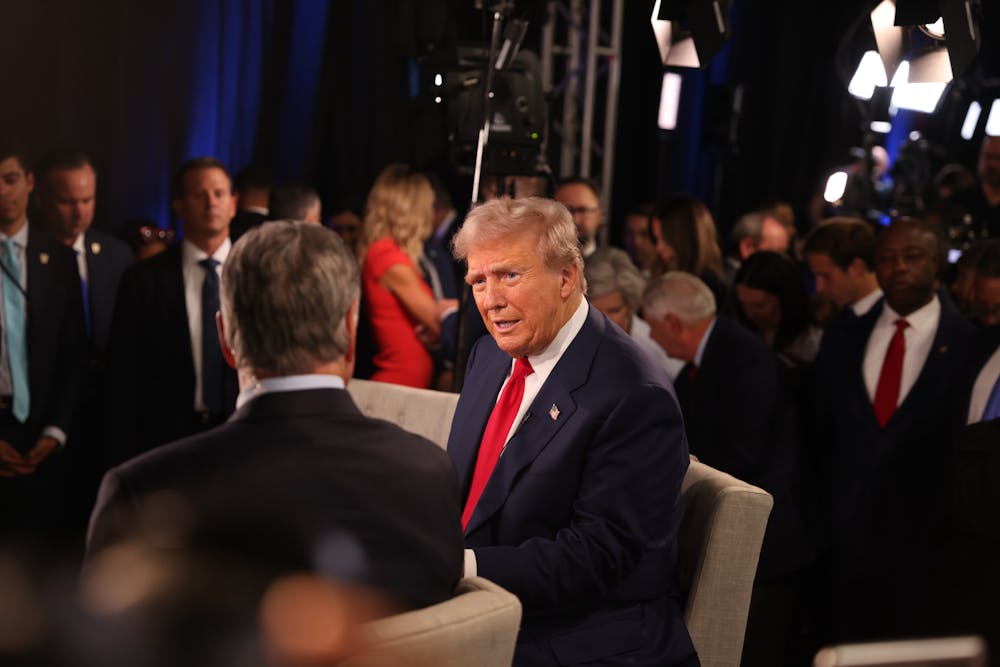
The 2024-25 academic year was distinguished by increased national scrutiny and significant University-wide policy changes following 1968 Wharton graduate and President Donald Trump’s reelection to the highest political office in the United States.
2024 presidential election
In September 2024, Trump and Democratic candidate Kamala Harris engaged in their first and only presidential debate at the National Constitution Center — just miles away from Penn’s campus. In response to Harris’ reference to a Wharton Budget Model prediction about the effects of possible tariffs, Trump stated that he “went to the Wharton School of Finance, and many of the professors, the top professors, think my plan is a brilliant plan.”
While Trump invoked his Ivy League credentials and affiliation with Penn during the debate, he began to distance himself from the University as his third presidential campaign came to a close.
Penn attracted additional national attention when 1999 College graduate and singer John Legend, model Chrissy Teigen, and author Jack Schlossberg visited campus in October 2024 to advocate for youth voter participation and Harris’ campaign. Student organizations — such as Penn Leads the Vote — encouraged voting through tabling events across campus.
Though Penn overwhelmingly voted blue — with 81.6% of campus voting for Harris relative to 16.3% for Trump — the latter won both the swing state of Pennsylvania and the presidency after a highly contentious election.
Student activism
August 2024 marked the beginning of an academic year during which Penn operated under temporary open expression guidelines — first implemented that June. The document banned encampments and overnight vigils on campus, restricted the use of noise amplification devices, and required events in most spaces to be registered two weeks in advance.
RELATED:
Penn updates faculty on budget cuts to schools, centers for next fiscal yearHow three Penn professors adapted their spring 2026 courses to the second Trump administration
An executive order — signed days after Trump’s inauguration in January 2025 — directed federal agencies to identify and deport non-citizen participants in pro-Palestinian protests. In April 2025, eight Penn affiliates’ visas were revoked by the Department of State — seven of which were later reinstated.
Federal scrutiny
Trump began implementing a series of executive orders targeting higher education in the first days of his second term — including a freeze on federal funding and grants.
The following month, the National Institutes of Health implemented a funding cut that would cost the University $240 million. Penn President Larry Jameson wrote that the cuts would “severely harm our highly impactful research mission” in an campus-wide email at the time.
Penn and 12 other institutions of higher education then sued the NIH — after which, the funding cuts were frozen. However, the University still directed department chairs to significantly reduce graduate admissions due to reduced federal funding opportunities. Faculty at the Perelman School of Medicine, for example, were instructed to cut admissions for its fall Ph.D. cohort by approximately 35%.
The University also implemented several “proactive financial measures” in March 2025, including a hiring freeze and a review of capital spending.
Institutions were also called upon to eliminate diversity, equity, and inclusion programs that might violate federal civil rights laws to maintain eligibility for federal funding in a January 2025 executive order from the Trump administration. The next month, the Department of Education threatened to revoke federal funding for universities that failed to remove DEI initiatives within two weeks.
All mentions of diversity and affirmative action were removed from Penn websites on Feb. 11, 2025 — and Penn’s central DEI website was scrubbed three days later. A few weeks later, the Wharton School renamed its DEI concentration to “Leading Across Differences.”
Amid scrutiny by the federal government, Jameson was appointed to serve as Penn’s 10th president following an interim tenure of 15 months.
Title IX investigation
In February 2025, the DOE began investigating Penn for Title IX violations related to the University allowing 2022 College graduate and transgender woman Lia Thomas to compete on Penn’s women’s swimming and diving team in the 2021-22 school year. The NCAA changed its policy to abide by the order shortly after.
The Trump administration announced that it would freeze over $175 million in federal funding to Penn the following month, citing the University’s failure to ban transgender women from participating in women’s sports.
Though Penn motioned to dismiss the case, the Education Department announced that the University was in violation of Title IX in April 2025. The Department’s Office for Civil Rights included a “Resolution Agreement” requiring Penn to respond to three demands: issuing a statement affirming compliance with Title IX, restoring accolades to “female athletes … misappropriated” by transgender athletes, and sending letters to affected athletes.
RELATED:
Penn updates faculty on budget cuts to schools, centers for next fiscal yearHow three Penn professors adapted their spring 2026 courses to the second Trump administration
Senior reporter William Grantland leads data and enterprise reporting and can be reached at grantland@thedp.com. At Penn, he studies international relations. Follow him on X @WmGrantland.


