

Penn’s graduate workers union overwhelmingly voted on Friday to authorize a strike, following over a year of contract negotiations with University administrators and a three-day-long voting period that began on Nov. 18.
Ninety-two percent of votes cast were in favor of authorizing a strike, approving Graduate Employees Together — University of Pennsylvania’s bargaining committee to call a work stoppage at its discretion. If a strike is called, Penn graduate workers — a group that encompasses those who are employed in teaching or research roles during the fall 2025 or spring 2026 semesters — will stop performing work duties.
The voting process — which began Tuesday at 9 a.m. and closed at 9 p.m. on Thursday — took place via an online secret ballot. GET-UP’s FAQ page describes a potential strike as a “last resort,” adding that the decision to strike will only be made if the bargaining committee deems that the circumstances “necessitate” it.
The next bargaining session is scheduled for Dec. 4, according to the union.
Two thousand four hundred and sixteen votes were cast — 2,229 in favor of authorization and 187 against. According to GET-UP’s Friday press release, more than 70% of the roughly 3,400 eligible employees voted in the election.
“After one full year of negotiations, Penn administrators have still failed to agree to a contract that includes fair wages, improved benefits, and strong support for international workers,” GET-UP wrote in the press release.
The statement also emphasized that the union has “tried to engage the university through other means,” including an October picket line, public petitions, and a November press conference. GET-UP has been negotiating its contract with Penn during bargaining sessions since October 2024.
“The University has been engaged in good faith negotiations with the Union since last October, reaching 21 tentative agreements and completing 35 bargaining sessions — with four sessions planned for December,” a University spokesperson wrote to The Daily Pennsylvanian. “We believe that a fair contract for the Union and Penn can be achieved without a work stoppage, but we are prepared in the event that the Union membership strikes.”
The spokesperson added that should a strike be called, “the expectation is that classes and other academic activities will continue.”
During a strike, workers will “participate in picket lines around campus to increase the visibility of the strike,” according to the FAQ. The strike will last as long as it takes for Penn administrators to agree to the terms of GET-UP’s contract, or until graduate workers “collectively decide to cease striking,” according to the union.
GET-UP’s ideal contract includes improved pay and benefits for graduate workers, support for international and immigrant workers, and protections against discrimination and harassment.
“Our elected Bargaining Committee may choose to set a deadline at which point graduate workers would begin striking if Penn has still not reached a fair agreement,” the union wrote. They also affirmed that they “hope that Penn will stop stalling our negotiations,” in order for a fair contract to be reached.
The United Auto Workers’ Strike and Defense Fund will be available to workers who choose to participate in a work stoppage if a strike is called. The fund offers $500 per week, and will provide additional support should Penn pause health care benefits.
As an employer in Pennsylvania, Penn has the legal right to take away health care benefits from striking workers, according to the FAQ.
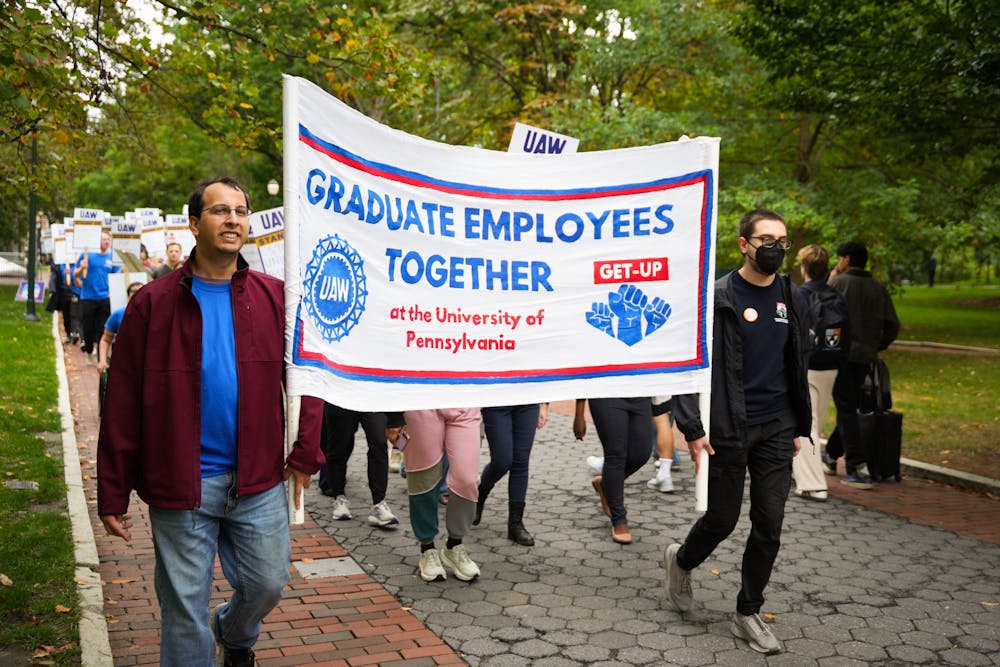
The possibility of a graduate worker strike was first raised at GET-UP’s informational picket on Oct. 8. At the demonstration, the union announced that it was gathering strike pledges, which graduate workers could sign to declare their intention of voting in favor of authorizing a strike.
The vote to authorize a strike was officially announced at a rally on Nov. 3.
The strike authorization follows similar union mobilization across campus this year. In July 2025, Penn Museum Workers United unanimously voted to authorize a strike during negotiations with the University. The union then ratified its second contract in late July.
Other campus organizations have expressed support for graduate workers in the event of a strike. After strike pledges were announced in October, Penn’s chapter of the American Association of University Professors released a memo that issued guidance to faculty on how they can support graduate workers during a potential strike.
AAUP-Penn’s guidance was issued in response to a document circulated by Penn's Office of the Vice Provosts for Education, which gave instructions on how faculty should “maintain teaching continuity” in the event of a strike. The faculty group responded with an annotated copy of the document, denouncing its language as “strikebreaking.”
On their FAQ page, Penn’s Office of the Provost wrote that graduate students can choose to continue work during a strike and that the process may impede individual academic progress.
Correction: This article has been updated to reflect that GET-UP has been engaged in bargaining with the University for more than a year and that the vote was in favor of strike authorization, not unionization. The DP regrets the errors.
Staff reporter Daniya Siddiqui covers campus advocacy and can be reached at siddiqui@thedp.com. At Penn, she studies political science.


