Tradition. If there was ever a word to represent Penn, it would be this one. The 19th century architecture. The path on Locust Walk. Even the Benjamin Franklin statue that fraternity brothers piss on. There’s no denying that the Penn prestige was part of the reason we applied, but when does prestige become a prison? When do our traditions begin to trap us?
I don’t think I’m the only one who notices the serious complaint epidemic that exists on our campus. Whether it’s long club meetings, never-ending internship applications, or general academic anxiety, we find it far too easy to list the cons and impossible to name the pros. Most times, it’s second nature to blame Penn — not because we’re drowning, but for the lack of a life jacket. And to be fair, there are several events I can name where our school did almost nothing to improve students’ wellbeing. But when it comes to a toxic campus culture, it might be time to start looking inward.
Throughout Penn’s 285-year-long existence, I am certain no student ever expected their time here to be easy. Most of us arrived here not just prepared for, but excited by the prospect of a challenge. For those who submitted their scores, we know the average Penn student has over a 1510 SAT score, a 35 ACT score, and some of the most impressive extracurriculars known to man. And yet, therein lies the problem: we’ve become so used to a challenge, we accept the traditions that make our lives impossible. And consequently, at any hint that this system of stress might improve, instead of relaxing, we resist.
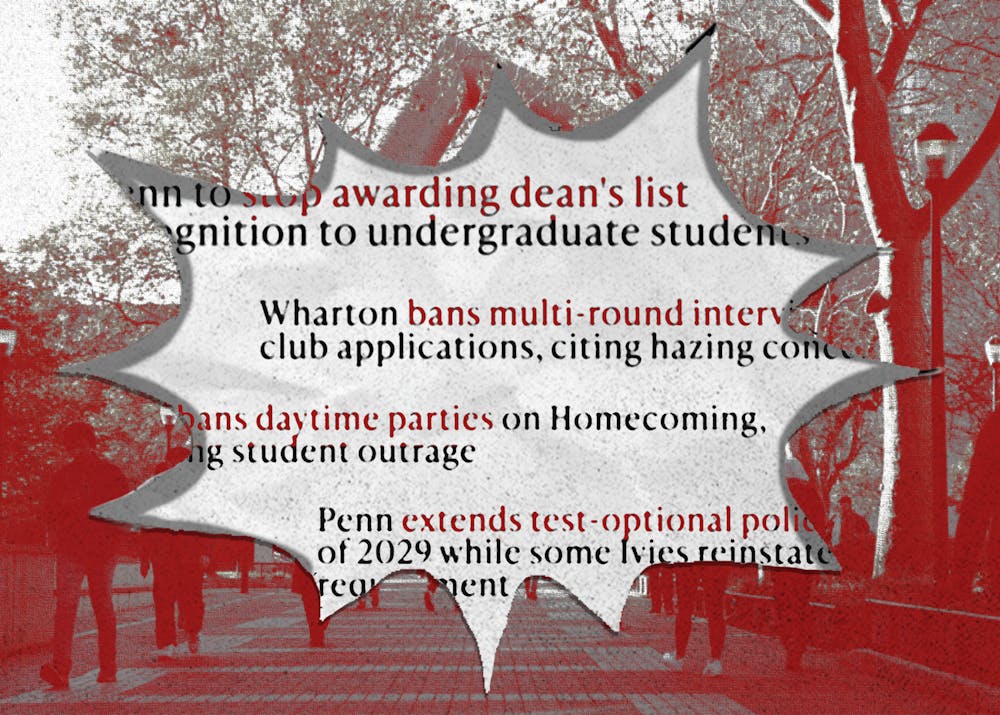
The fact is that even if Penn did everything to acknowledge the hyper-exclusivity and the academic anxiety, it wouldn’t make a difference if the students aren’t willing to part with these traditions in the first place. Penn might’ve removed the Dean’s List, but it doesn’t mean we don’t talk about our GPAs. Wharton ended multi-round interviews for clubs, and students now call them “coffee chats.” And even if they somehow were to forbid club applications for first years, kids would still find a way to dirty rush. Let’s face it: Penn will never change, but it’s not on them, it’s on us.
There seems to be this misunderstanding that Penn students maintain stressful lives because they like to suffer, but the truth is worse. It would be more understandable if we suffered for suffering’s sake, but we conform to such stressful systems because like everything else, it looks better on paper. We join a million clubs, take more credits than should be allowed, and get our master’s degrees for fun. Nobody talks about how their bodies scream for a break even as they adorn their classmates’ Instagram feeds with grins. What I’ve learned at Penn is that sometimes tradition isn’t throwing toast or running naked outside — it’s struggling with a smile. And when the majority of students have sacrificed their personal lives to gain the perks that come with studying here, they learn to live with the pain if that’s what it takes.
But there’s far more to life than leadership positions in clubs and 90th-percentile test scores in organic chemistry. The issue is that we’re nowhere near to coming to that realization without acknowledging the existence of an issue in the first place. It’s true that Penn might not be our friend, but it’s definitely not the enemy either. No, our enemy is staring at us in the mirror. And it’s about time we fight back.
Nobody can deny the importance of ambition or the necessity of sacrifice to achieve one’s goals, but we don’t have to resign ourselves to being miserable. Prestige doesn’t have to be a prison and tradition only traps us if we let it. So, close the laptop once in a while, stop checking LinkedIn every two seconds, and push beyond convention. For the sake of our school and our sanity, we must remember old habits die hard, but we don’t have to die alongside them.
LINDSAY MUNETON is a College junior studying sociology from Bergenfield, N.J. Her email address is lmuneton@sas.upenn.edu.

Lindsay Muneton is a College senior studying sociology from Bergenfield, N.J. Her column focuses on student culture and identity. She currently serves as a Deputy Opinion Editor and can be reached at lmuneton@sas.upenn.edu.