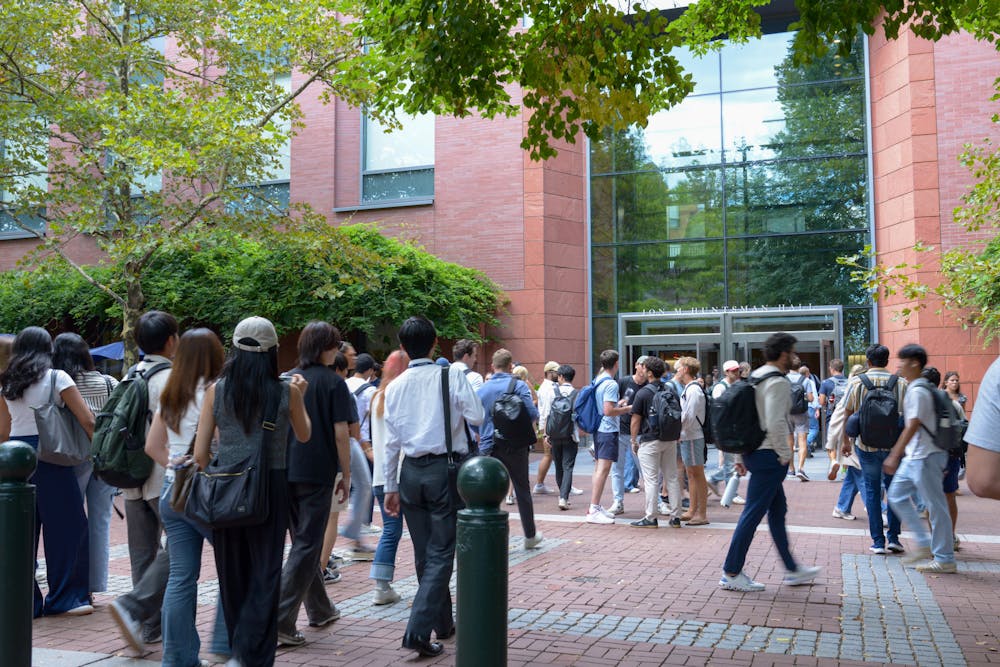
“Where is your Penn pride?” I remember hearing this question from my friend after getting stuck behind a swarm of high schoolers touring our campus during my first year. These days, following certain administrative policy changes, a similar question rings in my head for different reasons: Where exactly do we come together as a school?
Every school has its unifying force: The University of Notre Dame has the brawn, the Massachusetts Institute of Technology has the brains, Harvard University is Harvard University, but where do we come into play? We might mention the Wharton School, but that doesn’t seem right to say when we have three other undergraduate schools (yes, they matter too). And in the era of institutional neutrality, I would argue that Penn comes together not from a mutual yearning for community or social change, but from a deep inclination to uphold just that: neutrality. The topics that go unacknowledged and the current events we do not mention stand out more to me than the ones we do. We are no longer the school of brilliant academics or highbrow thinkers; we are now officially the school of proud sellouts.
You would have to be living under a rock to forget Penn President Larry Jameson’s statement on neutrality from the previous year. It is easy to believe that these statements have no bearing on our academic careers or even our personal lives, but it’s actually the opposite. Though Penn’s website encourages students to pursue interdisciplinary research or a life of public service, Penn’s compliance in response to highly historic geopolitical events simply encourages otherwise. In fact, there seems to be a phenomenon I’ve noted among the majority of classmates, friends, and even myself: The longer students remain at Penn, the less their passion remains.
How many times have you seen your friends forgo their dreams to enter another preconsulting route? How many times have you had conversations with students who always seem to skirt around their own political affiliations? How many times have you encountered people who drop a class they deem interesting because attendance is mandatory, it has a “no-tech” requirement, or the workload is too high? It is completely possible that none of these particular statements ring a bell, but it’s impossible to deny that Penn students exist in this bubble of apathy.
There is nothing inherently wrong with Penn taking a more impartial stance; some people would even go so far as to classify its neutrality as mere open-mindedness. But in the larger context, when dealing with a long-historied institution started by one of the Founding Fathers, it’s a little ironic to be the school that pleads the fifth. We call ourselves an Ivy League school, reaping all the benefits of being classified as such, but it’s a fair case to make that Penn can’t even begin to compare with a university like Harvard and other colleges that didn’t back off without a fight. As such, it’s not enough that we sell out; we are worse because we settle for the decisions that are most convenient simply to maintain our status.
Obviously, there are always exceptions, and at Penn, these are the students who are willing to break the mold. There are students who are willing to be put on academic probation or have their visas rescinded for an important cause. On a smaller scale, there are also plenty of students who are not sacrificing their initial plans to work in investment banking or defense contracting. But how many of our classmates really check these boxes? In this bubble, it is not that there is an absence of students who care, but rather a severe lack of individuals who are willing to burst the bubble to show they do.
It is true that we don’t always have the right to criticize our fellow classmates for taking the road more traveled by. Coming from a working-class background, I recognize how much pressure there is to pursue lives that seem more stable, more beneficial to our 10-year plans, and less detrimental to our social lives. Besides, if a globally renowned institution like Penn stands for nothing, then why should we act any differently?
Even still, coming from someone who used to loudly declare that “selling out” was a choice as valid as any other, we need to reflect on when “selling out” became less of a Sidechat joke and more of a campus culture. Penn might have become a school of neutrality — in other words, a school of nothing — but we all came here to do something. Have pride in your University, put it on your resumes and Hinge profiles, but let us not forget, we are people first and Penn students second.
SEE MORE FROM LINDSAY MUNETON:
LINDSAY MUNETON is a College junior from Bergenfield, N.J. studying sociology. Her email is lmuneton@sas.upenn.edu.

Lindsay Muneton is a College senior studying sociology from Bergenfield, N.J. Her column focuses on student culture and identity. She currently serves as a Deputy Opinion Editor and can be reached at lmuneton@sas.upenn.edu.