It’s that time of year again. And no, I am not talking about Penn students’ post-Halloween weekend depression or even the holiday season. Any of these experiences would be far more fun than what most upperclassmen are dealing with currently: the season of off-campus leasing. It is the Penn-honored sophomore tradition of scrambling for the right location, the right roommates, and, without a doubt, the right rent. But what about the ones left behind at the bottom of the Penn housing hierarchy? What about the upperclassmen who feel stuck with on-campus housing?
As college students, we expect to go through certain rites of passage like the first party or the first failed exam. A first apartment or house isn’t any different. Students look forward to finally having an actual kitchen and sufficient space to decorate and create a place to truly call home. And it is almost always cheaper to lease than stay on campus, either because of the housing costs or the rats. Even so, there is one invisible benefit to living off-campus that I would argue defines the experience more than affordability or independence: the symbolic status.
Don’t get me wrong, finding and signing a lease is stressful for anyone, no matter the reasoning. Penn students have spoken out on coding violations at their properties or failed city inspections, which, considering the amount of Penn students who live out of state, doesn’t sound too pretty. I’ve heard countless stories of landlords who refuse to give back security deposits or fire alarms that go off if the shower is steaming. Obviously living off-campus isn’t always paradise; there are definite disadvantages to living at HamCo as opposed to Harrison.
And yet, movies make it seem like dorm living is a quintessential part of the college experience. At Penn, they require us to live on-campus for two years, on the assumption that by living in a college house, we will form our own communities. Unsuprisingly, there are students who feel the complete opposite. But if we hold this assumption, where does this community go when time is up and dorm buildings turn into burdens instead of blessings? For upperclassmen on-campus, their peers disappear.
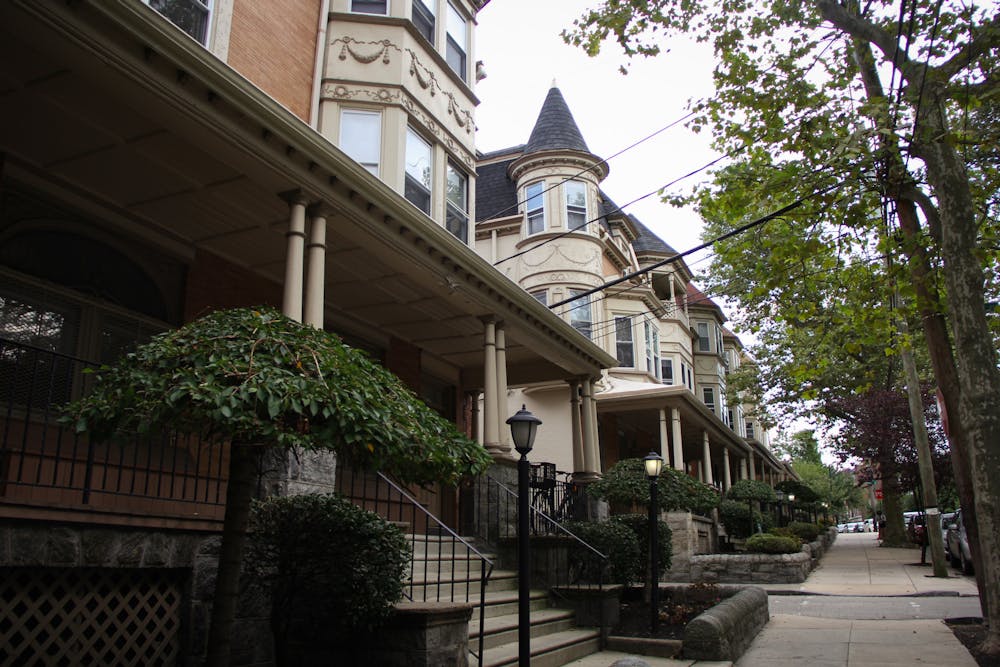
It might not seem intuitive, but living off-campus sends a sign to acquaintances and friends alike that they've moved on. Off-campus students host the housewarmings and pre-games with their porches and yards. It’s our first taste of adulthood and the best part? Even if we don’t live together, by living-off campus we do it together. As such, for the upperclassmen who stay on campus, either for financial or personal reasons, there is an unwanted feeling of isolation as they remain in dorms, unable to cross over from student life into their peers’ adult life.
The main assumption with living on-campus as an upperclassmen is for financial reasons. Even if highly-aided students receive a refund to live off-campus, it doesn’t include security deposits or utility bills. Students who don’t qualify receive no help at all. Consequently, students here, especially those with larger financial means, either feel pity or awkwardness when the news is revealed. For some students, the question “where do you live?” is a commonality, but for others, it’s just another social barrier.
On the surface, this issue feels very individual, but we shouldn’t neglect the university’s role in perpetuating this social divide. Other universities like Princeton or UCLA guarantee their students four-year housing, schools that in some cases have larger student bodies. Penn might claim that they don’t possess the space to guarantee four-year housing, but why require second-years to live on-campus? If it was a simple case of students who live on-campus vs. off-campus, but Penn creates this divide where the main reason students have to live on-campus is obligation.
On a smaller scale, Penn could employ the funds they use to own new buildings and put it towards renovating upperclassmen housing. Nothing signals difference as much as not having an actual kitchen or even a real kitchen sink. If we think about the problem through this lens, it almost feels like Penn wants to be rid of us. And they definitely succeed, but at the cost of perpetuating this strange social disparity where off-campus equals luxury and on-campus means inferior.
SEE MORE FROM LINDSAY MUNETON:
There’s a lot more nuance to this topic that cannot be covered in one article, but there’s something tragic when so many of Penn students’ experiences are marked by social differences. It’s impossible not to feel them in the clothing we wear or the vacations we go on; we can’t control where we come from. Still, it’s not wrong to expect that maybe our university can assist in physically constructing these similarities instead of fortifying our differences.
LINDSAY MUNETON is a College junior studying sociology from Bergenfield, NJ. Her email address is lmuneton@sas.upenn.edu.

Lindsay Muneton is a College senior studying sociology from Bergenfield, N.J. Her column focuses on student culture and identity. She currently serves as a Deputy Opinion Editor and can be reached at lmuneton@sas.upenn.edu.