In 1736, Benjamin Franklin wrote, “An ounce of prevention is worth a pound of cure,” as he warned Philadelphians about the city’s lack of fire preparedness. Nearly three centuries later, Penn would do well to revisit its founder’s advice.
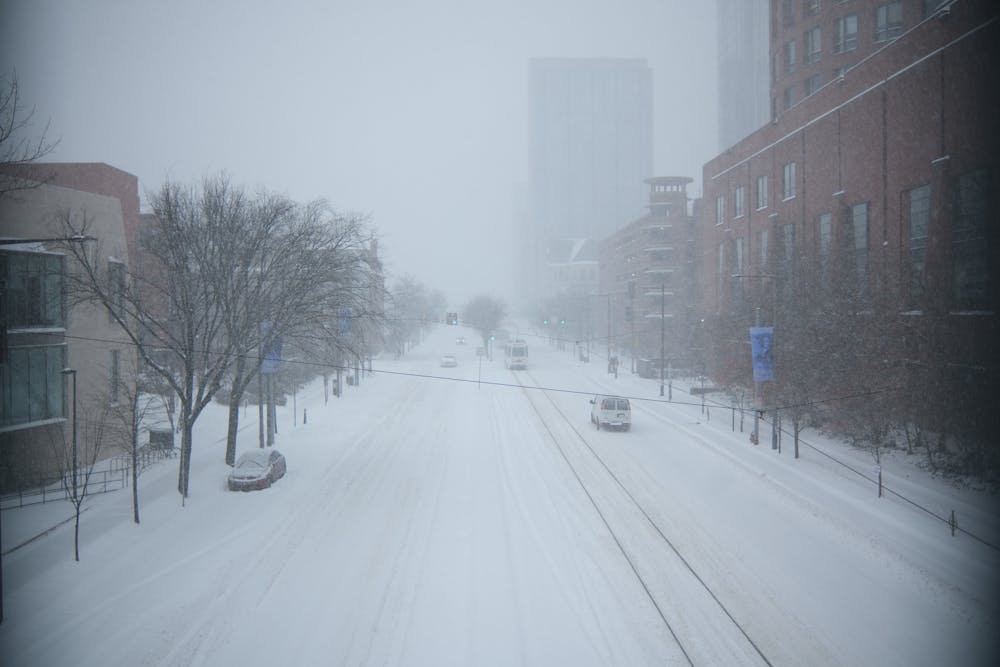
This winter has put the University’s operations to the test, with Feb. 22 marking the third cancellation of in-person classes this semester amid one of Philadelphia’s most severe snowstorms in years. While the University can’t control the weather, these repeated disruptions have highlighted the limits of our campus’ aging infrastructure. The storm, along with other recent maintenance disruptions across campus, underscore Penn’s need for a more proactive response to these incidents.
The adverse effects of Penn’s dated infrastructure have also stretched well beyond canceled lectures. In student spaces such as the ARCH and Platt Student Performing Arts House, severe flooding has disrupted day-to-day university functions. Burst pipes and water damage at Harnwell College House, Rodin College House, and Kings Court English College House resulted in damage to students’ property and forced temporary relocations. Most visibly, a major water main break shut down Spruce Street between 34th and 38th Streets, temporarily closing Houston Market and continuing to disrupt access to the Hospital of the University of Pennsylvania and the Perelman Center for Advanced Medicine.
No university can prevent every snowstorm pipe rupture, and Penn’s facilities teams work around the clock to keep the campus running safely. However, the pattern is becoming harder to ignore: our historic, urban campus is increasingly vulnerable to the elements.
Winter is only half the battle. Just this past June, Philadelphia declared a three-day state of emergency amidst a punishing heat wave, and less than five years ago, Hurricane Ida caused severe flooding in and around University City. These extreme weather events are not mere inconveniences, but recurring stress tests on the foundation of our campus.
Simply weathering it out is not a sustainable long-term strategy. Even with a multibillion-dollar endowment and a dedicated facilities and operations staff, Penn remains an old campus with aging systems beneath its historic facades. As the frequency and intensity of extreme weather increase, reactive repairs alone will not be enough.
Penn must instead focus on identifying and fixing vulnerabilities before they escalate — that means investing in upgraded drainage systems to manage storm surge, systematically replacing aging water and steam lines, reinforcing flood-prone facilities, and installing real-time monitoring systems that monitor structural stress before failure occurs. These investments are less visible and glamorous than new buildings or sustainability pledges, but they are just as essential.
It would be unfair to act as though Penn has not made any meaningful progress. The University’s ambitious Stormwater Management Master Plan has improved drainage, limited excess runoff, and mitigated flood risks throughout University City. Through these targeted investments in green infrastructure and modernized systems, Penn has successfully reduced strain on the city’s sewer system and worked towards achieving its water conservation goals.
Still, resilience is about more than managing stormwater. It requires ensuring that academic life continues uninterrupted, that residential buildings remain safe, and that hospital operations don’t falter when they’re needed most. As Philadelphia’s largest employer and the home to one of the busiest hospital systems in the country, Penn has a responsibility not only to students, but to patients, staff, and the broader community who depend on the institution.
The recent disruptions are not evidence of negligence, but of vulnerability. Infrastructure failures rarely announce themselves in advance. They accumulate quietly until one cold snap or one heavy rainfall exposes the strain. So while Penn can’t control what nature brings its way, it can control how prepared it is for the next storm.
Franklin’s advice to eighteenth-century Philadelphians is as timely now as it was back then: “An ounce of prevention is worth a pound of cure.” As a campus through which the city’s lifeblood flows, Penn has a duty to take these words to heart.
PETER KENNEDY is a College first year from West Chester, Pa. studying history and political science. His email is kenned29@sas.upenn.edu.

Peter Kennedy is a College sophomore studying philosophy, politics, and economics from West Chester, Pa. His column focuses on University policy and student culture. He can be reached at kenned29@sas.upenn.edu.