

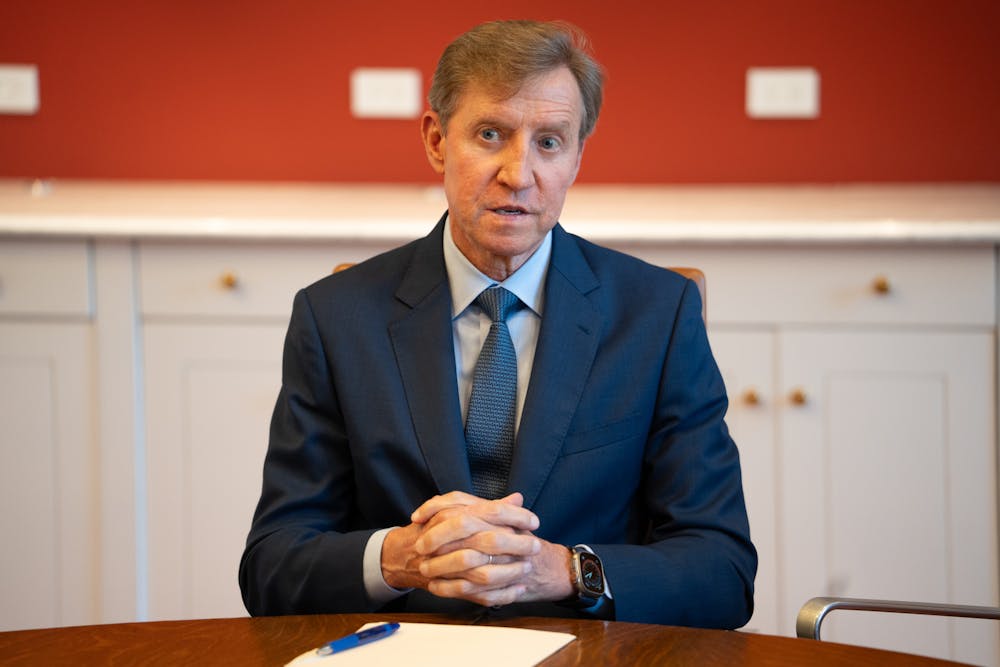
Amid administrative changes, national scrutiny, and escalating labor organization on campus, Penn President Larry Jameson sat down with The Daily Pennsylvanian for an interview.
During the Nov. 24 conversation, Jameson addressed the University’s relationship with the federal government and highlighted the role that students, faculty, and other campus stakeholders play in Penn’s future. He discussed the University’s approach in adapting to a rapidly changing environment and the values Penn maintains throughout its decision-making processes.
Here are five takeaways from Jameson’s recent sit-down interview with the DP.
Graduate student union bargaining
Penn’s graduate student workers union, Graduate Employees Together — University of Pennsylvania, voted to authorize a strike last month following a year of contract negotiations with Penn administrators. If a strike is called, graduate workers involved in teaching and research roles will stop performing all work duties.
“I certainly respect their right to do this and understand what some of the interests are that they’ve raised,” Jameson told the DP. “At the same time, the University really has an obligation to take care of the elements that are important to the University.”
Jameson reaffirmed his commitment to the “best education, the best research opportunities” at Penn, and the culture, policies, and procedures needed “to support those missions.”
GET-UP previously criticized Penn for “distribut[ing] misleading and confusing information” during the bargaining process — citing the University’s claim that choosing to strike could result in “separation from” employment.
RELATED:
Jameson addresses campus labor organization, federal government relationship in DP interview
Federal agency sues Penn, alleges Univ. withheld information in antisemitism investigation
Previous guidance from the Office of the Provost stated that “students are expected to attend classes even if it requires crossing picket lines.”
The union has four meetings planned with Penn administrators through the end of the calendar year, according to Jameson. The next bargaining session is scheduled for Dec. 4.
A Penn spokesperson previously told the DP that the University has been “bargaining in good faith with the union over this initial contract and made significant progress.”
“This will ultimately, I think, get resolved in a good way,” Jameson said.
“Penn Forward” strategic framework implementation
Jameson first announced the University’s new strategic framework — titled “Penn Forward” — in a September interview with the DP. The initiative builds upon pillars of the “In Principle and Practice” framework developed by then-Penn President Liz Magill in 2023.
During his Dec. 1 interview with the DP, Jameson categorized the framework as one of the “most important things that we’re doing.”
“In Principle and Practice” was a “conceptual framework,” Jameson told the DP in September, while the “Penn Forward” plan is a way to “develop more tangible, concrete, actionable, timely projects and activities.”
The plan outlines six working groups that will consist of undergraduate students, graduate students, and postdoctoral scholars, as well as faculty, staff, and administrative support. Jameson said the initiative’s planning committees have discussed “very high-level, innovative, specific, concrete ideas.”
Jameson added that “not all of [the strategic plan] will roll out in a single moment.” While some recommendations “can roll out early,” he provided a tentative timeline including 2030 and beyond.
“Whoever comes behind you will inherit a University that’s really ready to adapt to the future in a constructive way,” Jameson said. “The energy is super high.”
Penn’s relationship with the federal government
In July, Penn became the first Ivy League university to reach a settlement with the Trump administration.
The Department of Education launched an investigation into the University earlier this year, alleging that it violated Title IX for allowing 2022 College graduate and former Penn swimmer Lia Thomas to compete on the women’s swimming and diving team.
Penn agreed to the White House’s three demands in July, stripping Thomas’ records, issuing a Title IX statement, and sending letters to Thomas’ former competitors.
The University took a markedly different approach to dealing with the federal government when the White House approached the University on Oct. 1 with a preferential funding compact. Two weeks after being approached with the plan, Penn became the third university to reject the compact — a decision Jameson partially attributed to its restrictions on academic freedom during his interview with the DP.
Jameson declined to comment on the University’s ongoing conversations with the White House, but characterized Penn’s historical relationship with the federal government as “powerful, amazing, and valuable.”
“Our sense is that funding should be based on competing for the best ideas,” Jameson said about Penn’s compact rejection. “So those principles make sense. We identified some areas of separation … but I haven’t had any further contact about this. I don’t know what steps they will take and follow up on.”
In the compact feedback he gave the White House, Jameson emphasized the importance of academic freedom, which he told the DP is the “bedrock of what makes American universities so effective in their creativity and innovation.”
“The ability to not always follow conventional wisdom, but to think differently, has allowed us to innovate and create,” Jameson added. “This is just a critical function of our identities as universities. I think if we were asked to be conformist, it would limit our ability to pursue these innovative ideas.”
Marc Rowan’s influence at Penn
Jameson discussed the “advice” he has received from outgoing Wharton School Board of Advisors Chair Marc Rowan, who holds a 1984 bachelor’s degree and a 1985 MBA from the Wharton School and has been a prominent donor to Wharton.
In 2018, Rowan gave a $50 million gift — at the time the largest single contribution in the school’s history — and made an anonymous $10 million gift in May. The latter came around a year and a half after Rowan publicly announced that he was withholding donations to the University in protest of Penn’s response to campus antisemitism allegations.
“[Rowan] is very close to what goes on at the University, and, like many of our alumni, has views, as he shares privately and publicly about things we should do or don’t do at the University,” Jameson said. “I tend to listen to people’s viewpoints and take them into consideration.”
In May, Rowan publicly called for “fundamentally reforming” higher education across the country, arguing that the Trump administration was in a uniquely appropriate position to usher in an era of change. Rowan was a chief architect of the preferential federal funding compact presented to Penn in October — which mirrored a list of reform questions he presented to the University Board of Trustees in 2023.
Rowan also contributed millions of dollars to primarily Republican-aligned groups and candidates in the first two fiscal quarters of 2025, according to a recent DP analysis.
Jameson emphasized that Rowan holds “public positions of his own choice,” along with his Wharton Board of Advisors position and previous role as a University trustee.
After Magill’s remarks during a 2023 congressional testimony faced national scrutiny, Rowan orchestrated a pressure campaign that ultimately led Magill and former Board of Trustees Chair Scott Bok to resign their positions.
Administrative decisions at the University
Jameson explained that decision-making at Penn is a “step-wise process” rather than centralized directives at the level of the President or Provost’s Office.
University governance is distributed “very broadly” throughout Penn, Jameson explained, “which allows people who know the most about these topics to be the ones who are managing the content and the processes and procedures.”
Jameson also addressed Penn’s “faithful” responses to “complaints and inquiries” from various sources of scrutiny.
The United States Equal Employment Opportunity Commission recently alleged in a lawsuit that the University failed to provide documents for an antisemitism investigation. Jameson said that Penn has, in fact, “produced hundreds and hundreds” of documents.
“We’re always cooperative, but when there are situations that we feel that we need to stand up for the rights of either students or faculty or employees here, then we also take that position,” he continued.
He also confirmed that Penn sent a “congratulatory letter” to 1968 Wharton graduate and President Donald Trump when he was elected, but he clarified that administrators have sent letters to Penn’s affiliates “regardless of political party,” citing the University’s policy of institutional neutrality, which was first introduced in September 2024.
RELATED:
Jameson addresses campus labor organization, federal government relationship in DP interview
Federal agency sues Penn, alleges Univ. withheld information in antisemitism investigation
Ayana Chari is the assignments editor at The Daily Pennsylvanian and can be reached at chari@thedp.com. At Penn, she studies political science. Follow her on X @AyanaChari_.
Staff reporter Anvi Sehgal can be reached at sehgal@thedp.com. At Penn, she studies philosophy, politics, and economics. Follow her on X @anvi_sehgal.


