

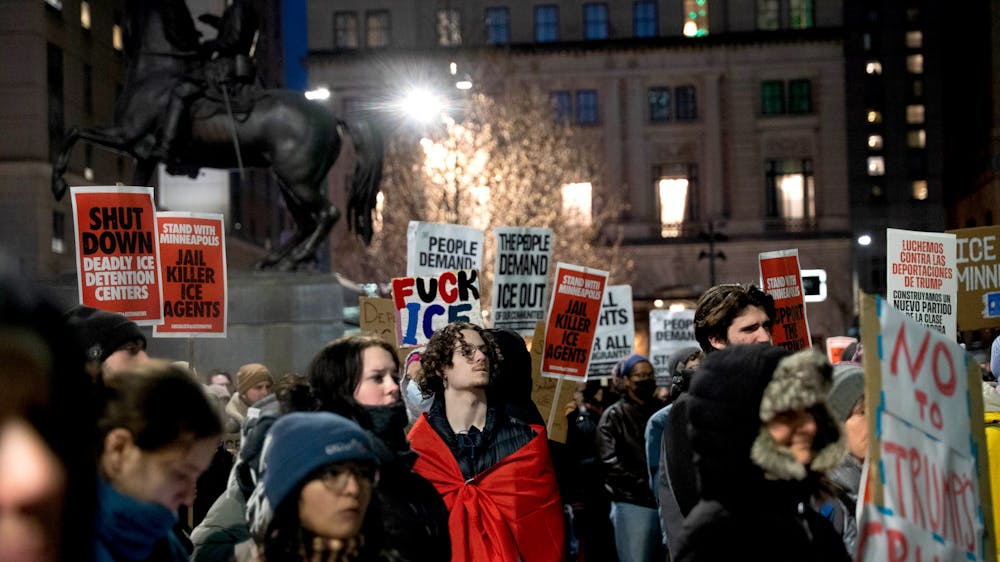
Amid a federal immigration enforcement crackdown in Minneapolis, The Daily Pennsylvanian sat down with University of Pennsylvania Carey Law School professor Claire Finkelstein to discuss how the recent events mimic her 2024 experiment simulating how the United States could descend into civil war.
Following the deployment of an estimated 3,000 Immigration and Customs Enforcement agents to the city, Minneapolis has become a center for tension between state and federal authorities. The situation resembles a September 2024 simulation conducted by the Center for Ethics and the Rule of Law, which was designed to test how friction between different levels of authority could spiral into unprecedented domestic conflict.
In the past month, two people were shot and killed by federal agents during ongoing protests — including Alex Pretti, whose death is being investigated by the Department of Justice. On Jan. 17, Minnesota Gov. Tim Walz mobilized the state National Guard.
“What we were testing out was the risk that tension between the state and federal government could result in escalation that would eventually pit National Guard troops against federal forces,” Finkelstein said. “That is called green-on-green violence, and it has not happened in the history of this country — at least since the Civil War.”
The simulation — conducted two months before the 2024 presidential election — aimed to identify legal questions that courts might confront but scholars were not currently considering, Finkelstein explained. By anticipating these scenarios, CERL hoped to “forestall this kind of escalation” and provide courts and legal analysts time to address these unsettled questions before they became crises.
“Where matters are not legally settled, that’s a point where troops can be confused, governments can be confused, and rifts between the federal government and state government can open even wider,” Finkelstein — who serves as CERL’s faculty director — said.
She added that the only historical precedent similar to the center’s simulation was Little Rock, Arkansas — following the Supreme Court’s Brown v. Board of Education decision — when it was not clear whether National Guard troops would abide by President Eisenhower’s order enforcing school integration.
Finkelstein said the simulation did not anticipate Trump v. Illinois, in which a court struck down the legal reasoning the federal government previously used to justify the deployment of the National Guard. CERL filed an amicus brief on behalf of over 150 members of Congress in that suit.
RELATED:
City councilmembers to introduce legislation restricting ICE operations in Philadelphia
Hundreds gather at City Hall in solidarity with Minnesota anti-ICE protests
She said that the legal victory may have inadvertently facilitated the current situation where 1968 Wharton graduate and President Donald Trump’s administration deployed ICE agents rather than the National Guard.
“The closing of the [U.S. Code §] 12406 deployment options on the National Guard for the Trump administration is partly why they deployed so many federal agents to Minneapolis,” Finkelstein said. “They seem to be using ICE as a kind of paramilitary force in lieu of the National Guard.”
She warned that the shift from the employment of the National Guard to ICE represents an escalation due to differences in training between the groups. The result, she said, is “in a way worse than it was when the National Guard was deployed.”
“Unlike the National Guard, who are well trained and understand the boundaries, these ICE agents are poorly trained and seem not to have any interest in following the limits on the use of force at all,” Finkelstein said. “They have sort of wantonly engaged in lawless activity, seemingly quite heedless of the consequences and, in some cases, baiting confrontation.”
Other elements of CERL’s simulation also materialized in Minnesota. Like in the simulation, federal agents are engaging in what Finkelstein characterized as unlawful uses of force against protesters, and the state National Guard has been mobilized “to try to keep the peace … and to try to protect the lawful right to protest.” Finkelstein also noted that local law enforcement has been “potentially overwhelmed,” which also occurred in the simulation.
Most “damaging,” Finkelstein said, is the federal government’s pattern of defying court orders — citing a Minnesota judge who attached an appendix documenting nearly 100 instances in which the federal government did not comply with judicial directives.
“The best hope for de-escalation is when you have a court that’s willing to get involved, is clear-sighted about what’s going on, and can resolve disputes between the federal government and the states,” she said. “But if the federal government is not willing to follow court orders, the hope for that sort of intervention is weak.”
She further argued that another critical factor in de-escalation is accountability.
“If federal agents are allowed to violate the law with impunity, then it will keep happening, and it will escalate, and they’ll do more of it,” Finkelstein said. “But some well-placed prosecutions would stop that.”
Beyond Minnesota, Finkelstein emphasized that the dynamics unfolding are not geographically isolated and that Philadelphia could be particularly vulnerable to similar federal action.
“Philadelphia is one of the places that I think would be on the government’s list to have the same situation repeat itself, and indeed, in our simulation, the events took place in Philadelphia,” Finkelstein said.
She noted that both Minnesota and Pennsylvania have Democratic governors who are prominent figures within the party and potential presidential contenders for 2028.
She also pointed to recent federal actions across the country — including a raid on the Fulton County elections office in Georgia and a letter from Attorney General Pam Bondi demanding voter roll data — as evidence that political considerations are intertwined with federal enforcement decisions.
For Finkelstein, the implications extend beyond courts and law enforcement. She said that Penn students have a responsibility to be aware of their rights, and that the University has a responsibility to educate them.
“Understanding these rights should be an extremely high priority for the Penn community right now,” she said. “We have a lack of civic knowledge in this country.”
She added that remedying that knowledge deficit requires deliberate action from educational institutions.
“Educational institutions need to be at the forefront of educating their own students and educating the country about the constitutional rights of citizens,” Finkelstein said. “Penn needs to do as much as it possibly can to really prepare the Penn community for what could be a repetition of the Minnesota situation coming to Pennsylvania.”
RELATED:
City councilmembers to introduce legislation restricting ICE operations in Philadelphia
Hundreds gather at City Hall in solidarity with Minnesota anti-ICE protests
Senior reporter Riana Mahtani covers national politics and can be reached at mahtani@thedp.com. At Penn, she studies political science. Follow her on X @Riana_Mahtani.


