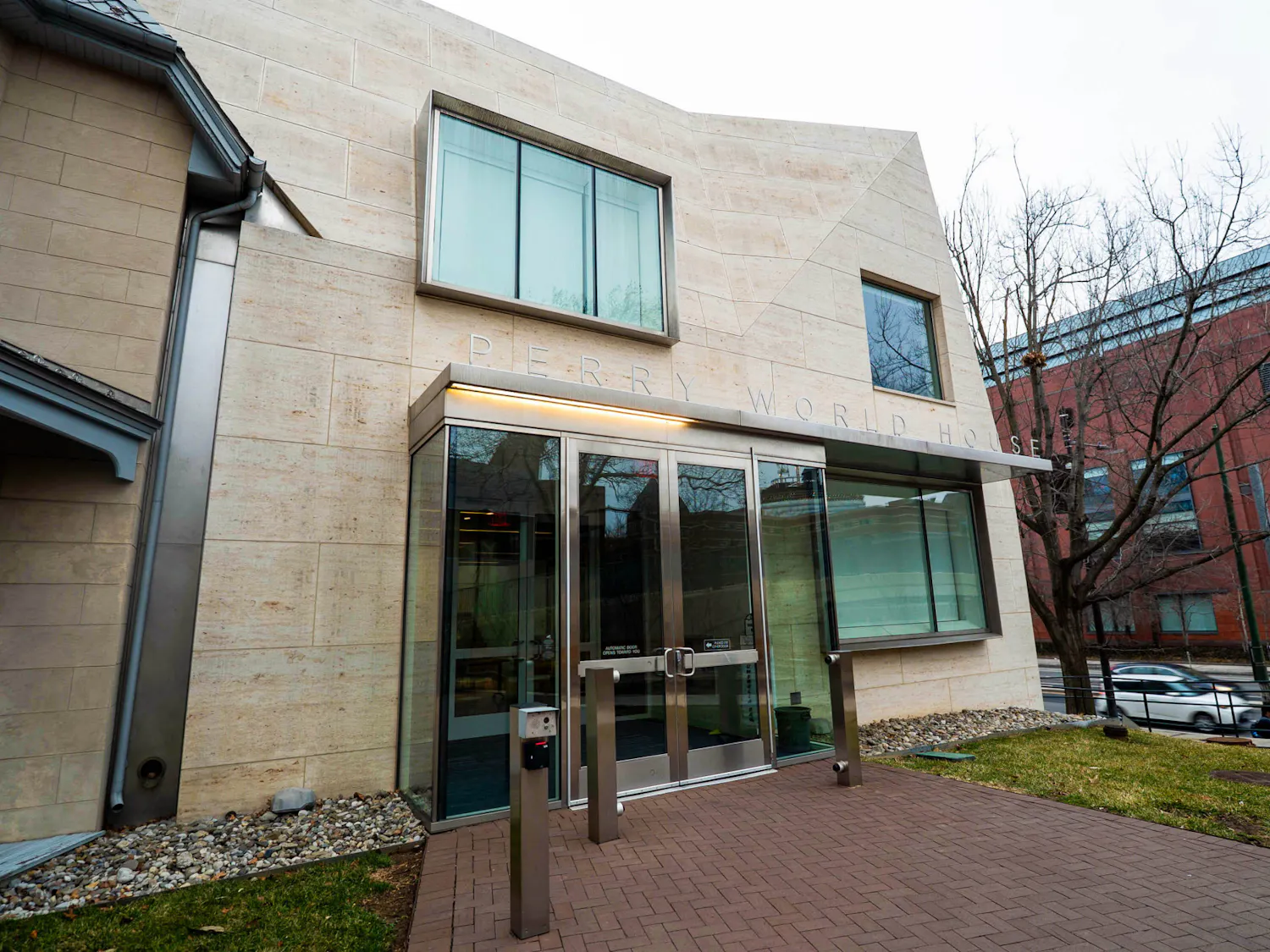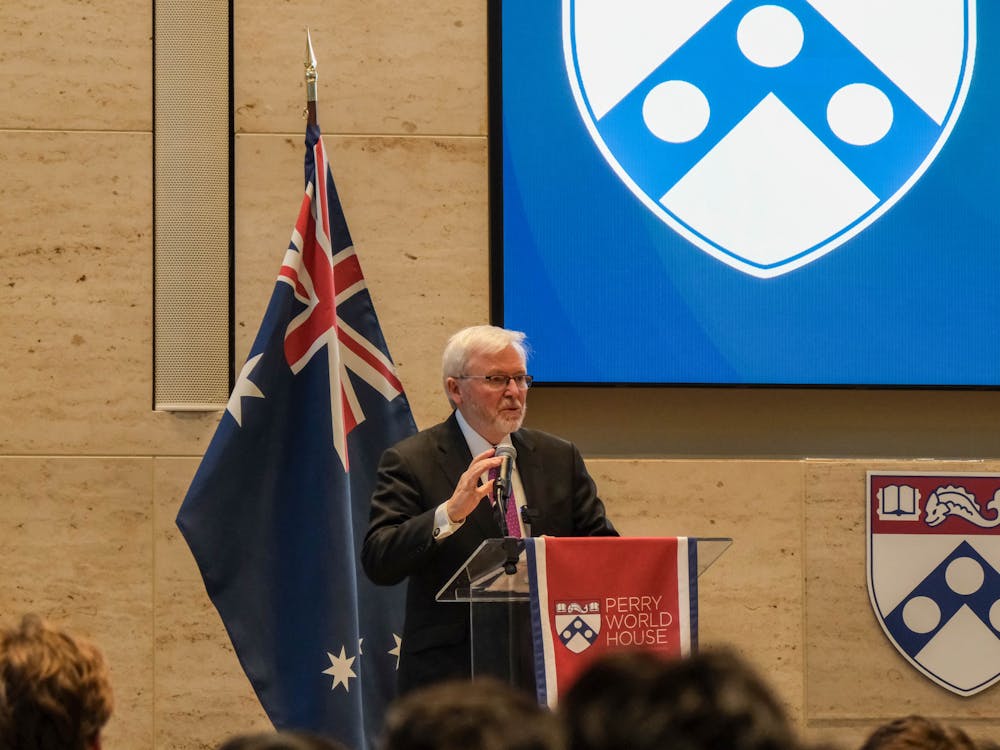
Perry World House hosted the Australian ambassador to the United States at an event on Monday about the future of the country’s relations in the Indo-Pacific region.
The Feb. 2 discussion welcomed Ambassador Kevin Rudd, who is also the former Australian prime minister, as the speaker for the Center for the Study of Contemporary China’s annual lecture series. Director of the CSCC Jacques deLisle moderated the event — which covered military and economic strategies in the Indo-Pacific before transitioning to an audience question and answer session.
In an interview with The Daily Pennsylvanian, deLisle explained the importance of Rudd’s perspective as an “ally” and “partner” to the U.S.
During the event, titled “Australia and the Future of Deterrence and Diplomacy in the Indo-Pacific,” deLisle described the area as the “most economically vibrant region in the world,” drawing attention to China’s economic dominance in recent years.
Rudd’s lecture recognized China as the “world’s largest trading nation” through an analysis of the country’s GDP. He also highlighted the “assertive” nature of the Chinese President Xi Jinping’s foreign policy.
“Over the last 15 years or so, we have seen under Xi Jinping increasingly assertive Chinese foreign policy — not just towards China’s neighbors, but frankly, across the world as well,” Rudd said.
Rudd spoke about 1968 Wharton graduate and President Donald Trump’s “America First” priorities — as well as his administration’s November 2025 National Security Strategy and January National Defense Strategy. Rudd emphasized the importance of military cooperation in the Indo-Pacific.
The security strategy includes a principle titled “Peace through Strength.” Rudd highlighted a statement from that section: “Strength is the best deterrent. Countries or other actors sufficiently deterred from threatening American interests will not do so,” Rudd read. “Therefore, the United States must maintain the strongest economy, develop the most advanced technologies, bolster our society’s cultural health, and field the world’s most capable military.”
RELATED:
Perry World House hosts Jewish history professor, father of Israeli hostage for advocacy event
Former NSA, U.S. Cyber Command director speaks on global threat landscape at Perry World House
“The national security strategy calls for a robust and ongoing focus on deterrence to prevent war in the Indo-Pacific,” Rudd explained. “We in Australia have a parallel view when it comes to deterrence — our own national defense strategy of 2024 says that the strategy is designed to deter through denial, any potential adversaries attempt to project power against Australia or through our northern approaches.”
When considering China’s concept of deterrence, Rudd highlighted that it is “much broader” and conceptually “quite different” than the western concept of deterrence.
“It includes a combination of what we would call classical deterrence, causing you not to do something, compellence, and dissuasion through calculated escalation,” Rudd said. “All three elements are actually buried within the Chinese military concept of effective control.”
Rudd explained that given these differing approaches, “allies and partners’ contributions will be vital in deterring and balancing China,” in the Indo-Pacific.
During the Q&A section, audience members engaged with the content of the lecture.
College sophomore Tareque Chowdhury told the DP he came to this event especially because of an interest in Chinese influence in the region.
“I thought it would be really interesting to get a glimpse of the Australian perspective, which is probably not talked about as much, mainly because of the Trump era,” Chowdhury said.
College first-year Lindy Black attended the event following a recommendation from her professor, and to further her interest in foreign policy and international relations.
“I'm really trying to branch out this semester and go to as many opportunities as I can to see whether or not I like political science,” Black said.
In reference to the lecture series, deLisle explained that the “goal” is “always to try to get people interested in China.”
RELATED:
Perry World House hosts Jewish history professor, father of Israeli hostage for advocacy event
Former NSA, U.S. Cyber Command director speaks on global threat landscape at Perry World House
Staff reporter Eleftheria Sermpeti contributes to data reporting and can be reached at sermpeti@thedp.com. At Penn, she studies economics and international relations.