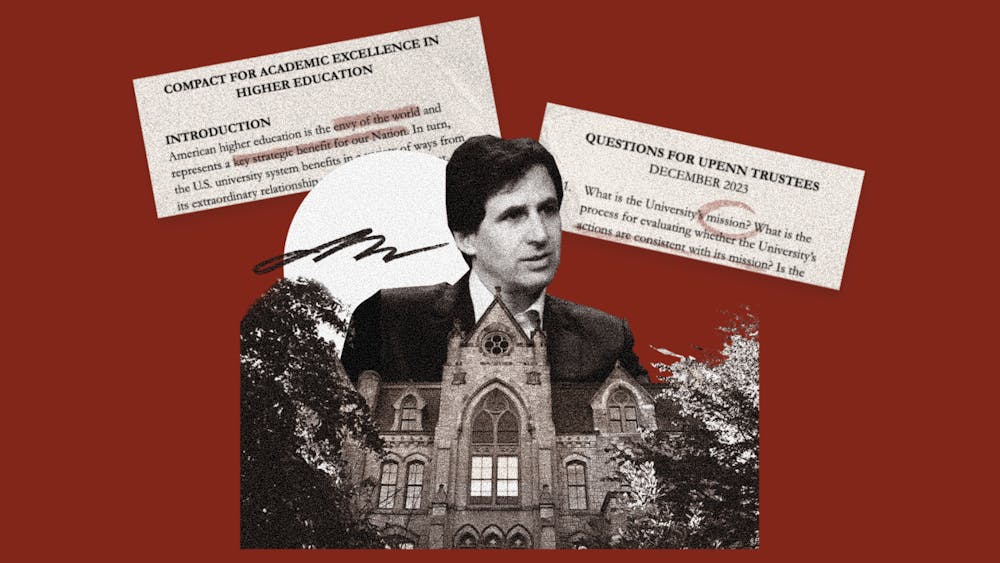
In December 2023, Wharton School Board of Advisors Chair Marc Rowan circulated a list of reform questions to the University Board of Trustees, urging them to make “clear choices” that would define the direction of the University’s future.
On Wednesday, nearly two years later, the White House distributed a proposed compact to Penn and eight other universities, offering preferential funding in exchange for signing onto sweeping governance and policy reforms. According to The New York Times, Rowan was a chief architect of the compact — which builds directly on the ideas he first outlined in his 2023 message to the Board of Trustees.
Universities have until Oct. 20 to provide comments on the document, and the White House is aiming for institutions to sign the compact by Nov. 21, according to an attached cover letter. Penn acknowledged receipt of the compact in an email on Sunday, writing that administrators plan to review the document with stakeholders across campus to develop a response.
Rowan declined to comment on the report. The White House did not respond to repeated requests for comment.
***
Rowan — who holds a 1984 bachelor's degree and a 1985 MBA from Wharton — called on Penn's Trustees to determine the role that “merit/academic excellence” played in “admissions, faculty hiring, and other areas of recruitment.”
The first provision in the White House compact describes an admissions model “based upon and evaluated against objective criteria” and calls for mandated reporting of standardized test scores from undergraduate applicants. Later — in a section titled “Nondiscrimination in Faculty and Administrative Hiring” — the document outlines a requirement for institutions to commit to “rigorous and meritocratic selection based on objective and measurable criteria.”
The White House’s document also includes a mandate that universities “acknowledge that a grade must not be inflated, or deflated, for any non-academic reason” and that grades should “rigorously reflect the demonstrated mastery of a subject that the grade purports to represent.”
RELATED:
Penn to begin review of White House preferential funding compact, Jameson writes
'Blatantly unconstitutional': Penn faculty warn proposed Trump compact threatens academic freedom
Provisions in the Oct. 1 compact echo the questions Rowan posed to the Trustees about Penn’s policies on free speech, civil discourse, and related issues — including asking the Trustees whether the University should create a formal code of conduct.
“While universities should protect debate and academic freedom, harassment falls outside permissible bounds,” the White House document reads. “Signatories shall adopt policies prohibiting incitement to violence, including calls for murder or genocide or support for entities designated by the U.S. government as terrorist organizations.”
Rowan’s initial list also questioned the importance of “viewpoint diversity in the hiring of our faculty, our administrators, and the remainder of the University community.”
The White House compact binds signatories to “fostering a vibrant marketplace of ideas on campus,” further delineating an “open campus environment with […] no single ideology dominant, both along political and other relevant lines.”
Rowan also asked the Trustees whether Penn had an “institutional opinion” in his December 2023 email while seeking clarification on “when and how” the University would speak out about national and international issues.
The compact now compels signatories to adopt institutional neutrality policies that prohibit employees from “actions or speech relating to societal and political events” in their capacities as representatives of their respective institutions — except for those that directly affect a university.
Penn implemented an institutional neutrality policy in September 2024. In an email announcement at the time, Penn President Larry Jameson wrote that the new policies sought to protect the “diversity of thought” central to Penn’s mission.
In the 2023 message, Rowan also questioned whether Penn was “prepared to significantly adjust budgeting to further” interdisciplinary academic integration. He challenged the trustees on whether it was “desirable” for “all interested students” to have the ability to gain “course certification in an immediately employable skill.”
The compact states that signatories must “responsibly deploy their endowments to the public good.” Higher education institutions that agree to the guidelines and possess endowments “exceeding $2 million per undergraduate student” will be barred from charging tuition for students pursuing “hard science programs,” according to the document.
Penn’s Trustees were also asked whether existing academic departments at the University should be shut down or consolidated. Invoking multiple provisions of the University Charter, Rowan sought to clarify the scope of the Trustees’ influence on student instruction, degree recommendations, and faculty hiring processes.
In its current draft, universities that sign the compact would be required to “streamline or eliminate academic programs that fail to serve students” and work to “control their costs” by easing tuition burdens and performing regular audits.
In his initial document, Rowan asked the Board of Trustees multiple questions about the University’s policy regarding contributions from foreign countries and the disclosure of donations from governments and other individuals.
Should Penn sign the compact, the University would be required to “promptly and fully disclose all funding from any foreign institutions and individuals.” The document also outlines necessary compliance with all federal laws on anti-money laundering, Know-Your-Customer, and foreign gift disclosures to prevent “criminal and terrorist financing.”
***
Rowan initially sent the list of questions to the Trustees just days after a pressure campaign that he helped orchestrate successfully ousted then-Penn President Liz Magill and former Board of Trustees Chair Scott Bok. In an email, he introduced the list of “essential and strategic questions” and called for “governance reform, a strategy, and a new leader” at Penn.
“Trustees have a once in a generation opportunity to chart the future for UPenn, while our peer institutions remain focused on the present,” Rowan’s email read. “The choices that you make will not only determine UPenn’s future, but also have the potential to impact academic institutions across the country.”
Rowan’s “ambitions have now gone national” because of the reelection of 1968 Wharton graduate and President Donald Trump, according to History professor Benjamin Nathans.
In an interview with The Daily Pennsylvanian, Nathans expressed his belief that both Trump and Rowan are seeking “radical intervention by the federal government” to reform higher education.
“He now has the ear of someone who wants to enact these kinds of policies on a national level,” Nathans said. “I think Rowan understood that there was now someone who could be a vehicle for a much more ambitious takeover of higher education.”
In a statement to the DP, Bok similarly described the compact as a “frightening culmination of the attack on core values and operating principles of the University that began two years ago.”
In a May 22 interview with Barron’s, Rowan voiced support for “fundamentally reforming” higher education nationwide.
According to the Times, by the time Rowan gave that interview, his initial draft of a “university support and eligibility agreement” — whose provisions closely mirrored or exactly matched aspects of the White House compact sent to Penn — had been circulating among University administrators and lawyers for two months.
Ethan Young is the Editor-in-Chief of The Daily Pennsylvanian and can be reached at young@thedp.com. At Penn, he studies history and political science. Follow him on X @EthanYoung.
Jasmine Ni is the Executive Editor of The Daily Pennsylvanian, Inc. and can be reached at ni@thedp.com. At Penn, she studies English and political science. Follow her on X @JasmineNi_.