

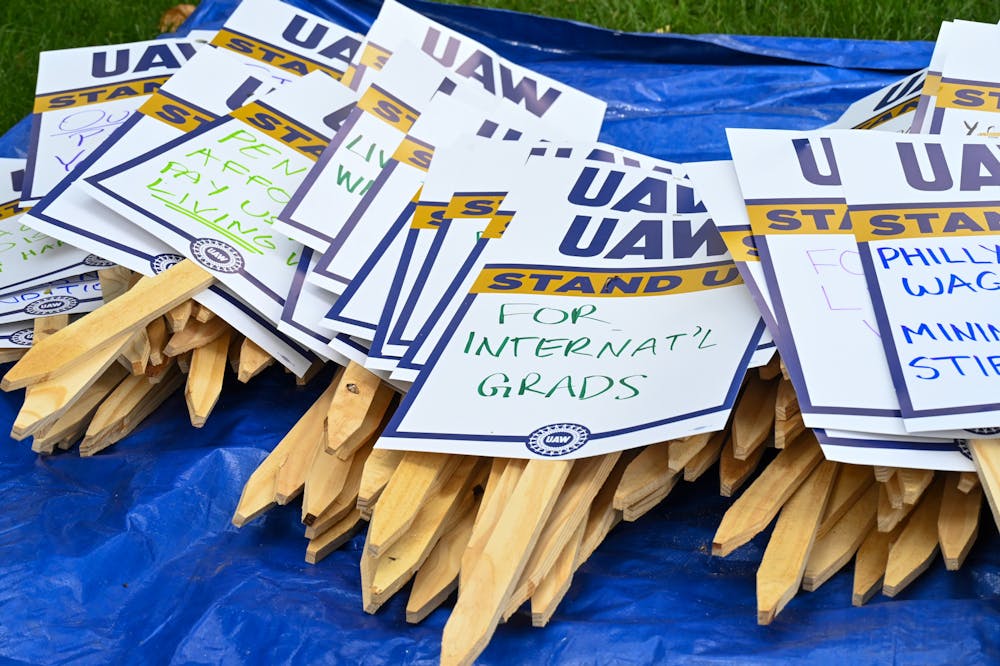
Penn’s Office of the Provost has issued guidance about a possible work stoppage as this week’s strike authorization vote by Graduate Employees Together — University of Pennsylvania takes place.
GET-UP formally announced its strike authorization vote at a Nov. 3 press conference with local elected officials.
The vote — which began Tuesday at 9 a.m. and will close at 9 p.m. on Thursday — will take place via an online secret ballot. If the motion passes with a two-thirds majority, GET-UP’s elected bargaining committee will have the power to call a graduate worker strike at its discretion.
GET-UP’s FAQ page describes the potential strike as a “last resort,” adding that the decision to strike will only be made if the bargaining committee deems that the circumstances “necessitate” it.
If a strike is called, Penn graduate workers — a group that encompasses those who are employed in teaching or research roles during the fall 2025 or spring 2026 semesters — will stop performing all academic duties. Workers will instead “participate in picket lines around campus to increase the visibility of the strike,” according to the FAQ.
The union also emphasized that a strike would last as long as it takes for Penn administrators to agree to the terms of GET-UP’s contract, or until graduate workers “collectively decide to cease striking.”
According to a University spokesperson, Penn has been “bargaining in good faith with the union over this initial contract and made significant progress.”
“We believe that a fair contract for the union and Penn can be achieved without a work stoppage, but we are prepared in the event that the union membership votes to authorize a strike,” the spokesperson added.
RELATED:
Penn security guards’ union reaches agreement for new contract, avoiding strike
Penn community members rally outside Sen. McCormick’s office, denouncing attacks on higher education
The FAQ page for the Office of the Provost states workers who “voted to strike” are able to “choose to continue working.”
“If you strike and do not perform instructional or research services, then you will not be paid your stipend for the period you are on strike,” the website states. “Once you return to work, your stipend payments will resume.”
The University’s page also advises against non-unionized workers striking in solidarity with graduate student workers, writing that anyone “not covered by the GETUP-UAW bargaining unit is expected to continue to work in that job.”
Failure to work, the Office of the Provost explained, could result in consequences like “separation from” employment.
“Graduate workers are disappointed that the university administration would distribute misleading and confusing information to us while we are in the process of bargaining for a fair union contract,” GET-UP wrote in a statement to The Daily Pennsylvanian.
The Office of the Provost’s site also addresses the status of international workers, the future of federal financial aid, and what students should do if they are concerned about crossing the picket line.
“All students are expected to attend classes even if it requires crossing picket lines,” according to the guidance from the Office of the Provost. “Students who choose not to cross picket lines should discuss the implications of this decision in advance with individual faculty.”
RELATED:
Penn security guards’ union reaches agreement for new contract, avoiding strike
Penn community members rally outside Sen. McCormick’s office, denouncing attacks on higher education
Staff reporter Daniya Siddiqui covers campus advocacy and can be reached at siddiqui@thedp.com. At Penn, she studies political science.


