

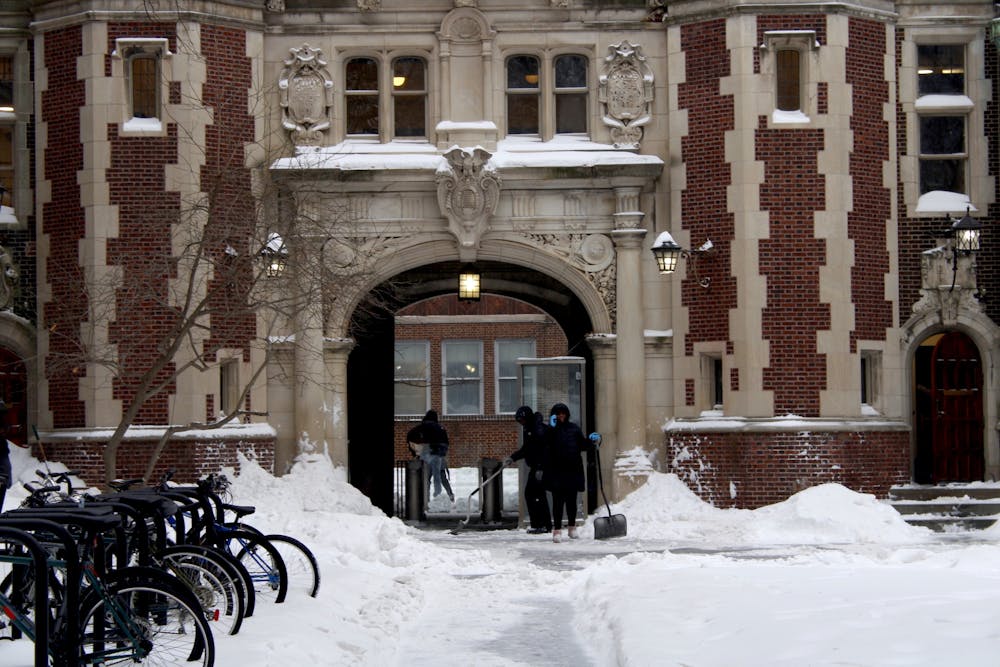
In the week following a winter storm that brought record snowfall and freezing temperatures to Philadelphia, Penn experienced water-related infrastructure issues that affected buildings across campus.
From flooded hallways to frozen fan coil units, multiple college houses sustained damage that affected residents. Plumbing issues underneath and around Locust Walk also impeded access to academic buildings and community spaces.
“During a period of sustained, unusually cold weather, Facilities & Real Estate Services has been responding to several water‑related issues at different locations on campus,” a FRES spokesperson wrote in a statement to The Daily Pennsylvanian.
“This is a time of year when these types of incidents are more likely to occur throughout the city and region,” the spokesperson added.
On Jan. 24 — the night before the major coastal storm hit Philadelphia — Megan Edelman, the associate director at Platt Student Performing Arts House, notified select students of a “major leak” impacting “several spots” in Platt’s lobby.
“The Lobby, including the stage, kitchen, computer bank, and restrooms, is currently unavailable,” Edelman wrote. “If you are using Platt House rehearsal rooms, please enter and exit through the Stouffer Commons entrance only.”
In a Jan. 25 statement to The Daily Pennsylvanian, Platt House Director Laurie McCall emphasized that “Platt House is not closed” and while the lobby was “roped off,” rehearsal rooms “remained open.”
“The plumbers are working on the cause, but the water has stopped,” McCall wrote, adding that a “clean-up crew” came in to “address the wetness.”
RELATED:
Penn extends course selection deadline following two-day suspension of University operations
University operations remain suspended as Philadelphia snow emergency continues
Platt House closed on Jan. 26-27 in compliance with the University's suspension of operations due to the winter weather. The day the building reopened, another leak was reported in the lobby.
While McCall described uncertainty about the origin of the leak, she wrote to the DP that student performing arts groups would still have access to essential spaces.
“We are waiting for more definitive answers from Facilities as they finish checking into everything,” she wrote. “We are restricting lobby use but keeping all rehearsal rooms open.”
The FRES spokesperson clarified that there was “no burst pipe or failure within Penn’s building infrastructure,” pointing to a “localized drainage obstruction outside Penn’s system” that caused the “limited water intrusion.”
“The obstruction was dealt with promptly and has been cleared,” the spokesperson wrote. “Selected spaces are being dried.”
On Jan. 30, residents also reported flooding in King’s Court English College House.
In an interview with the DP, Wharton first-year Malu Coelho — who lives on the second floor of English House — recalled receiving an email “around 2 p.m.” notifying her that “the building was experiencing some flooding, but it was under control.”
When she returned to her room that afternoon, however, Coelho said she “couldn’t use the elevator because it was apparently flooded, and the stairs were also all full of water.”
“The hallway was flooded,” and there were “multiple machines” throughout the space “to dry the water,” Coelho told the DP. She added that the University stationed “huge” and “very noisy” turbines “in each room” to address the damage.
Coelho recounted finding out her room had been unlocked and entered without her knowledge while she wasn’t present.
“All of the rooms on my floor were opened — like the staff opened them for us,” Coelho said. “We had no idea they were getting into our rooms. I had all of my personal stuff exposed.”
Due to the noise, Coelho explained that she was unable to sleep in her own room.
“There was no way someone could sleep with those turbines inside their room,” Coelho told the DP. “I don’t know what … the other people on my floor did, but I needed to sleep over at my friend’s dorm.”
A request for comment was left with the House Director of KCECH.
The FRES spokesperson acknowledged the flooding, pointing to “two separate incidents involving frozen fan coil units” in the building. They wrote to the DP that these events were “determined to be related to windows not being fully closed during the extreme cold.”
“The areas impacted have been cleaned and are being dried; additional repairs to an affected elevator shaft will take place over the coming weeks,” the statement continued.
On Jan. 31, a portion of Locust Walk was taped off due to flooding and icy conditions — which the FRES spokesperson attributed to a “water main break” that obstructed the front and side entrances to the Arts, Research, and Culture House building.
College senior Bill Chen was leading a retreat with the Asian Pacific American Leadership Initiative at the ARCH during the day of the flooding. Chen was told to evacuate the building later that day due to “a pipe burst within the building.”
“In the moment, it was definitely a bit frustrating,” Chen told the DP. “We weren't sure that we even could move to another room on campus, and we had a lot of activities that we had planned for our retreat that we hadn’t finished.”
Chen was told to evacuate to Houston Hall for the remainder of the retreat. He added that one of his “fellow club leaders” was “on the phone with facilities,” who was helping them shift the club’s plans for the rest of the day.
“It just felt like campus was falling apart a little bit,” Chen added.
“The issue was addressed with the Philadelphia Water Department, and the building is operational,” the FRES spokesperson wrote. “Additional exterior repairs will be required and are being investigated.”
On Feb. 1, Harnwell College House residents were notified via email of a separate leak “on the water supply line” serving the building.
“Please be advised that an excavation crew will begin work tomorrow morning to perform repairs,” the email read. “These repairs may require temporary shutdown(s) of water service to the building.”
The email emphasized the uncertainty of the situation and encouraged residents to be proactive when planning their water usage “in anticipation of a possible service disruption.”
“At this time, the duration of any potential interruption cannot be determined, as it will depend on the findings once excavation is complete, and the extent of the leak is confirmed,” the email read.
Students also received emails from Penn Dining that afternoon encouraging them to “use caution around 1920 Commons,” citing “icy conditions” related to a leak “on the corner of Locust Walk and 39th Street.”
A similar email was sent to residents of Rodin College House by Building Manager Rae’Shelle Drayton-Greene on the same day.
“Repairs will be made on Monday, February 2nd. In the meantime, please exercise caution when walking around the building,” the email read. “Staff are actively applying salt to affected walkways and will continue these efforts early tomorrow morning.”
The FRES spokesperson also highlighted that Penn’s Facilities team plans to continue mitigating the ongoing issues.
“Facilities teams are assessing each situation based on its specific conditions and coordinating with appropriate partners as needed,” the statement read.
RELATED:
Penn extends course selection deadline following two-day suspension of University operations
University operations remain suspended as Philadelphia snow emergency continues
Senior reporter Christine Oh leads coverage of student life and can be reached at oh@thedp.com. At Penn, she studies English and philosophy. Follow her on X @ChristineOh_.





