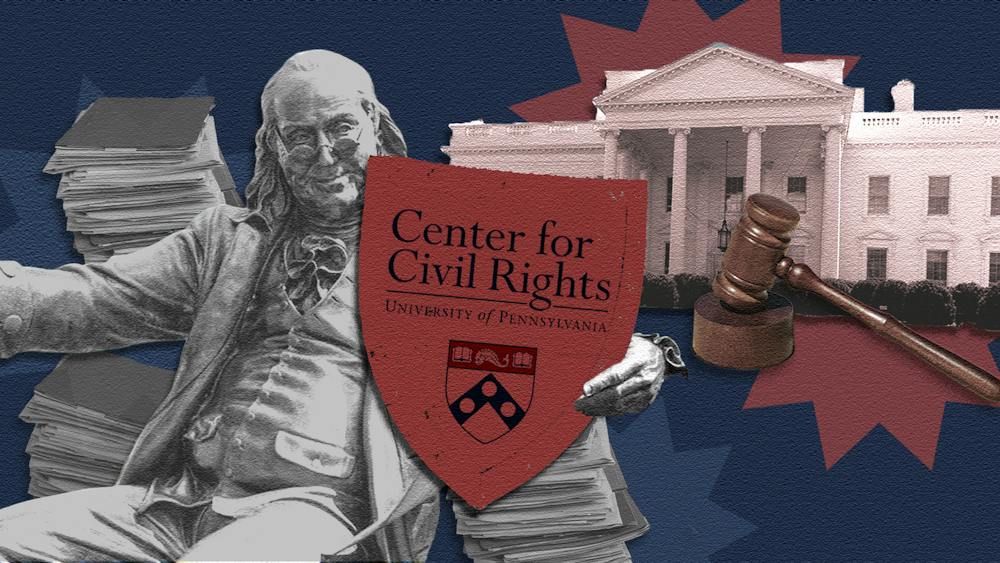
Last month, Penn’s new Center for Civil Rights became fully operational. The center, absorbing the individual offices that previously handled Title VI and Title IX, is now the central resource for all matters relating to religious, racial, and gender discrimination on campus. Penn has presented this merger as an investment in centralized reporting measures and support options. But the CCR is also undoubtedly a response to increased federal scrutiny of our University policies, and its creation raises questions about the administration’s commitment to mitigating harm in a way that truly supports students.
In contrast to its typical usage as a response mechanism for sexual misconduct, Penn’s relationship with Title IX has long been defined by a debate on athletic participation. The Trump administration has repeatedly weaponized the policy in service of the president’s anti-trans agenda, finding Penn in violation based on 2022 College graduate Lia Thomas’ participation on the swim team. Our University has also gained national attention due to federal accusations of antisemitism, the initial slew of which triggered Penn to create a Title VI office in the first place.
It’s clear from these controversies that the connection between Title VI and Title IX is not so much their mutual concern with civil rights as national indictments of our University’s enforcement of them. The creation of the CCR, which will “partner closely” with Penn’s Office of General Counsel, is another obvious attempt to shield the University from legal threats of the Trump administration. If the intention was genuinely to increase accountability in all civil rights violations, the University would not dilute the specialized focus of each issue by consolidating them.
All forms of discrimination certainly have intersections, but their periodic overlap absolutely does not necessitate a unified complaint process. The administration has argued that this change will reduce confusion by providing community members with a “single point of contact” for civil rights concerns. While filing any sort of complaint is definitely an overwhelming process, the idea that a joint civil rights office addresses this concern relies on a fundamental misunderstanding of the issue.
Penn’s problem with segmentation was never an issue of two completely separate legal processes operating in different offices. In actuality, ambiguity is far more common in relation to more general resources like Special Services or Restorative Practices, which are defined not by the type of complaint they address but by their method of resolution. With this in mind, increasing clarity in student resources should be done through unique resource centers for specific issues. These would have staff with appropriate expertise who can advise community members on options for counseling and confidential interventions, as well as their right to formally report. Contrary to Penn’s advertising of the CCR, a legal office should never be the starting point for a student to begin processing an act of violence or discrimination.
Many universities have initiated similar projects already by creating sexual assault response centers that serve as a true single point of contact for survivors. These are places where students can receive explanations of resources, ongoing counseling, referrals to medical care or law enforcement, and connections to the reporting process if they so choose. If Penn really wanted to ease the resource confusion it claims to be so concerned about, it would create more centers, not destroy them.
If this merger is ineffective as a source of individualized support, it is even less so as an approach to cultural reform. While the CCR is allegedly dedicated to “prevention, education, and training,” this unified approach to transforming our University culture makes little sense for such a broad range of topics. A single training curriculum for religious discrimination and sexual assault is insulting to both issues, failing to treat each with the individualized care it deserves. Each matter becomes a module to click through on a nondiscrimination Canvas page instead of a genuine dialogue about how these issues impact the lives of our community in deeply personal ways.
At Penn, there already exist resources and initiatives that assist community members in events of discrimination and other misconduct. From Penn Violence Prevention to the Spiritual and Religious Life Center, there is no shortage of community-based support options. Real dedication to antidiscrimination and student safety is investment in the bottom-up initiatives of these organizations, not the promotion of a legal office as the primary source of advocacy and prevention.
SEE MORE FROM THE DAILY PENNSYLVANIAN EDITORIAL BOARD:
It is disingenuous for Penn to present this merger as an investment in community support when it is truly an investment in its own legal protection. Make no mistake: This is another layer of bureaucracy framed as a unified approach. The endless addition of new links in the chain of command does not streamline the reporting process. It only moves University leadership farther from the victims of discrimination and violence it claims to support.
Editorials represent the majority view of members of The Daily Pennsylvanian Editorial Board who meet regularly to discuss issues relevant to the Penn community. This body is led by Opinion Editor Ingrid Holmquist and operates independently from the newsroom. Questions or comments should be directed to letters@thedp.com.