

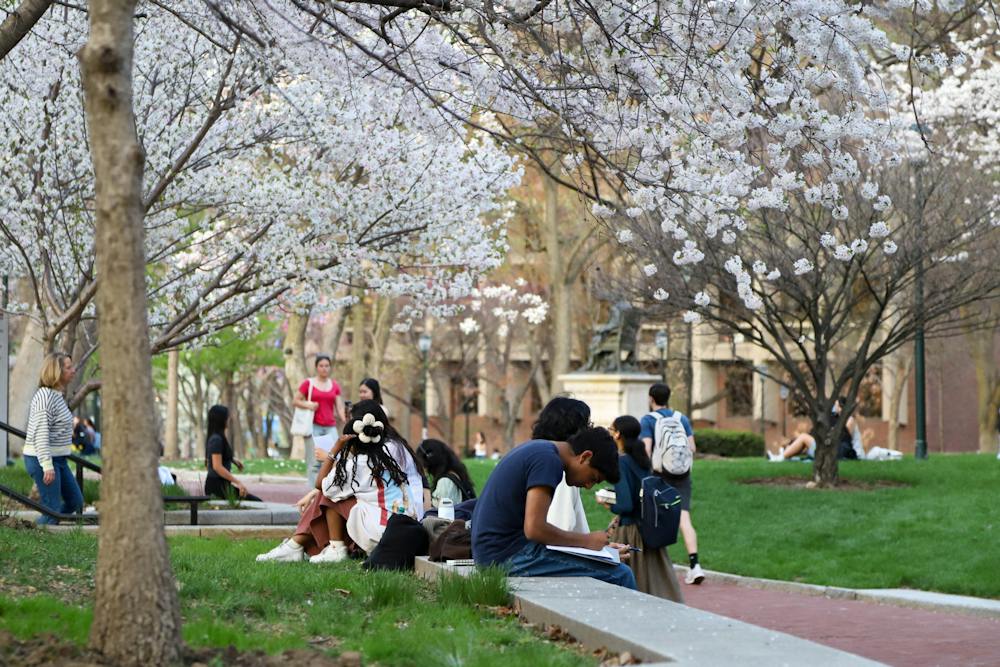
Penn has no shortage of places to spend time. Students can study in Van Pelt-Dietrich Library, exercise at Pottruck Health and Fitness Center, grab coffee at one of the many cafes around campus, eat at Houston Market, stroll along Locust Walk, or sit outside on College Green.
These spaces might seem like obvious examples of third places, a term used to describe spaces outside of home and school or work where people can gather and socialize. Research has found that these informal spaces can help people form relationships outside of more structured settings. But a cafe filled with students working on laptops or a gym full of people wearing headphones does not necessarily encourage social interaction or create a sense of community.
Penn’s problem is not a lack of physical places to gather, but a lack of places designed for gathering itself. Creating or repurposing more spaces designed around casual interaction, rather than studying, working, eating, or simply passing through, would give students more opportunities to feel more connected to campus and each other.
One reason these spaces matter is that they create opportunities for what sociologists call weak ties. These are the casual relationships we have with people we recognize but may not know particularly well. Stanford sociologist Mark Granovetter introduced the concept in 1973, arguing that these connections can make a large community feel more familiar because you begin to recognize the people around you as part of your everyday environment. At a university with more than 10,000 undergraduate students, those relationships can make the campus feel much smaller. Seeing the same person, exchanging a few words, or recognizing a familiar face can make Penn feel less anonymous, even if the interaction never develops into a close friendship.
Weak ties are difficult to plan: you cannot schedule a familiar face into your week the way you can schedule a club meeting or dinner with a friend. They happen because people repeatedly occupy the same spaces, and a third place gives those encounters somewhere to happen.
Third places can also introduce students to people outside the circles they already have. At Penn, many relationships naturally develop through College Houses, classes, clubs, and other organizations. These spaces bring people together for a clear reason, whether they live together, study the same subject, or share the same activity or interest. A space’s unique characteristics make the relationships formed within them valuable, but it can also mean that students spend much of their time around people they already have something in common with.
Third places can also create room for spontaneity in one’s social life. As midterms roll around, college has quickly become a cycle of plans — planning for classes, meetings, assignments, and events. As a result, even making time for friends can start to feel like another item on a schedule. There is nothing wrong with planning time together, but not every interaction should require effort by arranging it in advance.
Penn does not need to build an entirely new campus to make this possible. The University could start by repurposing spaces it already has. That could mean replacing some traditional desk-style seating with couches, movable chairs, and larger communal tables, creating more indoor lounges where students can talk without worrying about disturbing people who are studying, and adding covered outdoor seating that can be used beyond the warmer months.
Other universities have already experimented with making existing spaces more conducive to this kind of interaction. Princeton, for example, has flexible seating in its art museum, which is open to students and is accessible beyond typical museum hours. Similarly, Brown renovated its quad last year, which created new gathering areas and landscaping — notably a tiered layout amphitheater — designed to encourage students to spend time there.
It is important to note that most of Penn’s college houses do have lounges and study group spots, which do, to some capacity, allow for social interactions. However, these spaces aren’t genuine third places. Third places should be accessible beyond a specific residential community and separate from the routines of home and work, yet, college house lounges are tied to residential buildings, meaning access can be limited for students who do not live there or cannot enter at all times. Their proximity to students’ living spaces can also make them feel like extensions of the dorm rather than shared spaces where students from across campus can casually interact.
One month into my time at Penn, most of the people I’ve met have come from a class, club, or my dorm. As much as I care for those friendships, I wonder how many people I would know if I had more chances to cross paths with people I never would have thought to look for.
LUNA BOUHAIRI is a College first year studying law and society from Irvine, CA. Her email is lunabou@sas.upenn.edu


