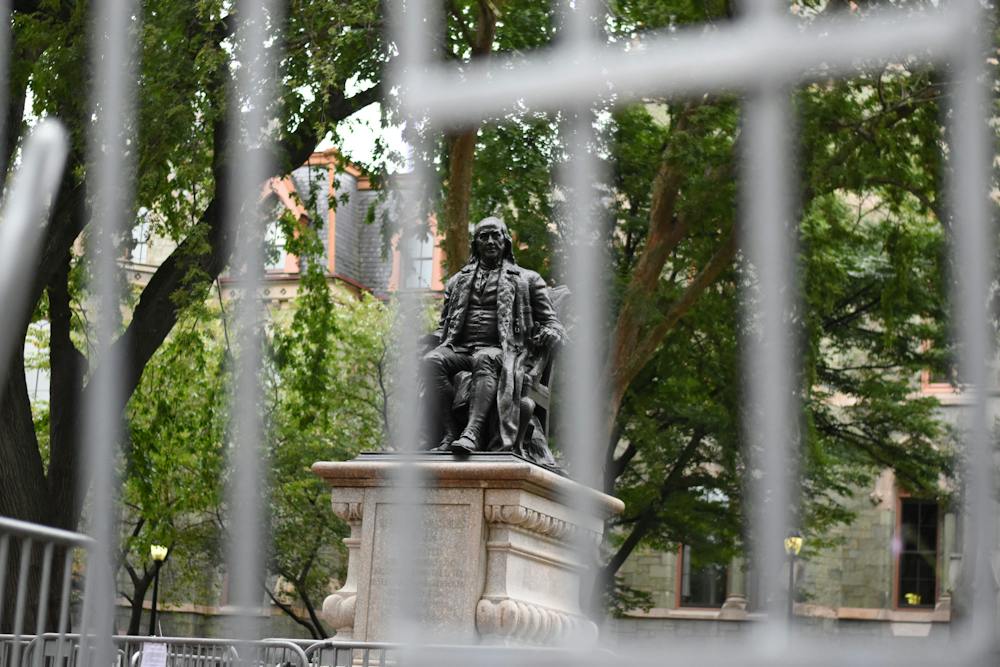
Open expression, including the right to assemble, speak, and protest, is fundamental to education and to democracy itself. Penn’s Guidelines on Open Expression, first established in 1968 in response to student activism around the Vietnam War, have for decades provided valuable, though incomplete, safeguards for these rights. This year, we have the opportunity to expand those protections against the administration’s efforts to erode them.
Protest has inarguably made Penn better. Without protest, our campus wouldn’t have a program in gender studies, a Department of Africana Studies, or the LGBT Center. We wouldn’t have Take Back the Night, the Weingarten Center, Student Health and Counseling, or the ARCH. These programs, centers, and majors didn’t come into being because Penn administrators woke up one day and decided students should have access to them. They were the direct result of activist struggle and open debate — of sit-ins, marches, and rallies staged by coalitions of students, faculty, and staff.
In June 2024, the Penn administration unilaterally imposed deeply problematic Temporary Standards and Procedures for Campus Events and Demonstrations, before initiating a secretive, illegitimate process to produce new proposed guidelines. The administration acted so precipitously because external donors and politicians disliked the legitimate ways Penn faculty and students protested the destruction and genocide in Gaza. Guidelines that had survived decades of protest were scrapped because wealthy, powerful, and politically-motivated people disagreed with a contentious but non-violent protest movement. The process behind the new guidelines went against past precedent, with language that was so vaguely worded that even library study groups and casual picnics could fall afoul of the rules. In a major divergence from precedent, powers of enforcement would be concentrated in the Provost’s Office, with the bare minimum of input from key stakeholders like faculty, postdoctoral researchers, staff, and students.
As a result of campus-wide protest and resistance, the proposed guidelines have been scrapped, and the authority to draft new guidelines has been returned to the Committee on Open Expression. This committee has the important job of drafting guidelines that ensure our university lives up to its values, giving us a narrow window of time when we can help shape conversations about what open expression should look like on campus.
We offer the following four principles that should guide the restoration and strengthening of open expression guidelines that protect open inquiry and non-violent protest at Penn:
1. Guarantee a democratic interpretation, amendment, and enforcement mechanism for the Guidelines on Open Expression. The power to modify, interpret, and enforce the guidelines must be transferred from the administration to a representative, democratically elected body consisting of faculty (tenure-track and non-tenure-track), postdocs, staff, and students, all elected at large. The disciplinary process for student open expression cases should be transferred from the Center for Community Standards and Accountability to the same democratically elected body and reformed to provide a fair procedure and equal treatment for all members of the University. Modification of the guidelines must be democratic and subject to a campus-wide referendum vote.
2. The guidelines should apply only to activity on Penn’s private property and not nearby public property or online spaces, where all people have rights to freedom of speech and assembly under the First Amendment.
3. Protect forms of non-violent political action, including disruptive protest, that facilitate campus-community interaction and have historically been necessary in creating high-quality universities that serve the public good in a democratic society.
4. The guidelines must be consistent with United States labor law, guaranteeing that University policy does not infringe on workers’ right to engage in concerted activity. The guidelines should state that in case of conflict, workers’ right to engage in concerted activity supersedes University policy. The guidelines should acknowledge that any disciplinary decisions based on alleged violation of the guidelines are subject to collectively-bargained grievance and arbitration procedures for unionized workers.
History shows that open expression policies at Penn are not carved in stone — they are shaped by public comment, collective resistance, and organized pressure. The existence of Penn’s Committee on Open Expression was itself the product of faculty, staff, and student advocacy in decades past. We’ve already shown that when we push back on problematic policies with a unified voice, we can have an impact.
With war raging in Iran, daily violence against immigrants, increased attention to sexual assault on college campuses, mass defunding of lifesaving research, and continued environmental catastrophe across the globe, free speech and political protest have never been more necessary. For some of us, our areas of study have already been marginalized as “political speech,” whether that research is into gender and policy, gene editing, or vaccine development. If we allow protections of true open expression to be eroded, we cede one of our most powerful tools to collectively confront issues that impact our campus community, and Penn will cede its status as a leading institution of free thought. Penn must do its part to stand up for its values, and we must do our part to hold Penn accountable. Open expression is not a thing of the past but a guiding principle for Penn’s future.
MAYA ENGLISH is a graduate student studying cell and molecular biology in the Perelman School of Medicine. Her email is maya.english@pennmedicine.upenn.edu.
LORENA GRUNDY is a practice assistant professor of chemical and biomolecular engineering in the School of Engineering and Applied Science. Her email is lgrundy@engineering.upenn.edu.
DAVID KAZANJIAN is graduate chair of comparative literature and literary theory and professor of English in the School of Arts and Sciences. His email is kazanjia@english.upenn.edu.
JESSA LINGEL is a professor of communication in the Annenberg School for Communication. Her email is jessa.lingel@asc.upenn.edu.