Making my morning coffee run at Pret, I can’t help but notice how every table is almost always occupied with some perfect pair, both with perfect posture and hands neatly tucked into their laps. These people always look completely uncomfortable with their tense smiles and drinks practically untouched. It didn’t take me long to realize that I was witnessing one of the cornerstone experiences of a first year’s first semester at Penn: the coffee chat.
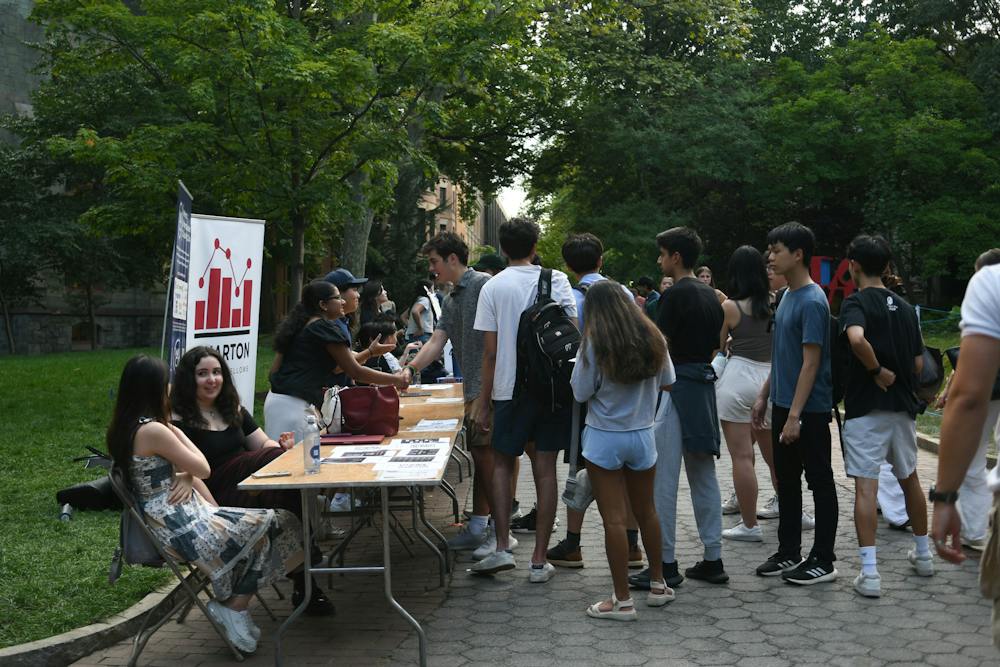
In theory, the practice is harmless: meet with a member of the organization you are interested in joining to introduce yourself and learn about the club. The problem is that for freshly convocated 18-year-olds, the club culture at Penn can often present itself as the sole determining factor of your life trajectory.
This stressful environment is not conducive to settling into college. When first-year students should be making friends, meeting their professors, and exploring a plethora of courses, they are instead consumed by the prospect of gaining entry into the professional world. Penn offers over 800 student organizations, with a diverse array of opportunities: a cappella, community service, dance, and more. So, although it may feel like the only extracurriculars Penn has to offer are preprofessional, that is most definitely not the case.
I will admit that the offer of a professional organization is enticing: admission into an exclusive club with a network that might just snag you a six-figure job fresh out of college. This narrative is probably similar to the one that attracted the student population to Penn in the first place.
But the first weeks of college should not be the time where students are tasked with reckoning with their careers and entrance into corporate America. Rather than place this pressure on the fresh and impressionable minds of first years, preprofessional clubs should wait until at least the second semester to begin their recruitment process.
Reform in Penn’s club scene is not a foreign concept. In 2025, the Wharton School rolled out major regulation changes, banning multi-round club interviews in an effort to ease intensity and address hazing concerns. These changes, however, did not expel the shadow of club applications that looms over the heads of new first years. When peering into the agenda of a Penn first year in September, it is likely that their calendar is dominated by coffee chats, interviews, and application deadlines rather than office hours, downtown dinners, or homework assignments.
Not all of Penn’s extracurricular recruitment occurs in the first semester. Notably, Penn’s fraternities and sororities start their recruitment in the spring. With this delayed recruitment schedule, first years who are considering joining greek life still have ample time to explore a wide variety of social circles and get acclimated to Penn’s social scene.
Theoretically, this logic could be transferred to Penn’s preprofessional scene as well. If club recruitment was pushed to the second semester, first years would be given the opportunity to not only settle into dorm life or classes, but into Penn as a whole. First years should have the time to explore various career options, before having to answer a flood of case questions in a consulting club interview. In what world should a student be researching private equity funds before they know how to do their own laundry?
Ultimately, I do not think that Penn’s club scene is inherently harmful and should be completely eradicated. These organizations offer students amazing opportunities and mentors while allowing them to pursue the extracurricular interests that initially drew them to the University. This past year, the University reported 94.5% of undergraduates either continuing their education or holding jobs within six months of graduation, boasting a median starting salary of $103,000. Penn’s professionalism clearly isn’t for nothing.
Despite these shimmering statistics in the midst of today’s grim job market, I still believe that club culture here at Penn is too much like a race — and one that begins far too early. First-year students should first have the opportunity to get to know the Penn community before being forced into a simulated job market. I can only hope that the next time I find myself grabbing a Pret coffee, Penn’s students are sitting together, relaxed and open to meeting a friend, instead of making a new LinkedIn connection.
SAMANTHA AFNAN is a College first year studying English from Washington, D.C. Her email is safnan@sas.upenn.edu.