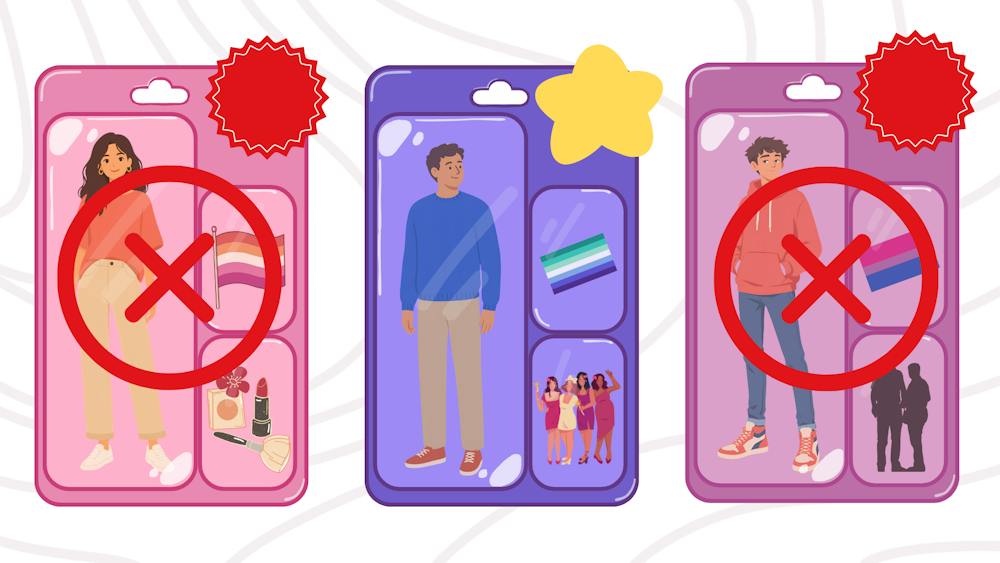
When you walk through Penn’s campus, it isn’t rare to see gay people. While our presence is far less felt here than at places like Wesleyan and Bryn Mawr, gay people are an undeniable part of Penn’s culture. However, the LGBTQ+ community here often feels far overrepresented by the G. If you were to park yourself on Locust Walk and watch for gay people, 90% of your sightings would be flamboyant gay men surrounded by women. Unless your gaydar is impressively fine-tuned, different types of queer people will be much harder to spot than on other college campuses. While this data is far from objective, it’s fair to say that Penn has a buttoned-up approach to queerness — especially when it comes to gay men — making our presence here feel quite straight.
But what’s at the root of this queerness crisis? One hypothesis is that Penn makes it hard for the gays to find each other. When strolling about Penn’s notoriously stress-free and fun-loving club fair, you may notice a stark lack of queer clubs. Even on the day centered around “affinity groups,” there were virtually no LGBTQ+ groups to be found — believe me, I looked. Most queer clubs on campus are mission-based and combined with other specific identities, unlike Penn’s other more social groups. Without a social context to find each other, many gay guys are forced to fall back on an old classic: “gay guy with his girlies.” This scientific phenomenon tends to have a strict limit of one gay man per group of girls, although in rare instances there can be two. This social structure gives the gay guy a role to play in heteronormative society that can actually work in their favor — if they play it right.
One of the most common sources of fun on Penn’s campus society is Greek life. Along with being sweaty and crowded, fraternity parties are famous for their confusing rules of exclusivity. The logic used by many fraternity bouncers — if you can even call them that — revolves around maximizing the ratio of women to men. This imbalance makes it nearly impossible for a group of men to gain entry to a fraternity without relying on women to even out their ratio. While this may be a problem for straight men, it is a blessing for gay ones. The aforementioned gay guy with his girlies method works like a charm, allowing gay men to slip into parties among their hordes of women. This utility shifts the power dynamic in favor of the gays, making them powerful allies for otherwise uninterested straight men. Straight men can also use gay men to meet more women without the fear of them stealing the girls’ attention.
However, this social capital only applies to getting into parties, as it vanishes the second you are in one. Fraternity parties are not about dancing or meeting people; they are opportunities for straight men to meet women with fewer obstacles. In this context, gay men are often forced into a managerial role for their female friends. They are in charge of headcounts, finding the next place to go, and making sure their girls don’t vomit, as if they were Kris Jenner “mom-aging” her Kardashians. Some especially type-A gay guys love this role, but those who don’t are left to awkwardly stand near their girls and pray for an excuse to leave. While gays can find each other at fraternities, it’s akin to parents chatting on the park bench as their kids go wild on the swing set. Needless to say, it’s not the most inclusive environment.
Although this symbiotic relationship may work out for many gay men, it leaves other members of the queer community stuck in the metaphorical line outside the fraternity house. At Penn, queer people aren’t naturally woven into the social world; they are forced to play a supporting role. Penn’s culture wasn’t made by or for gay people, and yet some of us have found a way to thrive within it. I’m not saying there is one way to be gay at Penn, but rather that there is a notable lack of diverse queer expression, especially compared to other college campuses. College is often thought to provide queer people with a chance to reinvent themselves and find their community. While this may be a Herculean task at Penn, it’s all the more reason to keep trying to find your people, and eventually, you will.
INDY WINK is a College first year studying communications from Philadelphia. His email is iwink@sas.upenn.edu.