

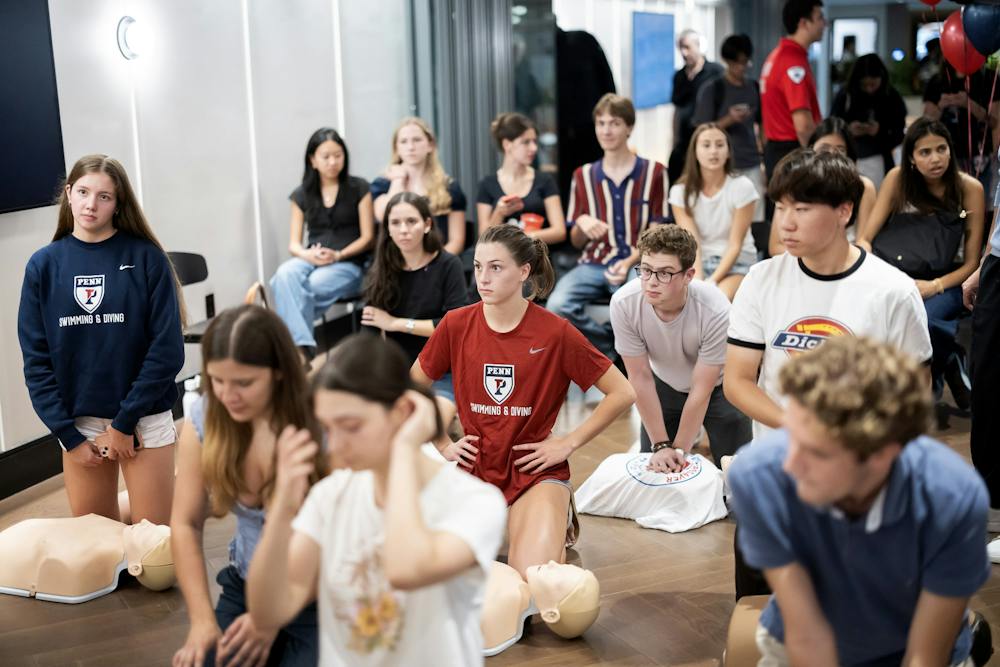
Penn’s Medical Emergency Response Team is hosting a campus-wide program to teach first years first-aid skills.
The Lifesaver program, organized in partnership with Penn Wellness, aims to train 50% of the first-year class and has already reached nearly 1,000 students. The month-long initiative teaches first years how to deliver hands-only CPR, recognize an opioid overdose, manage heavy bleeding, and respond to someone who is choking.
“As an emergency medicine physician, those are five skills that I think every citizen should know and understand,” MERT medical director and Perelman School of Medicine professor Josh Glick said in an interview. “Those encompass a combination of truly lifesaving interventions that are fairly easy to teach and learn, but could really save someone’s life.”
Glick added that the “overarching mission” of the initiative is to prepare students “for any number of medical emergencies.” The program celebrates National Campus Safety Awareness Month and is set to run for at least the next five years.
MERT Chief and College senior Raymond Tabak echoed this sentiment by adding that this program is a “microenvironment” of what MERT does on a regular basis. He added that student feedback has been “positive” so far, with many becoming interested in joining MERT and obtaining their Emergency Medical Technician license.
“It’s the camaraderie of students feeling that they want to come with their peers and learn something new together,” Tabak stated.
At one of the initiative’s 14 sessions, MERT members use mannequins and other equipment to demonstrate different skills. While students are practicing the techniques, the instructors provide guidance and corrections where necessary.
College first year Ava Lin described the MERT staff as “very attentive.” She said in an interview that they ensured her CPR form was accurate and answered questions so everyone had a “comprehensive understanding of what we were doing.”
RELATED:
What Penn students should know about MERT policies, services on campus
Penn Med, state officials host information session on women’s health resources
Angelina Zhang, another first year in the College, enjoyed learning “really important skills” that she could “apply in real life.”
After the 20-minute training, students were offered free Narcan nasal spray, snacks, T-shirts, and backpacks. According to the Director of Communications for Wellness at Penn Mary Kate Coghlan, the merchandise was funded by donors who care “deeply” about the initiative.
Coghlan said that Penn Wellness hosted a preview event for campus leadership in the Quadrangle on Sept. 10 — where Penn President Larry Jameson, his wife, and donors completed the trainings before they opened up to students and faculty.
Before and after students participate in the sessions, they are instructed to fill out a survey that asks them how comfortable they feel with the skills. The questionnaire also asks if students have previously received any first-aid training.
“There’s been some studies across the United States that show that college students are unfortunately very underprepared for these emergencies,” Glick said. “I’d say more than 80% of students have never received training in opioid overdose recognition or bleeding management, which hurts my heart a little bit.”
MERT conducts additional programming throughout the academic year, including a “Stop the Bleed” course and an annual CPR training during the spring.
“You need to protect and take care of those around you,” Glick stated. “There’s a sense of civic and community duty that I think is important for Penn’s campus and our students to embrace.”
RELATED:
What Penn students should know about MERT policies, services on campus
Penn Med, state officials host information session on women’s health resources
Staff reporter Tanvi Shah covers science and health and can be reached at shah@thedp.com. At Penn, she studies neuroscience.


