Penn faculty, staff, and students came together Wednesday afternoon to discuss the ongoing revision of the University’s open expression guidelines.
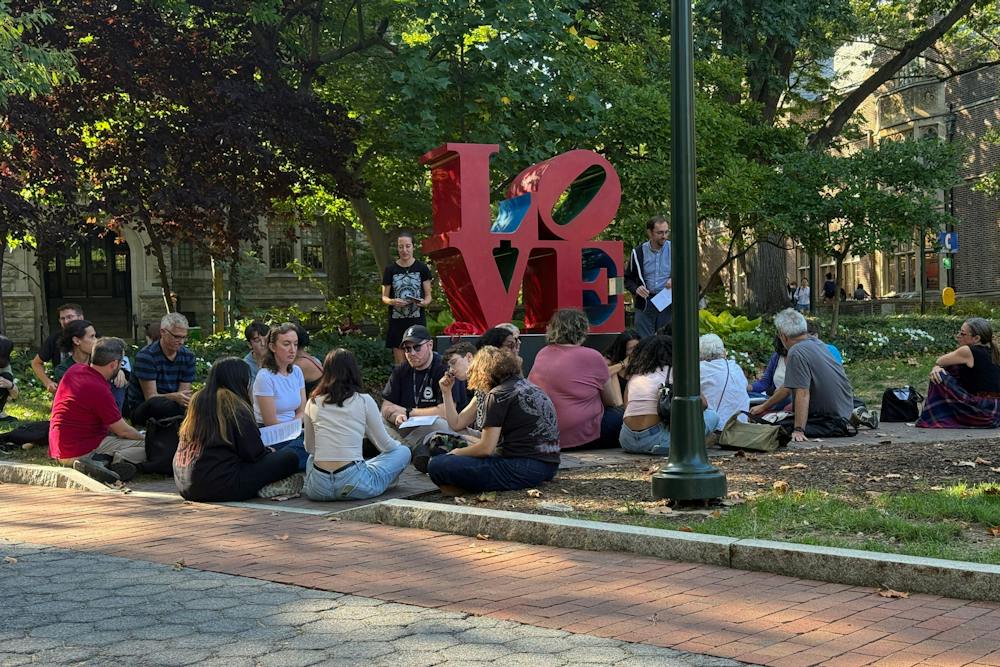
The community meetup, hosted by Penn’s chapter of the American Association of University Professors, ran from 3:30 to 4:30 p.m. Attendees gathered at the LOVE statue to share their perspectives on the changes they hoped to see in the draft and on the role community members should play in shaping the final policy.
In a statement, the AAUP-Penn Executive Committee described open expression — including the rights to speak, assemble, and protest — as “necessary to education and to democracy itself.”
“At this event today, faculty, students, and staff gathered to collectively envision what the rights and responsibilities of a community-led open expression policy should look like,” the committee wrote.
The group called for a policy that protects free speech rights, complies with federal labor law, and allows democratically elected community members to be put in charge of interpreting and enforcing the guidelines.
The Sept. 16 event comes three weeks after the University published a summary of feedback on the draft guidelines. The summary outlined community members’ concerns about both the content of the draft and the transparency of the revision process.
According to Asian Pacific Student Coalition political chair and Wharton junior Kayuga de Guzman, attendees discussed the vagueness of the term “disruption” in the draft, whether Penn should have an open campus, and the effects of policies on students and faculty at the gathering.
Undergraduate Assembly President and College senior Musab Chummun said that the turnout at Wednesday’s meetup demonstrated that students and faculty were willing to devote time to the issue.
RELATED:
Penn’s multi-year streak as one of nation’s worst-ranked institutions for free speech continues
Penn publishes summary of community feedback on open expression draft guidelines
“There’s a strong incentive on both students and faculty to make sure that open expression guidelines are being as true to what open expression should be on campus, and that is promoting education, promoting diverse perspectives, and promoting University values,” Chummun said.
He added that the event showed that policy discussions could take place publicly rather than “behind closed doors.”
“People are willing to show up and willing to come out there and spend their time, especially during the day when both faculty and students are incredibly busy, and they’re willing to have these discussions, create this change,” Chummun said.
“I also really liked that more and more people joined us as they were able to physically see us there and better understand what the situation was,” de Guzman said, echoing a similar sentiment.
Members of Graduate Employees Together — University of Pennsylvania were also present at the meeting. GET-UP recording secretary Riley Shahar, a second-year mathematics Ph.D. student, called for a revised policy that explicitly recognizes workers’ rights to engage in collective labor activity.
“While university policy cannot infringe on workers’ federally-protected rights to engage in collective labor action, any guidelines which do not explicitly acknowledge these rights risk chilling such action,” Shahar wrote.
Shahar added that changes to the pre-2024 guidelines should be developed through “a democratic process reflecting majority support of staff, students, and faculty.”
AAUP-Penn’s Executive Committee wrote that, soon, it plans to release a “more detailed vision of ways that the Penn administration can not just tolerate but celebrate the expressive rights that we all hold dearly.”
The group added that it also awaits the next draft of the open expression guidelines, which will be circulated for further feedback this fall.
Once the University releases another draft, Chummun said that the UA plans to publicize it across campus and encourage more students to engage with the proposal. He said those efforts could include an all-school message, outreach through student organizations, collaboration with the Faculty Senate and AAUP-Penn, and remarks at University Council.
“Universities are places in which national discourse about important issues takes place and sees actual change,” Chummun said. “Whether that’s in the 1800s, 1900s, or even 2026, these issues are still impactful, and they matter, and I think open expression is just a reflection of the ability to do that.”
“We just need to fully trust that we are really building this document together,” de Guzman said. “All everybody wants is to understand and have some sort of transparency on how this document will be governing our lives and our expression.”
RELATED:
Penn’s multi-year streak as one of nation’s worst-ranked institutions for free speech continues
Penn publishes summary of community feedback on open expression draft guidelines
Senior reporter Ananya Karthik covers central administration and can be reached at karthik@thedp.com. At Penn, she studies communication and economics. Follow her on X @ananyaakarthik.