

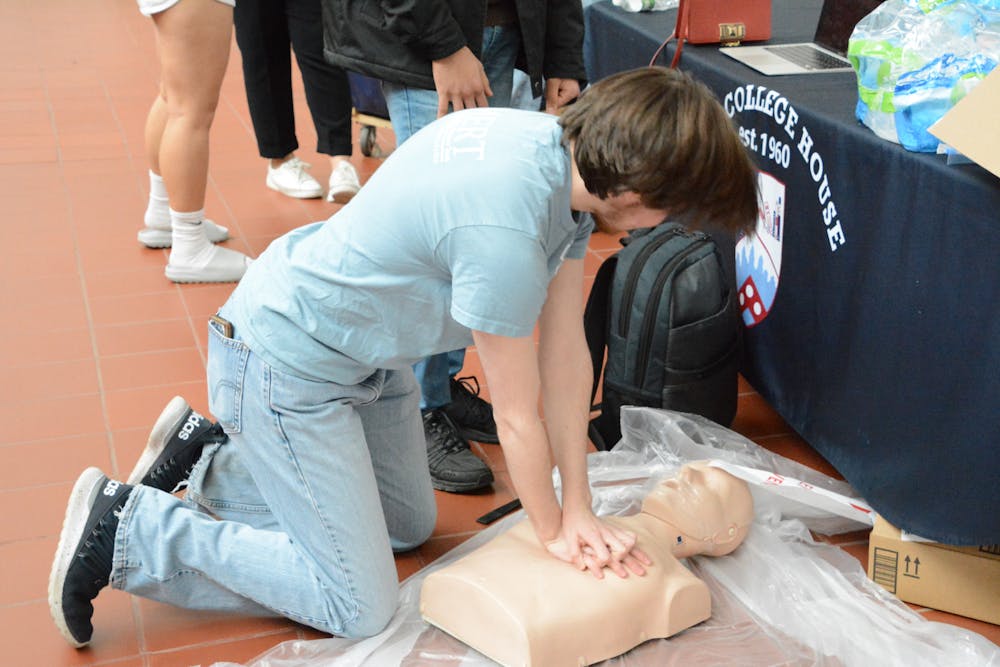
Penn’s Medical Emergency Response Team hosted its fourth annual campus-wide CPR training event on Sunday.
MERT members held “rapid five-minute trainings” where students, faculty, and staff could learn how to perform hands-only CPR at 14 locations across Penn’s campus. The Feb. 15 initiative expanded beyond the University for the first time and exceeded last year’s reach with a record participation rate of over a thousand attendees.
In an interview with The Daily Pennsylvanian, MERT Chief Raymond Tabak explained that these quick CPR trainings can “triple the chances of someone being resuscitated.”
“The chance of someone surviving an out-of-hospital cardiac arrest without any sort of intervention is very, very low,” Tabak said. “This quick five-minute training can save somebody’s life, not only here, but all over the world.”
Josh Glick, the medical director of MERT and the mobile CPR project — and a professor of Clinical Emergency Medicine at the Perelman School of Medicine — told the DP that cardiac arrest occurs when the heart malfunctions and stops beating unexpectedly as a result of factors such as “overdose, trauma, drowning, or the complications of other medical conditions like liver disease.”
At the event, attendees were taught how to perform compressions — at a speed of 100 to 120 beats per minute — using a mannequin to simulate an unconscious individual.
“Three things: push hard, push fast, in the center of the chest,” Glick said. “If you can remember those three things, you are already doing CPR fairly effectively.”
College junior José Méndez Cruz, MERT’s scheduling officer, explained that the team — alongside many other CPR training programs — uses the “memorable” song “Stayin’ Alive” by the Bee Gees to help students match the necessary CPR rhythm.
RELATED:
Wharton club hosts nation’s largest undergraduate healthcare conference
Meet three students from the incoming Perelman School of Medicine class
Méndez Cruz spoke about his motivation for joining MERT and gaining exposure to the medical field.
“A few weeks before the application, one of my friends was diagnosed with a congenital heart defect, and they had to perform CPR on him,” he said, adding that this experience motivated him to “learn about emergency medicine and techniques.”
College junior and MERT co-CPR officer Ananya Madhira explained that students were initially reluctant to stop by the training sessions but became “very excited to learn about” CPR once they came to the stations and heard “a little bit about why it's important.”
College senior JoAnna James, who completed the program’s short training at 1920 Commons, described her experience simulating an emergency.
“I would check for their pulse and if they’re breathing,” she said. “Then I pretended to request for someone to call 911 and to bring over an AED.”
College junior David Kerendian, who had experience with CPR training from high school, said he was glad to have a “refresher” after his workout at Pottruck Health and Fitness Center — where one of the MERT trainings was held.
“It was incredibly accessible,” he said. “The people staffing the CPR were very friendly and very welcoming.”
Glick explained that the amount of people who experience cardiac arrest and receive CPR from a bystander is only 28% in Philadelphia — which is less than the national average of about 40%.
This year, in collaboration with the American Heart Association, MERT expanded the event beyond Penn’s campus to multiple locations across Philadelphia and hopes to push it farther in 2027. Partnering universities — including West Chester, Villanova, Temple, and Drexel — joined in a broader effort to “train as many people on as many campuses as possible,” according to Glick.
The Fire and Emergency Services unit, which is a part of the Division of Public Safety, supported MERT in this training initiative.
“We’ve been involved with the MERT since the beginning, since 2006,” Eugene Janda, chief of Fire and Emergency Services at Penn, said. “We support them in every way we can — it’s a great bunch of young students that I have always admired personally because of what they give to the campus.”


