

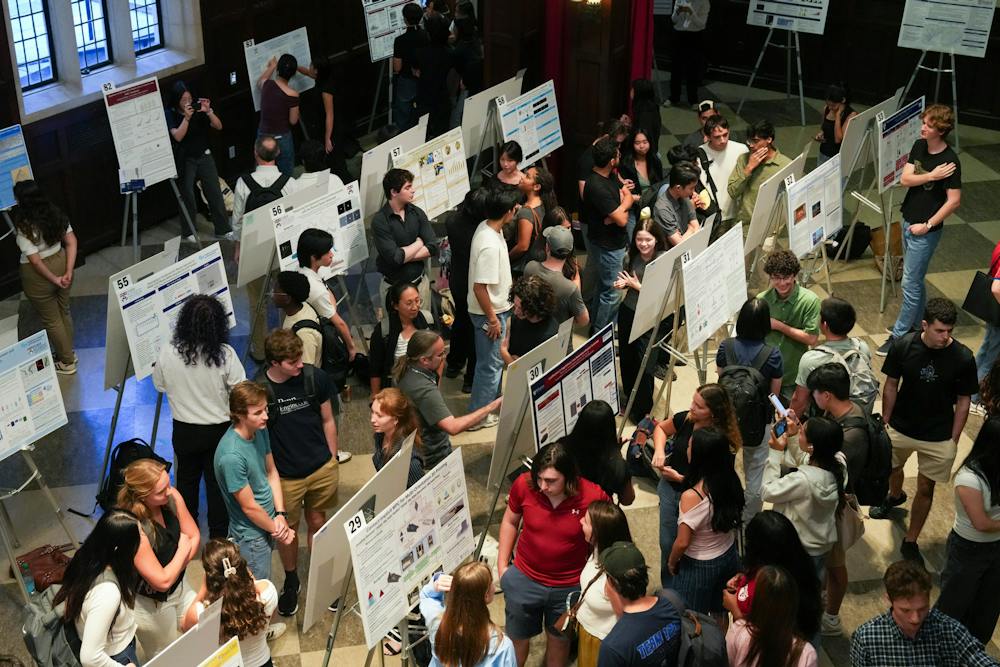
Hundreds of students gathered in Houston Hall on Monday for the annual Fall Research Expo, showcasing projects on topics that ranged from capital punishment in 18th-century Philadelphia to healthcare services in Botswana.
The Sept. 14 event, hosted by Penn’s Center for Undergraduate Research and Fellowships, featured work from 382 students across all four undergraduate schools. CURF — which celebrated its 25th anniversary this year — funded many of the projects through initiatives such as the summer-long Penn Undergraduate Research Mentorship Program.
College sophomore Sinmi Adewunmi displayed her investigation of a new mouse model simulating Fanconi anemia, a rare genetic disease in children. She worked on the project at the Comprehensive Bone Marrow Failure Center at the Children’s Hospital of Philadelphia under the mentorship of Perelman School of Medicine professor Peter Kurre.
Adewunmi, who had no prior research experience, said PURM’s weekly meetings eased her transition into the lab. She added that her work in the Kurre Laboratory complemented her prior learning experiences in college.
“I feel like the liberal arts education in general prides itself on building off curiosity,” Adewunmi said. “That’s what research is: You’re curious about something, you have the resources to scratch that curiosity.”
PURM offers first years and sophomores across Penn’s four undergraduate schools the opportunity to spend 10 weeks researching under the guidance of a University faculty member.
School of Social Policy & Practice professor Chao Guo ran regular check-ins with students pursuing a project titled “Timebanking and Eldercare: Rethinking Community-based Care.”
As they gained familiarity with the work, Guo involved them in more “sophisticated” research activities — including data analysis and interviews. In a statement, Guo explained that it was also a “learning process” for him because it was his first time serving as a faculty mentor.
RELATED:
Two Penn students selected for Fulbright UK summer program
How PURM connects Penn students with faculty research opportunities
Guo reflected on the experience of watching his students present their work at the Expo — which he described as “deeply gratifying.”
“Seeing how much they had grown as researchers over the course of the project was one of the most rewarding aspects of the mentoring experience,” Guo wrote, emphasizing that his mentees were able to “present the project confidently, explain why the research matters, and reflect thoughtfully on their own contributions.”
CURF Director of Undergraduate Research Ann Vernon-Grey emphasized the importance of Penn's institutional support for undergraduate research — including through monetary resources and faculty mentorship — which helped make the expo possible.
“To be able to set these opportunities up on a grand scale while still maintaining that personal connection is huge for me,” Vernon-Grey said in an interview.
For attendees, the Expo presented an opportunity to explore intellectual interests beyond their own majors.
Engineering first year Alex Wang described the event as a way to “take in new perspectives and learn more information.”
“I’ve definitely been interested in doing research since I got here, and seeing what kind of labs people have done work with and what kind of process they did in order to get there was a good experience,” Wang said.
Vernon-Grey added that CURF provides students with skills that are transferable to most jobs, even outside of traditional academia.
“Not all careers require you to do research, but all the interesting ones do,” she said, adding that students learn a lot from the experience.
“Even if they end up not liking research, they tried it, and they talk about how much they learned about themselves,” she said. “What more can you ask for from your undergraduate years?”
To Vernon-Grey, research reflects the goals of the education system — which she described as the “installation of a love of learning.”
Vernon-Grey referenced her time as a biology research assistant during her undergraduate years, describing the experience as “transformative.”
Last year, the Fall Research Expo displayed work from over 350 undergraduates.


