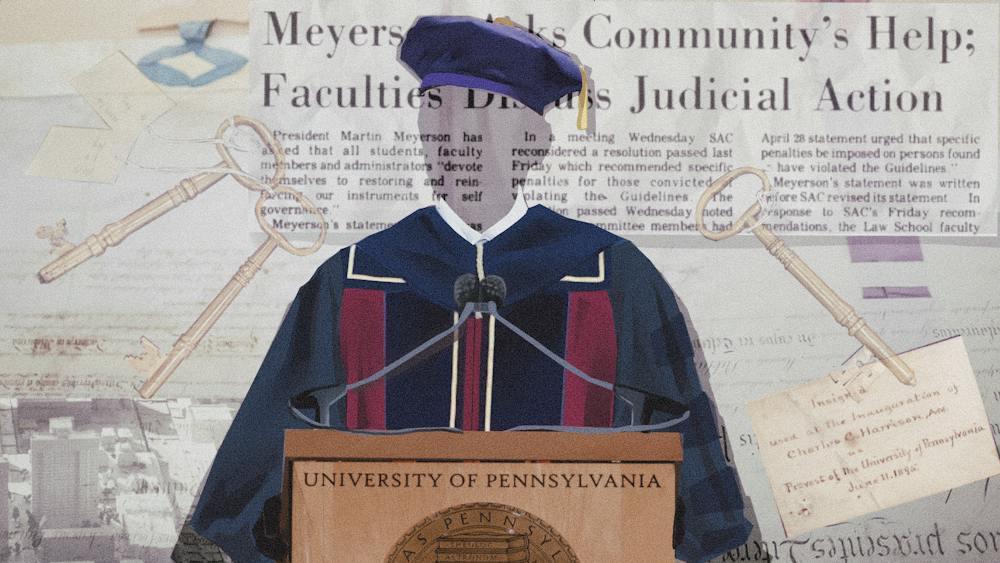
For most of Penn’s history, there was no University president.
Until 1930, Penn shouldered administrative responsibility as a collective, with its University Board of Trustees bearing responsibility for the most consequential decisions. With time, the University came to primarily entrust its direction to a single person.
Larry Jameson is the latest individual to embody Penn’s presidency. In 2024, he was handed the reins to the University at a time of unprecedented volatility on campus. But much of what has defined Jameson’s tenure has not been unprecedented at all. The office he stands to leave has only existed for 96 years, and in that time, nearly every president has faced campus protests, federal scrutiny, and political tension.
As the search for Penn’s 11th president continues, The Daily Pennsylvanian dug through University archives to examine the history of the office.
The role of the president
From Penn’s founding in 1740 until the late 19th century, the provost was the University’s highest-ranking administrator — with oversight only over faculty in the College of Arts and Sciences.
As new schools were added to the University, the administration was reorganized, a process that established the Office of the President in 1930, according to the University Archives.
On Oct. 6, 1930, the Board of Trustees elected Thomas Sovereign Gates, resolving to discharge all executive duties through a “President of the University” who would hold office at the board’s discretion.
That language still defines the job.
Under the current Statutes of the Trustees, the president is the University’s chief executive officer and its educational and administrative head. The president also serves as a liaison between the trustees and the faculty, holds the rank of professor, and is a “member of every Faculty of the University.”
Gates himself was a product of the Board of Trustees. An 1893 Penn graduate and J.P. Morgan partner, he had served as the chairman of the board for four years before his presidential appointment.
Gates’ administration went on to create the College of Liberal Arts for Women and the School of Nursing, while leading the University through both the Great Depression and World War II.
Each subsequent president has brought an entirely unique character with them, along with priorities that have defined various eras of the University’s history.
Gates was succeeded in 1944 by George McClelland, a Penn English professor who had served as provost since 1939 and whom Gates had primed for the role. McClelland was followed in 1948 by Harold Stassen, the former governor of Minnesota. Stassen — who had lost the Republican presidential nomination that summer — was the first president without prior ties to the University.
Gaylord Harnwell, elected in June 1953, had chaired the physics department for 15 years. Martin Meyerson, who took office in 1970, was a city planner who had previously served as acting chancellor of the University of California, Berkeley, and president of the University at Buffalo.
Meyerson’s “One University” vision called for Penn’s schools to collaborate across disciplines and led to the formation of what is now the School of Arts and Sciences.
The presidents who followed largely came from academic backgrounds. Sheldon Hackney was a historian of the American South; Judith Rodin, a 1966 College graduate, was the former provost of Yale University and the first woman to permanently lead an Ivy League university; and Amy Gutmann was the former provost of Princeton University before becoming Penn’s longest-serving president, from 2004 to 2022.
Liz Magill arrived from the University of Virginia, where she was executive vice president and provost. Jameson was the University’s longest-serving dean and the executive vice president for the University’s Health System.
Responses to campus unrest
Throughout Penn’s history, some of the most prominent moments of student activism took place inside or around College Hall — with a goal of catching the president’s attention. How each president responded reflects the evolving functions and influence of the role.
One of the most fiery confrontations began on Oct. 16, 1965, when 350 protesters walked from City Hall to 37th and Walnut streets to protest Penn’s Institute for Cooperative Research. Activists accused the institute of conducting research for the Vietnam War, although Harnwell said Penn had no direct relationship with the conflict.
In spring of 1967, after a two-year dispute in which professors threatened to wear gas masks at Commencement, the University canceled two classified Defense Department contracts, known as Spice Rack and Summit.
When protesters blockaded Van Pelt-Dietrich Library in May 1971 in support of union rights, Meyerson condemned the action as “immoral” and “illegal,” warning that he would “turn to civil authorities” if they ignored citations.
In 1977, the University’s Committee on Open Expression found that Penn’s Office of Security and Safety had paid students to attend campus political meetings and share information with authorities — all without identifying themselves as staff.
Meyerson wrote that he was “saddened” by the practice, but added that the Committee’s report did not adequately emphasize that “freedom of any kind cannot flourish without protection.”
While Hackney was president, students demanding divestment from companies doing business in apartheid South Africa launched a sit-in in College Hall on Jan. 22, 1986. During the 20-day demonstration, a wooden shanty was erected on College Green, according to the Pennsylvania Gazette.
Hackney’s response was to change who enforced the guidelines on open expression.
That October, he and then-Provost Thomas Ehrlich formed a special committee to review “ambiguities” in the policies’ language, a move some Committee members saw as an attempt to “dilute” the group’s power.
During Gutmann’s tenure, Fossil Free Penn’s proposal for the University to divest from fossil fuel companies was rejected in September 2016. The student group responded with sit-ins in College Hall in November 2016 and March 2017.
The protests escalated in November 2019, when about 100 FFP members disrupted a Board of Trustees meeting until it was shut down. In February 2020, Gutmann announced that Penn would not invest in the coal and tar sands industries.
Four years later, Penn again became the site of multiple demonstrations, including a 16-day Gaza Solidarity Encampment on College Green. After weeks of protests, rallies, and negotiations with administrators, Penn Police officers — assisted by the Philadelphia Police Department — dismantled the encampment and arrested 33 people, including nine Penn students, on May 10, 2024.
On June 6, 2024, Penn announced a temporary set of guidelines for campus demonstrations and began reviewing its open expression policies. That process is ongoing.
The president in Washington
Stassen is the only Penn president to have sought the White House while in office. After losing the 1948 Republican nomination to former New York Gov. Thomas Dewey, he ran again in 1952. He later lost the nomination to former U.S. President Dwight Eisenhower, who then named Stassen to his Cabinet as director of the Mutual Security Agency.
On campus, Stassen was known for his absences, particularly during his spring 1952 national campaign, and was criticized for using Penn as a political staging ground. Stassen would seek the Republican nomination nine times between 1948 and 1992. A 2001 article by the DP called him “the president that Penn forgot.”
Harnwell’s role on the national stage, on the other hand, was quieter. In 1960 and 1961, he advised the founding of an American-inspired university in Shiraz, Iran. He also spent World War II directing the Navy’s sonar research laboratory in San Diego and received the Medal for Merit in 1947.
Rodin became the first woman to lead the Rockefeller Foundation, which supports global initiatives to address climate change and economic insecurity. She also joined the boards of Aetna, BlackRock, Citigroup, and Comcast.
Gutmann also held many national roles while in College Hall. Former U.S. President Barack Obama appointed her in 2009 to chair the Presidential Commission for the Study of Bioethical Issues, which she led for seven years.
The Senate confirmed her as the U.S. ambassador to Germany on Feb. 8, 2022, the day she stepped down from the presidency. She served in Berlin until July 2024.
While many of Penn’s early presidents left the University for jobs in Washington, its most recent leaders seem to have Washington come to them.
Magill ended her presidential term with a House hearing. In December 2023, Magill — alongside the presidents of Harvard and MIT — was questioned about antisemitism on college campuses by the House Education and Workforce Committee. Members of Pennsylvania’s congressional committee urged the Board of Trustees to remove her from her post, which ultimately left Magill no choice but to resign.
Many of Jameson’s defining moments as president have revolved around federal scrutiny. In March 2025, the White House announced it would freeze more than $175 million in federal funding to Penn, citing the University’s earlier participation policies for transgender athletes.
In July of that year, Penn became the first Ivy League school to reach an agreement with the Trump administration.
Throughout Jameson’s tenure, Penn has navigated sustained scrutiny from the federal government, including an antisemitism investigation and efforts to pressure the University into changing its governance practices.
The presidential search process
Previous searches for a new Penn president began quickly.
The Board of Trustees formed a search committee 20 days after Hackney announced his resignation in April 1993, about two months after Rodin’s announcement in June 2003, and two months after Gutmann’s in July 2021.
But 130 days after Magill’s resignation, Penn still hadn’t announced its committee. The board instead extended Jameson’s interim term in June 2024, before making him permanent president in March 2025.
In an August interview with the DP, Jameson said that “somebody actually had to tell” him that he was the 10th president of Penn.
“I hadn’t counted them myself,” Jameson said. “But I think the caliber of the institution has just progressively improved all the time.”
Senior reporter Aidan Shaughnessy covers student life and can be reached at shaughnessy@thedp.com. At Penn, he studies philosophy, politics, and economics. Follow him on X @aidannsh.