

1968 Wharton graduate and President Donald Trump has begun drafting an executive order to establish a committee with the power to veto research awards that do not align with the administration’s political agenda.
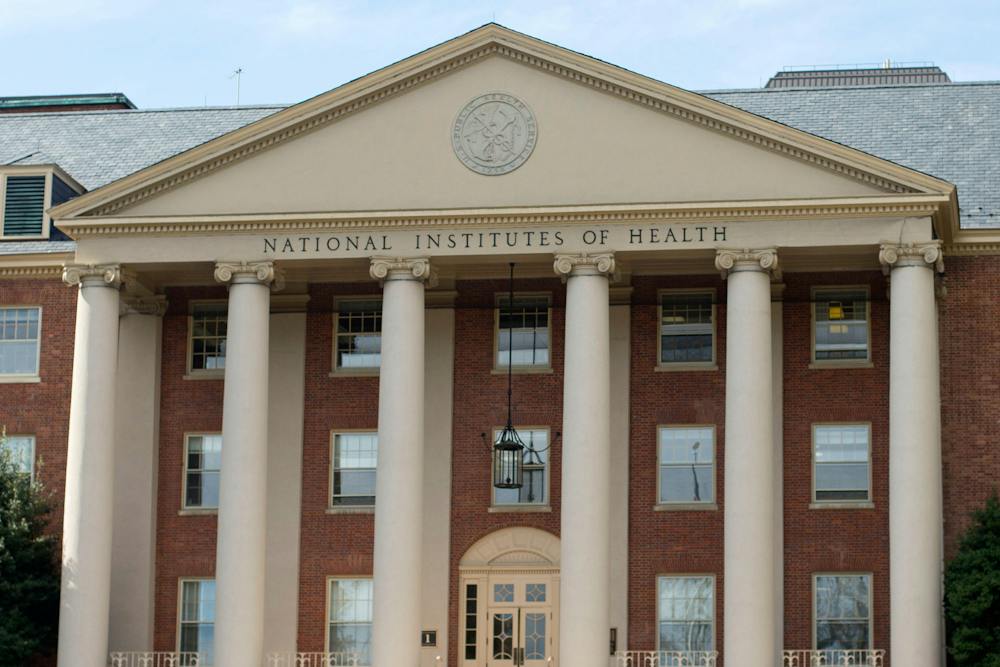
The proposal, discussed at a “highly contentious” meeting last Friday, would broaden the Trump administration’s control over the National Institutes of Health’s research portfolio at a time when the funding landscape at universities remains uncertain. The order is the latest in several attempts by the White House to exert control over the allocation of federal research awards.
A May proposal from the Office of Management and Budget would put political appointees in charge of reviewing grants, giving them the authority to modify or cancel awards already in progress.
Microbiology professor Susan Weiss called the office’s proposal a “terrible idea.”
“It leaves open a lot of leeway for whoever’s reviewing grants to fund what they think the current administration or leadership of the NIH wants,” she said in an interview. “It’s really vague how they’re actually going to pick the grants.”
The proposal was paused earlier this month, when Trump signed a stopgap spending bill to keep the federal budget funded. The bill funds the federal government through December, after which the Office of Management and Budget’s plan would be revisited.
According to Cell and Developmental Biology professor Kenneth Zaret, under the policy, federal administrators who “don’t necessarily know about the science” would make key decisions.
“It would be a huge stake in the heart of the United States’ ability to discover fundamental aspects of biology and medicine that would cure diseases and help people,” Zaret explained.
RELATED:
Penn researchers say federal grant rule invites ‘mind-boggling’ government oversight
Penn’s federal funding decreased by 7% in 2025, DP analysis finds
The Office of Management and Budget began seeking feedback on its proposal this summer. By July, over 50 Penn community members had publicly commented that the new rule would harm research efforts across the country.
At the time, one professor said that they were in “shock, frankly, that a political system would see fit to propose taking on unprecedented control of the scientific process.”
The NIH is also seeking public comment on a plan to change how it reports peer-review results to grant applicants.
Currently, after proposals are submitted to the NIH, they receive an overall impact score, and the top 50th percentile scores enter further review. Once review is complete, applicants receive summary statements that include critiques, criterion scores, notes on project applications, and a final score.
Under the proposed changes, the top 25% of grants would be labeled “most competitive,” the middle quartile as “competitive,” and the bottom 50% as “not discussed,” and applicants would no longer receive final scores or percentiles.
Despite the uncertainty in the status of federal funding at Penn, Zaret has no plans to change the long-term goals of his lab.
“I would not try to placate what I would anticipate an unknowing administrator might decide,” Zaret said. “I would never do that. I think the best thing for the country is for me to continue to try to be as creative and inventive as I can with my research, and let that be the guide.”
Weiss said the uncertainty has made it difficult to plan. Although she is nearing the end of her academic career, she is concerned about an upcoming grant renewal.
“At the moment I’m okay,” Weiss said. “But I don’t know what’s going to happen in the near future. I have another grant under renewal right now that I have no idea what’s going to happen. We just don’t know. It’s just a big black box.”
RELATED:
Penn researchers say federal grant rule invites ‘mind-boggling’ government oversight
Penn’s federal funding decreased by 7% in 2025, DP analysis finds
Staff reporter Ishani Modi covers state and local politics and can be reached at modi@thedp.com. At Penn, she studies biochemistry.


