

When then-freshman quarterback and 1983 Wharton graduate Gary Vura moved to Philadelphia in the fall of 1979, the idea that Penn football could become a powerhouse program was laughable at best.
It had been 20 years since the Quakers won an Ivy League championship. The Mount Rushmore of Penn football — John Heisman, Chuck Bednarik, George A. Munger, John H. Outland — had been firmly unchallenged since the dawn of the modern era.
Although the namesakes of the four biggest awards in college football took their first steps toward greatness on Franklin Field, Penn was considered a “basketball school” after a surprise run to the Final Four of the March Madness tournament in 1979. Vura was determined to change that.
The Cleveland native and Miami transplant got his first minutes with the Quakers during his sophomore season in 1980. Although he began the 1981 season as a starter, Vura would ultimately lose the role after a number of low-scoring performances, including a 58-0 shutout loss against Lehigh.
It’s hard to pinpoint what changed going into the 1982 season. Vura was back in the starting lineup. Then-coach Jerry Berndt made weight training mandatory after realizing the Quakers were being manhandled on short-distance downs. Franklin Field was re-turfed amid historic renovations.
The Quakers took their first game of the 1982 season — against defending Ivy League champion Dartmouth — in a shocking 21-0 shutout victory for the program’s first road victory since 1976. Lehigh, the same team that the Quakers struggled to score against just a season prior, was narrowly defeated, 20-17, at home the following week.
“It was the first happy ride home for our seniors,” Berndt told The New York Times after the win. “They didn’t know how to handle it. They started singing Christmas carols.”
Despite coming into that season ranked the third-worst college football team in the country, the Quakers managed to claw their way to the top of the conference rankings for the first time in over two decades.
The stage was set for the best-selling Homecoming contest in a decade. According to a 1982 article from The Daily Pennsylvanian, a crowd of 35,000 spectators was expected. National media pundits from Sports Illustrated and ABC News covered the tangible excitement on campus as anticipation grew.
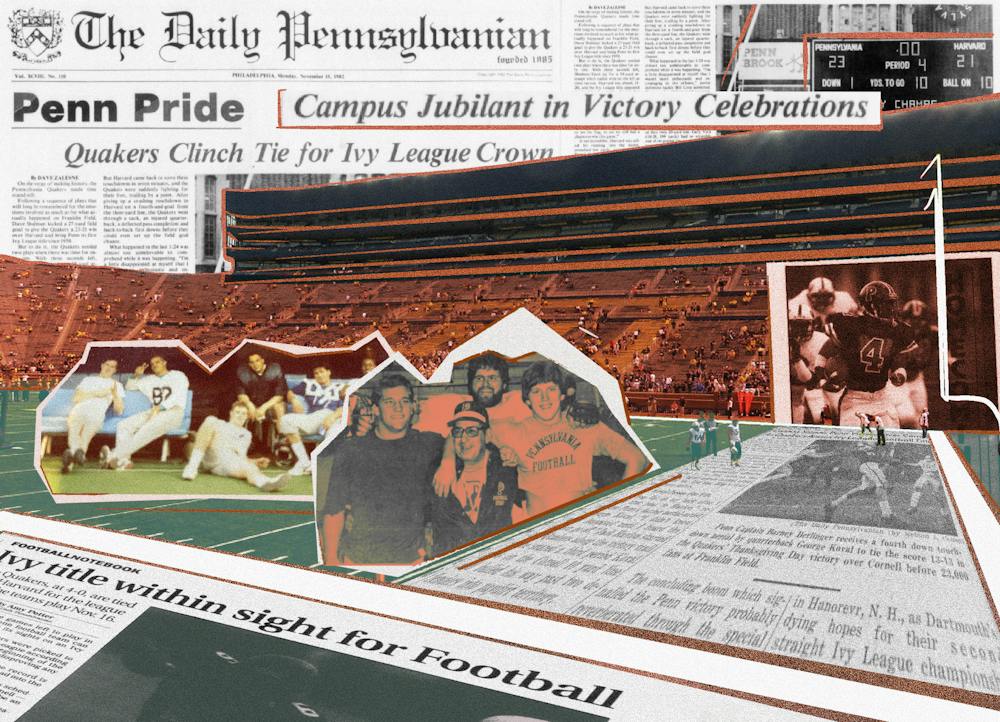
On Nov. 13, 1982, the Red and Blue held a dominant 20-0 lead going into the fourth quarter, but the Crimson had other ideas, firing off three touchdown passes for a late resurgence. With less than a minute on the clock, the Quakers had their backs against the wall. It was now or never — secure the Ivy League title or settle for second place.
A clean pass from Vura was seemingly intercepted by a Harvard cornerback, but the ball never hit the ground, instead finding its way into then-junior wide receiver and 1984 Wharton graduate Rich Syrek’s hands, who made a 19-yard run to Harvard’s 48-yard line. Successive sideline passes put the Quakers in field-goal range. Berndt pointed at then-junior kicker and 1982 College graduate Dave Shulman, who had spent most of the game watching from the sidelines.
His first attempt, a 38-yard kick, grazed the goal from the outside, veering a little too far to the left. But it wasn’t over yet — a referee called a yellow flag after a Harvard player ran into the kicker, penalizing the Crimson 10 yards. The Quakers called their final timeout, drawing out the tension as long as possible.
All eyes were on Shulman as he came back on the field at Harvard’s 21-yard line. A breath. A kick. A clearance. An Ivy League championship.
Penn fans clad in navy blue flooded onto the field, taking the goalpost down with them. It was, as a former DP sportswriter put it, “the Miracle on 33rd Street.”
“One of the great things about that [19]82 season was to start something, and not being a one-off,” Vura said. “It just became a purpose. It became a legacy, and that’s one of the great things that I really appreciate that I’m a part of with my teammates, that the [19]82 team really promoted the legacy and set the standard that still stands today.”
That standard was evident in the 1980s. From 1982 until 1988, the Quakers claimed seven Ivy League championships.
Since 1982, Penn has claimed 17 Ivy League championships, the most of any Ivy League program in the past 43 years. Former coach Ray Priore, who served on the Quakers’ coaching staff for 39 seasons, was at Penn for 12 of those championships.
“I was doing the math with it, you know, you say, 39-40 years, roughly 30 kids a class, give or take, and you’re talking about over 1,200 student-athletes that you had a chance to work with,” Priore said. “And each was unique, goal-driven, had their own needs, ambitious, successful. You have some great times and moments of sad times when different things happen.”
Priore started his head coaching career on a high note, taking down then-No. 4 Villanova for the first time in over a century in his first game at the helm of the program. He carried that momentum into conference play, claiming an Ivy League championship with 11 All-Ivy selections, including 2015 Ivy League Defensive Player of the Year and 2015 College graduate Tyler Drake and eventual three-time Super Bowl champion and 2017 Wharton graduate Justin Watson.
Although Priore wanted to stay on top of the conference, championships took a back seat to playing a “Penn kind of football” and a “family-first” philosophy.
Despite the dominant era of the 1980s, Penn football has spent much of the modern era being viewed as an underdog by the rest of the conference — or at least that’s how former players see it. After all, the 1982 Ivy League championship that put the program back in conversation with the best of the conference was secured by a three-second 21-yard drive in a crumbling Franklin Field.
When the Philadelphia Eagles shared Franklin Field from 1958 to 1970, the Quakers had to adapt, turning over the stadium each Sunday to their NFL counterparts. Before Franklin Field was renovated and refurbished, student-athletes would walk back and forth from Franklin Field to the Hollenback Center locker rooms off the Schuylkill Expressway. In the early days of the program, players would even be bused out to Lancaster, Pa., for practices before returning to campus for their classes.
On the field, that reality translated to a type of grittiness and physicality not found elsewhere in the conference. With Andy Coen as the offensive coordinator from 2000 to 2005, the Quakers employed a revolutionary scheme on the offensive line that facilitated several linemen’s transitions to the NFL.
The guys up front learned to excel at different positions by playing multiple sides of the ball during practice. Multiple plays were regularly called at the line of scrimmage, allowing players to adapt when approached with unusual defensive formations.
As defensive coordinator, Priore emphasized neutralizing specific high-power receivers to limit opponents’ scoring opportunities and force them to scramble.
The offensive line pressed onto the opponent’s side of the field like an unstoppable force, while the immovable defensive line held it down in the back, limiting scoring opportunities for the opponent. Trench warfare could be brutal, but the Quakers were more than prepared.
“We had some great, great, great players, guys that went on to play professional football, but we also won a lot of games because we outworked the opponent,” former Penn football safety, 2004 College graduate, and current Atlanta Falcons coach Kevin Stefanski said.
“We were playing a brand of football that traveled into cold-weather environments, and we could play tough defense, and on offense [we had] the ability to move the ball with some great quarterback play in the time I was there,” Stefanski added.
2003 College graduate and All-American Penn football safety Vince Alexander viewed the team as “gritty” workhorses.
“You know, we’d go out there, it was like punch him in the mouth football, right?” Alexander said. “We always had an attitude, it’s the guys from Philly against everyone else.”
“That’s how it was before I got there, it’s how it was when I was there, and I think that’s how they still like to be today,” Alexander added.
But the true embodiment of a “Penn kind of football” was former assistant coach Dan “Lake” Staffieri.
A tried and true Philadelphian, Staffieri bled Red and Blue. As head freshman coach for the Quakers, he led his team to 13 Ivy League championships. When freshmen were finally allowed to compete at the varsity level in 1993, Staffieri stuck around as a spiritual advisor of sorts.
Even when Penn football wasn’t the talk of the town, Staffieri made sure Philadelphians knew when the Quakers had a home game coming up. He’d pair his Ivy championship rings with a red plaid beret, a classic “P” sweater, and a megaphone while riding around campus in a helmet-shaped golf cart.
Staffieri’s unwavering belief in the program, in bettering yourself as both a player and a person for the good of the team, rubbed off on the few Penn players fortunate enough to make it to the pros.
“I kept all of his sayings in my locker in Kansas City,” former Penn offensive lineman and 1991 College graduate Joseph Valerio said. “I brought a tremendous amount of pride to what I was bringing to the Chiefs organization based on what it was that coach Staffieri had instilled in what it meant to be a great teammate and to be a leader.”
“That was the epitome of what Penn football meant for me,” Valerio added.
Valerio is noteworthy in his own right.
Despite focusing on baseball until his junior year of high school, the Philadelphia native was recruited by then-head coach Ed Zubrow for a spot on the offensive line. During his career with the Quakers, Valerio was selected to play in the East-West Shrine Game and received first team All-America honors, among other accolades.
National notoriety confirmed what the Ivy League already knew as Valerio gained a cult following for catching touchdown passes as an offensive lineman on the Kansas City Chiefs, including a pass from legendary quarterback Joe Montana.
Despite his success on and off the field, Valerio knows none of this would have been possible if the Quakers hadn’t taken a chance on what was then a “very skinny, physically underdeveloped person.”
Penn football has a living, breathing history, with each player making a testament to those who came before. Take freshman quarterback Miles Teodecki, who will make his first career start for the Quakers in the season opener against Bucknell on Sept. 19.
After mutually parting ways with Kansas State in December 2025, Teodecki flipped his commitment to the Quakers despite offers from Power Four programs like BYU and Cincinnati. It seemed like a shock to outsiders, but those who know Teodecki, like his namesake, 1996 College graduate Miles Macik, weren’t surprised.
After all, when Teodecki ties his cleats and throws his first pass at Franklin Field, he’ll be treading the same hallowed ground his father, 1997 Wharton graduate and former quarterback Steve Teodecki, dominated.
And perhaps in two years, Macik’s own son — a sophomore in high school who’s just starting to consider the possibility of playing college football — will be running wind sprints and perfecting passes on Franklin Field alongside his chosen cousin.
“It’s kind of cool to have that relationship with my best friend, who’s one of my teammates, and his son, who plays the same position as my son,” Macik added. “He wears number 12 because that’s what his uncle Steve wore, and that’s what Miles wore and is wearing at Penn, and he really looks up to Miles a lot.”
Family ties have shaped the legacy of Penn football and will do so for years to come. Legacy is a running theme on the gridiron, as is the brotherhood players join when they choose to don the Red and Blue.
“Franklin Field is the best classroom that anybody can learn in, and we’ve had many classes on that field,” Priore said. “From semester to semester, I think our kids have done a great job. It’s building young men for the future and for success.”
This story is the first of a multi-part series about football at Penn. The second installment will be published in early October.


